Meta Instant Forms allow advertisers to collect leads directly inside Facebook or Instagram without sending users to an external landing page.
That convenience is the reason Instant Forms scale so quickly. It is also why they create some of the biggest lead-quality problems in paid social.
Many advertisers mistake cheap submissions for efficient acquisition. Inside Ads Manager, the campaign may look excellent. Sales teams often see something completely different.
Why Instant Forms generate leads faster than landing pages
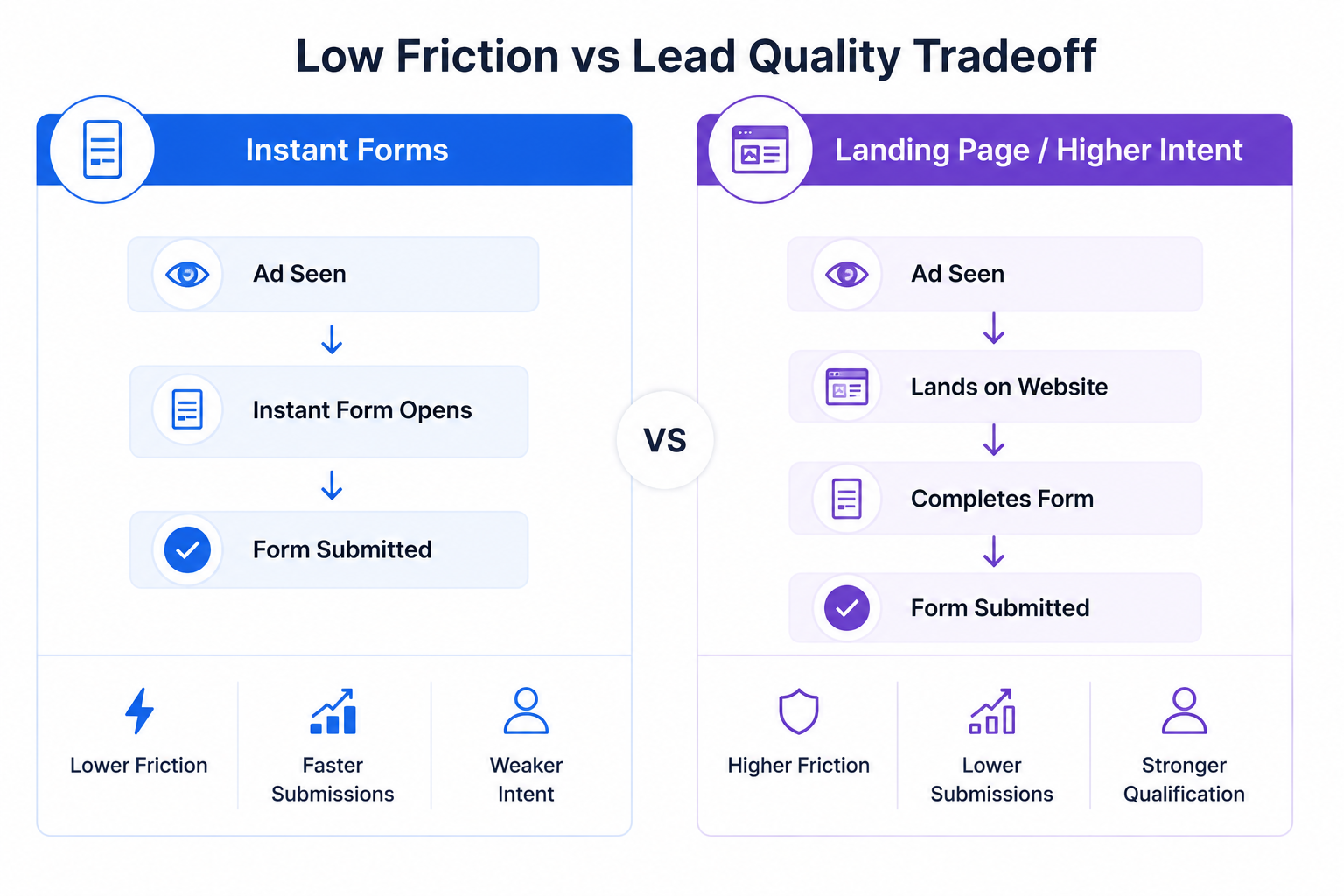
Meta designed Instant Forms to remove as much friction as possible.
Users stay inside the app. Contact details may already be prefilled. The form loads instantly instead of relying on external page speed, browser behavior, or website stability.
That changes campaign performance immediately.
Advertisers usually see:
- Higher form completion rates from mobile traffic.
- Lower CPC because fewer users drop during the conversion process.
- Faster optimization during the learning phase due to larger conversion volume.
- Stronger delivery across Instagram Stories, Reels, and other fast-scrolling placements.
This works especially well for advertisers struggling with slow landing pages or weak mobile experiences.
But Meta’s optimization system follows the easiest available signal. If the form is too easy to complete, the algorithm starts finding users who submit forms casually rather than users likely to buy.
That is where many lead-generation campaigns quietly fail.
Businesses comparing collection methods should also understand the tradeoffs between lead forms versus landing pages.
The “More Volume” form type can damage lead quality during scaling
The default “More Volume” setup is designed to maximize submissions.
For smaller advertisers, this often looks impressive early:
- CPL falls quickly.
- Conversion volume rises.
- Learning exits faster.
- Budget scaling appears easier.
The problem usually appears after expansion.
Once Meta begins spending more aggressively, the platform often reaches broader groups of low-intent users willing to complete forms without strong purchase intent.
This creates a classic reporting mismatch.
Marketing sees strong CPL numbers. Sales sees weaker conversations, lower response rates, and poor close quality. Inside Ads Manager, one of the first warning signs is stable or improving CPL combined with falling downstream conversion quality.
That often means Meta is optimizing toward form completion behavior rather than buyer intent.
This is one reason advertisers eventually ask why Facebook lead ads fail even when metrics look good.
Higher-intent forms create useful friction
Higher-intent forms introduce an extra review step before submission.
That sounds minor, but it changes user behavior significantly.
Users must pause, review their information, and confirm the submission intentionally. Casual users drop out more often during this stage.
For businesses with expensive sales processes, that friction usually improves efficiency.
This matters most for:
- Service businesses with manual sales follow-up.
- B2B companies booking demos or consultations.
- High-ticket products requiring qualification.
- Local businesses scheduling appointments.
Many advertisers fear that any friction will hurt performance. In practice, removing weak leads often improves CPA even when CPL rises.
A campaign generating 40 qualified leads usually outperforms one generating 200 weak submissions that sales cannot close.
The Questions section determines how Meta optimizes delivery
The Questions section is where advertisers either improve lead quality or accidentally destroy it. Most lead forms fail because the questions are either too broad or completely disconnected from buying intent.
Meta provides several filtering tools that advertisers underuse heavily.
Custom questions allow advertisers to ask directly about timeline, service needs, business size, budget range, or purchase urgency. Strong qualification questions create cleaner optimization signals for the algorithm over time.
Conditional logic changes the form dynamically based on previous responses. A user selecting “enterprise” can see different follow-up questions than someone selecting “small business.” That keeps forms shorter while improving qualification depth.
Work email validation matters more than many B2B advertisers realize. Personal email addresses often correlate with lower buying intent and weaker sales readiness.
Phone verification can dramatically reduce fake submissions and low-quality spam leads by requiring OTP verification before completion.
These tools work best when advertisers understand exactly what qualifies a good lead internally.
Without that definition, forms usually optimize toward volume instead of value.
If your sales team already struggles with bad submissions, learn how to spot low-quality leads before they hurt your funnel.
Intro and Ending screens quietly influence conversion quality
Many advertisers ignore the Intro and Ending sections completely.
That is a mistake.
The Intro section sets expectations before submission happens. A weak or vague explanation often attracts curiosity clicks rather than serious buyers.
For example, a SaaS advertiser offering “Free Growth Resources” may generate cheap submissions with poor intent. An advertiser offering “Enterprise Reporting Demo for Multi-Location Teams” naturally filters traffic before the form even begins.
Specificity improves qualification.
The Ending screen affects behavior after submission. Strong campaigns use this screen to direct users immediately toward:
- Booking calls.
- Starting Messenger conversations.
- Downloading gated content.
- Visiting pricing pages.
- Watching onboarding videos.
That extra action helps maintain intent while the user is still engaged.
Instant Forms break when audience quality weakens
Many advertisers try solving lead-quality problems by endlessly editing form questions.
The real issue often starts with targeting.
Broad campaigns generate more noise. The algorithm finds users likely to submit forms, not necessarily users likely to buy.
LeadEnforce becomes useful here because it improves the quality of the audience entering Meta’s optimization system.
Instead of relying entirely on broad targeting, advertisers can build higher-intent audiences from:
- Facebook group members.
- Instagram followers.
- Social engagement behavior.
- Community-driven audience signals.
That usually improves lead quality before the form optimization process even begins.
For niche B2B campaigns, local services, coaching businesses, and high-ticket offers, stronger audience intent often matters more than adding additional form fields.
Final takeaway
Instant Forms are extremely efficient at generating submissions. That does not automatically make them efficient at generating customers.
The best-performing campaigns usually balance three things carefully:
- Enough friction to filter weak leads.
- Clear qualification logic tied to real sales outcomes.
- Strong audience intent before the form even opens.
Low CPL alone is not a reliable success metric.
Qualified pipeline is.