Open Ads Manager and you’ll see two separate areas: advertising settings and ad account settings.
Most advertisers treat them as background configuration.
In reality, they directly shape how Meta interprets your business, distributes ads, and optimizes delivery.
When something feels off — unstable CPA, inconsistent reach, or uneven spend — the cause is often hidden in these settings, not in the campaign itself.
The structural difference between advertising settings and ad account settings
These two layers control different parts of the system.
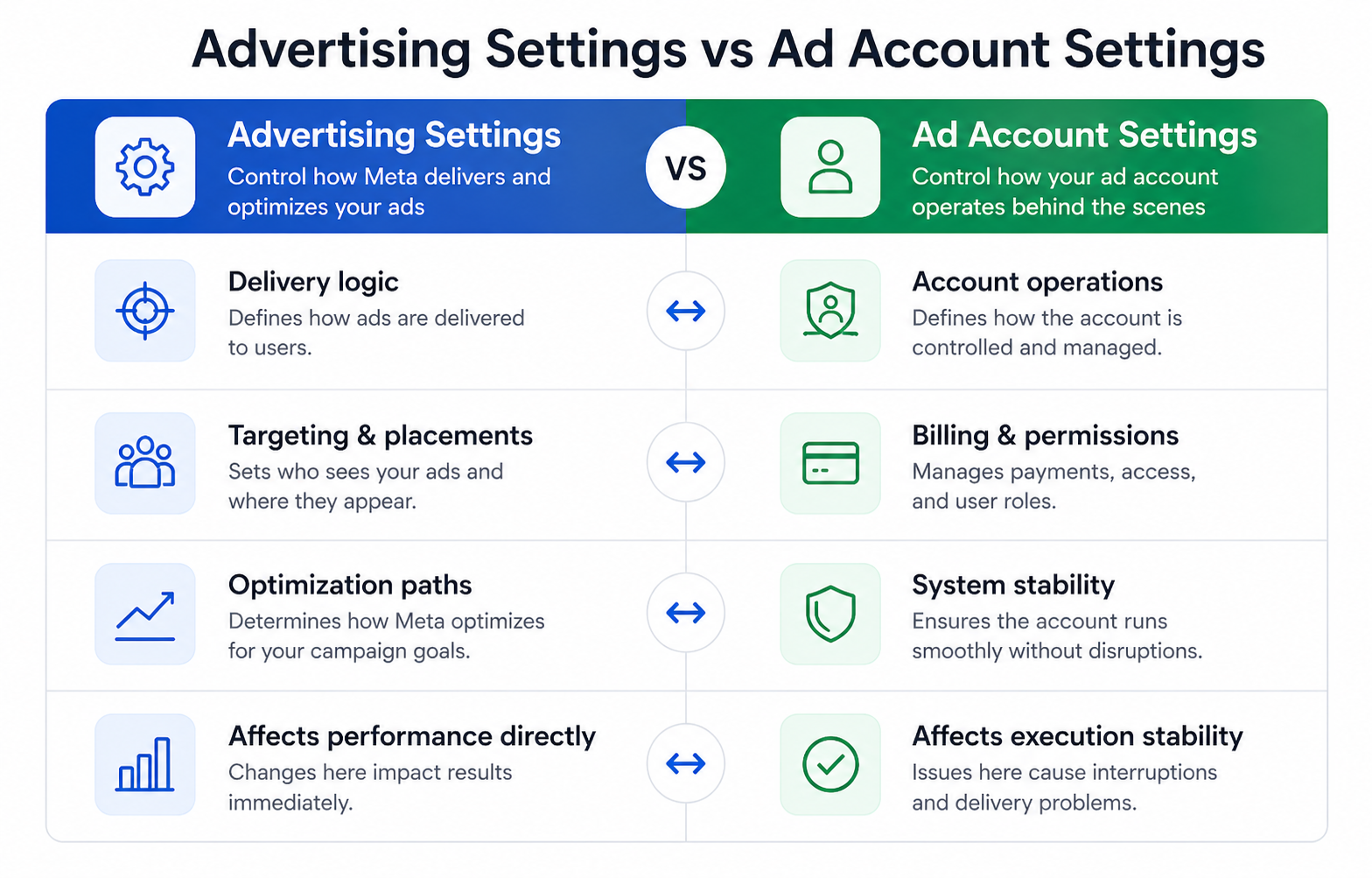
Advertising settings influence how Meta understands and optimizes your campaigns, while ad account settings control how your account operates behind the scenes.
The distinction becomes clearer when you break it down:
-
Advertising settings define delivery logic, including how Meta selects users, placements, and optimization paths.
-
Ad account settings define operational control, including permissions, billing systems, and account-level access.
If you mix these up, you end up solving the wrong problem. Many advertisers adjust campaigns when the limitation actually sits at the account level.
How advertising settings influence delivery and optimization
Advertising settings act as boundaries for the algorithm.
They don’t just store preferences. They actively limit or expand how Meta can deliver your ads.
Several core configurations have a direct effect:
-
Industry classification determines which features, compliance rules, and optimization models are available.
-
Account-level audience controls restrict who can see your ads across all campaigns.
-
Placement controls reduce or expand available inventory, which directly affects CPM.
-
Audience segments help Meta differentiate between new users and existing customers, improving optimization accuracy.
When these are misaligned, the system has fewer optimization paths. That usually results in higher costs and slower delivery.
Campaign-level signals that originate from advertising settings
Some performance issues look like campaign problems but actually come from these settings.
You can often spot this in Ads Manager through patterns like:
-
CPM increasing after tightening placement controls, even though targeting hasn’t changed.
-
Conversion volume dropping when audience segmentation is inaccurate.
-
Creative performance becoming unstable when automation settings are inconsistent.
These signals appear at the campaign level, which makes them easy to misinterpret.
To break this down correctly, it helps to analyze Facebook ad performance beyond CTR and CPC, especially when metrics don’t align.
Ad account settings: the operational backbone
While advertising settings shape delivery, ad account settings determine whether campaigns run smoothly at all.
This layer controls how the account functions on a daily basis.
Key elements include:
-
Role permissions, which define who can launch, edit, or pause campaigns.
-
Payment systems, which determine whether ads continue delivering without interruption.
-
Notification settings, which control how quickly you react to issues.
These don’t change targeting directly, but they affect execution. If something breaks here, performance drops immediately.
Permission structure and its hidden impact on campaigns
Poor access control is one of the most overlooked causes of performance instability.
In multi-user accounts, unclear permissions create operational friction that shows up in results.
Typical outcomes include:
-
Campaigns launching late because approvals are blocked.
-
Learning phases resetting after unintended edits.
-
Conflicting changes from multiple users affecting delivery consistency.
In Ads Manager, this often looks like random performance swings.
Many advertisers interpret this as creative fatigue or audience burnout, when it’s actually a control issue.
Billing and payment settings that affect delivery
Billing problems don’t just pause ads — they distort performance patterns.
If payment systems aren’t stable, Meta cannot deliver ads consistently.
Common failure points include:
-
Expired payment methods, which stop campaigns mid-delivery.
-
Outstanding balances, which limit scaling.
-
Billing mismatches across assets, which disrupt spend allocation.
Instead of clear errors, you’ll often see indirect signals: reduced spend, uneven delivery, or campaigns stuck below budget.
Notification settings and missed performance signals
Notification settings define how fast you catch problems.
Most advertisers ignore them, which delays reaction time.
Meta uses notifications to surface critical issues:
-
Learning phase resets that impact optimization stability.
-
Ad rejections or policy flags that stop delivery.
-
Payment failures that pause campaigns.
-
Delivery limitations caused by targeting or budget constraints.
If these aren’t configured properly, you notice problems only after performance drops.
That’s often when advertisers start asking why your Facebook ads are getting low engagement, even though the root issue sits in account configuration.
When settings changes reset performance
Certain changes at the settings level trigger system-wide recalibration.
This typically happens when modifying:
-
Audience controls, which redefine targeting boundaries.
-
Placement restrictions, which change inventory availability.
-
Business classification, which affects compliance and optimization models.
After these changes, campaigns may re-enter learning, CPA may fluctuate, and spend distribution may shift.
These are not random effects — they are system adjustments.
Why proper setup matters before scaling
Scaling amplifies both strengths and weaknesses.
If your settings are misaligned, increasing budget will expose those issues quickly.
For example:
-
Broad targeting becomes inefficient if hidden restrictions limit delivery.
-
Lookalike expansion behaves inconsistently when audience signals are weak.
-
Conversion optimization struggles when inputs are fragmented.
That’s why understanding how Meta ads campaign settings impact performance is critical before scaling budgets.
Where LeadEnforce fits into this system
LeadEnforce improves targeting precision by supplying high-intent audiences.
But its effectiveness depends on account stability.
If advertising settings restrict delivery, those audiences won’t scale.
If ad account settings create instability, campaigns won’t sustain performance.
Better targeting only works when the system behind it is clean.
Practical recommendations for advertisers
Instead of treating settings as a one-time setup, review them regularly.
Focus on:
-
Aligning audience and placement controls with campaign goals.
-
Keeping billing systems stable and monitored.
-
Cleaning up account roles to avoid conflicting edits.
-
Updating audience segments to reflect real customer behavior.
These actions remove hidden constraints that limit performance.
Final takeaway
Advertising settings and ad account settings control different layers of Meta Ads, but both directly influence results. One defines how Meta optimizes campaigns. The other defines how your account operates.
When both are aligned, campaigns scale predictably. When they’re not, performance issues appear as unstable delivery, rising CPA, and inconsistent results.
If your campaigns feel unpredictable, don’t start with creatives or targeting. Start with the system behind them.