Audience segmentation has always been central to B2B lead generation. However, traditional segmentation methods—based on firmographics, basic demographics, and static lists—are no longer sufficient in complex buying environments. Modern B2B purchase decisions often involve 6 to 10 stakeholders, extended sales cycles, and multi-channel engagement.
Artificial intelligence (AI) enables dynamic, predictive, and behavior-driven segmentation models that continuously refine themselves as new data becomes available. Instead of grouping prospects solely by industry or company size, AI-powered systems cluster accounts based on intent signals, engagement patterns, technographic profiles, and likelihood-to-convert scoring models.
The result: more precise targeting, higher engagement rates, and significantly improved marketing ROI.
Why Traditional Segmentation Falls Short
Conventional segmentation typically relies on:
-
Industry classification
-
Company size
-
Geographic location
-
Revenue band
-
Job title
While these variables remain relevant, they do not capture purchase intent, solution fit maturity, or engagement depth. According to industry research, over 60% of B2B marketers report that their segmentation strategy lacks predictive capability, leading to inefficient ad spend and misaligned messaging.
Furthermore, static segmentation models fail to account for behavioral signals such as:
-
Website activity patterns
-
Content consumption depth
-
Email interaction velocity
-
Technology stack evolution
-
Buying committee expansion
Without behavioral and intent-driven inputs, targeting remains reactive rather than proactive.
What AI-Powered Audience Segmentation Actually Means
AI-powered segmentation uses machine learning algorithms to identify patterns within structured and unstructured data. These models cluster accounts and contacts based on similarity scores derived from multidimensional data inputs.
Core components typically include:
1. Predictive Modeling
Supervised learning models evaluate historical conversion data to identify attributes correlated with high-value opportunities. These insights inform lookalike modeling and predictive scoring.
2. Behavioral Clustering
Unsupervised algorithms group accounts by behavioral signals—such as browsing cadence, resource downloads, and interaction frequency.
3. Intent Signal Integration
External intent data is processed to identify in-market accounts. AI ranks these accounts by urgency and probability of pipeline generation.
4. Continuous Model Training
Segmentation improves over time as the model retrains using updated performance outcomes, ensuring adaptability in dynamic markets.
Key Statistics That Demonstrate Impact
-
Organizations using AI-driven segmentation report up to 30% higher lead-to-opportunity conversion rates.
-
Predictive lead scoring can reduce customer acquisition costs by approximately 20–35%.
-
Companies leveraging intent data in segmentation strategies see 2x higher engagement rates compared to static targeting.
-
Personalized campaigns driven by advanced segmentation improve email click-through rates by over 40%.
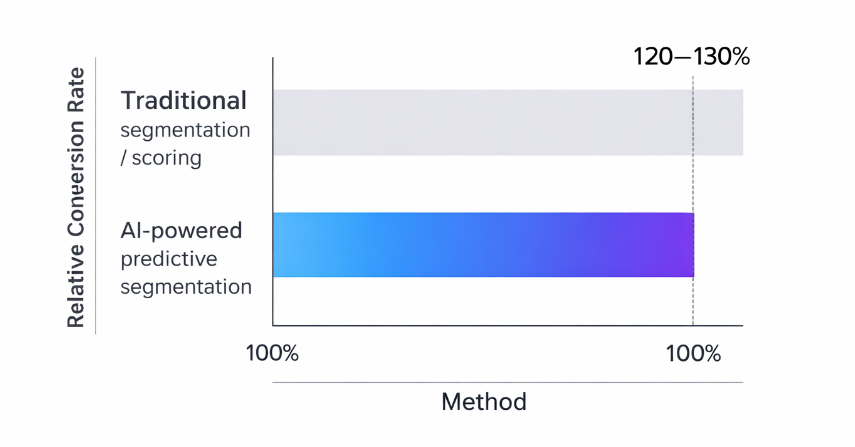
AI-driven predictive analytics can boost B2B lead conversion rates by 20–30% compared with traditional segmentation approaches
These performance gains compound across the revenue funnel, affecting pipeline velocity, sales efficiency, and overall customer lifetime value.
Data Foundations for Effective AI Segmentation
AI systems are only as strong as the data they ingest. Effective segmentation models rely on:
Firmographic Data
Industry, company size, revenue, region.
Technographic Data
Technology stack insights, software adoption signals.
Behavioral Data
Website interactions, content engagement, webinar attendance, campaign touchpoints.
CRM & Sales Data
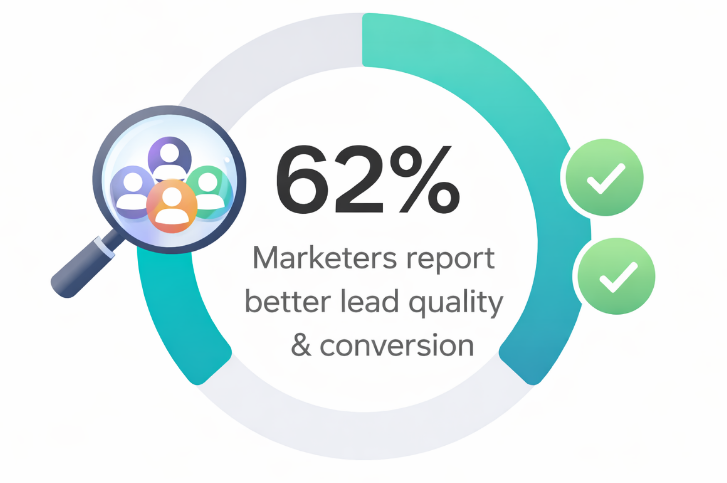
A majority of marketers (62%) report that buyer intent signals lead to better lead quality and higher conversion performance
Opportunity stage progression, deal size, sales cycle length.
Third-Party Intent Signals
Topic-level research behavior and competitor comparisons.
Data normalization, enrichment, and deduplication are critical preprocessing steps. Poor data hygiene directly degrades model accuracy.
Implementation Framework
To deploy AI-powered segmentation effectively, revenue teams should follow a structured approach:
Step 1: Define Revenue Outcomes
Align segmentation goals with measurable objectives such as pipeline growth, deal velocity, or upsell expansion.
Step 2: Consolidate Data Sources
Integrate CRM, marketing automation, website analytics, and enrichment platforms into a unified data layer.
Step 3: Establish Baseline Performance
Document existing segmentation performance metrics to quantify future uplift.
Step 4: Train and Validate Models
Use historical conversion data to build predictive models. Validate accuracy against holdout datasets.
Step 5: Operationalize Segments
Activate refined segments across advertising, email campaigns, outbound sequences, and account-based marketing initiatives.
Step 6: Monitor and Iterate
Track KPIs continuously and retrain models as needed to maintain predictive integrity.
Common Pitfalls to Avoid
-
Overfitting models to limited historical data
-
Ignoring data governance and compliance standards
-
Treating AI outputs as static rather than dynamic
-
Failing to align marketing and sales teams around shared segmentation definitions
AI segmentation is not a one-time project; it is an evolving capability requiring cross-functional collaboration.
The Strategic Advantage
AI-powered segmentation shifts B2B lead generation from volume-based targeting to precision-based targeting. Instead of expanding top-of-funnel reach indiscriminately, organizations prioritize high-propensity accounts and tailor messaging to demonstrated needs.
This transition enhances:
-
Pipeline predictability
-
Sales and marketing alignment
-
Campaign ROI
-
Customer acquisition efficiency
As buying committees grow and competition intensifies, data-driven precision becomes a structural advantage rather than a tactical enhancement.
Recommended Reading
For further exploration of advanced B2B targeting and optimization strategies, consider these related articles:
-
Intent Data in B2B Marketing: How to Identify In-Market Accounts
-
Predictive Lead Scoring: Turning Data into Revenue
-
Account-Based Marketing Strategies for High-Value Prospects
Conclusion
AI-powered audience segmentation represents a fundamental evolution in B2B lead generation. By leveraging predictive modeling, behavioral analytics, and continuous optimization, revenue teams can transition from reactive targeting to proactive opportunity creation.
Organizations that invest in data infrastructure, model governance, and cross-functional adoption will outperform competitors in pipeline efficiency and long-term growth.
The future of B2B lead generation is not broader targeting—it is smarter targeting.