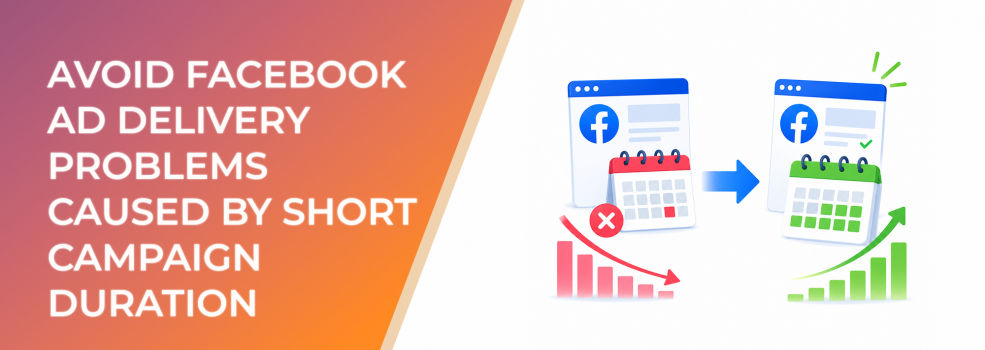
Short Facebook ad campaigns feel efficient.
You launch fast, spend a little, and expect a clear answer within a few days. But many short campaigns do not fail because the ad is bad. They fail because the schedule is too compressed for delivery to stabilize.
This is especially common with Facebook Page-created ads. The setup flow makes it easy to choose a daily budget and duration quickly, but a short duration can create weak delivery, unstable CPA, and misleading performance data.
For performance marketers, the question is not just “How long should the ad run?” It is “How long does the campaign need to produce a trustworthy signal?”
The Problem
The problem is setting campaign duration too short for the objective.
A two-day or three-day campaign may be enough for a simple announcement, but it is often too short for a lead-generation, sales, or structured testing campaign.
Meta needs time to review the ad, enter auctions, test delivery patterns, find responsive users, and gather enough performance data. If the campaign ends before those processes mature, the advertiser may judge performance before the campaign had a real chance to work.
The result is poor delivery and bad interpretation.
Why This Problem Hurts Performance
Short campaign duration can hurt performance in several ways.
First, it compresses learning. Meta’s learning phase is the period when the delivery system is still learning how an ad set may perform, and Meta has said performance typically stabilizes after around 50 optimization events within a seven-day period.
Second, short duration can create uneven pacing. If the campaign has only a few days to spend, the platform has less flexibility to find efficient delivery windows.
Third, short campaigns are more vulnerable to review delays. If a campaign spends hours in review, a one-day or two-day schedule loses a meaningful part of its active delivery time.
Fourth, short duration encourages premature edits. Advertisers see early instability, assume the campaign is failing, and change creative, targeting, budget, or objective too soon.
That can hurt CPA, ROAS, lead quality, conversion rate, and testing reliability.
Common Scenarios Where This Happens
A local business runs a three-day ad for a weekend offer but launches it late Friday afternoon. Review time and compressed delivery leave little room for optimization.
A B2B team runs a five-day lead campaign for a webinar and judges the campaign after the first 24 hours. The early CPL is high, so they change the audience before the campaign has enough signal.
An ecommerce store runs a two-day product test and concludes that the product has weak demand because there were no purchases. The campaign generated clicks, but not enough time or budget to evaluate conversion behavior.
An agency launches a short Page-created ad for a client and receives uneven results. The client asks for immediate optimization, but the data is too thin.
A startup tests a new offer with a small daily budget and a short duration. The campaign ends with a few clicks and no clear conclusion.
Why the Problem Happens
Short-duration problems usually come from confusing speed with efficiency.
Fast launch is useful, but fast launch does not guarantee fast learning. A campaign may be easy to create from a Facebook Page, but delivery still needs time to stabilize.
Another cause is deadline pressure. Marketers often launch ads only when an event, sale, or deadline is already close. The campaign then has to handle review, learning, and conversion in a compressed window.
A third cause is budget anxiety. Advertisers set a short duration because they want to limit spend. That can be reasonable, but a hard spending limit should not be confused with a valid test structure.
Finally, advertisers often evaluate too early. The first day of delivery may reflect review timing, auction availability, early exploration, or audience testing rather than true campaign potential.
The Solution
The solution is to schedule campaigns based on the learning required, not just the calendar deadline.
Start by matching duration to the objective.
For awareness campaigns, a shorter duration can work if the goal is simple visibility. For traffic campaigns, give the ad enough time to produce meaningful click and landing page behavior. For lead-generation campaigns, allow enough time to review lead quality, not just CPL. For sales campaigns, give the campaign enough room to collect purchase or funnel-event signals.
Next, build a launch buffer. For time-sensitive campaigns, publish earlier than the moment you need delivery. This protects the campaign from review delays and gives you time to catch setup issues.
Then separate testing windows from promotion windows. If the promotion is only three days long, test the audience, creative, or offer before the live promotion starts. Do not make the entire learning process depend on the same short window when revenue is expected.
Use duration and budget together. A seven-day campaign with a daily budget too low to generate meaningful activity may still produce weak results. A high-budget campaign over one day may spend aggressively but still fail to produce stable learning.
Finally, define review milestones. Instead of reacting every few hours, decide when the campaign will be evaluated: after a minimum number of days, after a planned amount of spend, or after enough conversion signals to make a reasonable decision.
Risks and Considerations
Longer duration is not always better.
A campaign can still fail if the audience is wrong, the creative is weak, the offer is unclear, or the landing page does not match the ad. Duration gives the campaign room to work; it does not guarantee success.
Another risk is letting a clearly broken campaign run too long. If delivery is blocked, the ad is not approved, the campaign is not spending, or the destination is broken, waiting will not fix the issue.
Also consider audience size. A small audience paired with a long duration can fatigue quickly. Frequency may rise, CTR may drop, and CPA may increase.
For urgent campaigns, duration must be balanced with the real business deadline. You may not be able to turn a flash sale into a two-week test, but you can prepare audiences, creative, and approvals earlier.
Prerequisites and Dependencies
To set the right duration, you need a clear objective, budget, audience size, and success metric.
You also need an active ad account, approved creative, a working destination, and a realistic launch timeline.
For lead-generation campaigns, you need a process for evaluating lead quality. For ecommerce campaigns, you need enough post-click data to judge conversion behavior. For agencies, the client should understand that early delivery volatility is normal.
Reliable conversion tracking and clean reporting make duration decisions easier. Without them, a longer campaign may simply collect more unclear data.
Practical Recommendations
Do not use a two-day campaign to answer a seven-day performance question.
Launch time-sensitive ads early enough to account for review and initial delivery instability.
For new campaigns, avoid major edits during the early learning window unless something is clearly broken. Frequent changes can make the campaign harder to interpret.
Use short campaigns for narrow goals, such as announcements, reminders, or limited promotions. Use longer windows for lead quality, sales, audience testing, and conversion learning.
When budget is limited, reduce the number of variables instead of shortening the campaign too aggressively.
Judge performance in phases: initial delivery, early signal, qualified outcome, then scale or rebuild.
Final Takeaway
Short campaign duration can make Facebook ads look worse than they really are.
If the schedule is too compressed, the campaign may not have enough time to pass review, stabilize delivery, collect signal, and produce useful data. The solution is to plan duration around the objective, build in a launch buffer, and evaluate results only after the campaign has had enough time and budget to answer the right question.
Related LeadEnforce Articles
- How Long Do Facebook Ads Take to Work? — Explains what advertisers should expect during the first days and weeks of campaign delivery.
- The Lifecycle of a Facebook Ad: How Long Should You Let It Run? — Helps marketers decide when to let an ad continue, pause it, or adjust it.
- Meta Ads Delivery Status Explained: Fix Campaign Issues Fast — Useful for diagnosing whether delivery issues are caused by timing, review, learning, or auction problems.
- How to Set Realistic Ad Budgets for Your Facebook and Instagram Campaigns — Connects campaign duration with budget planning and realistic performance expectations.
- How Ad Scheduling Can Improve ROI in Facebook Ads — Helps distinguish campaign duration from time-of-day and day-of-week scheduling strategy.