Lead ads work because they remove friction. A user taps the ad, opens the Instant Form inside Facebook or Instagram, and submits information without loading an external website.
That convenience usually lowers CPL quickly. But it also creates a common problem: advertisers optimize for cheap submissions while sales teams struggle with weak lead quality.
The best lead campaigns balance volume and qualification at the same time.
Your ad creative filters lead quality before the form opens
Most advertisers spend too much time adjusting form questions and not enough time improving the ad itself. The creative determines who opens the form in the first place.
A vague ad attracts casual clicks. A specific ad filters users before they even enter the funnel.
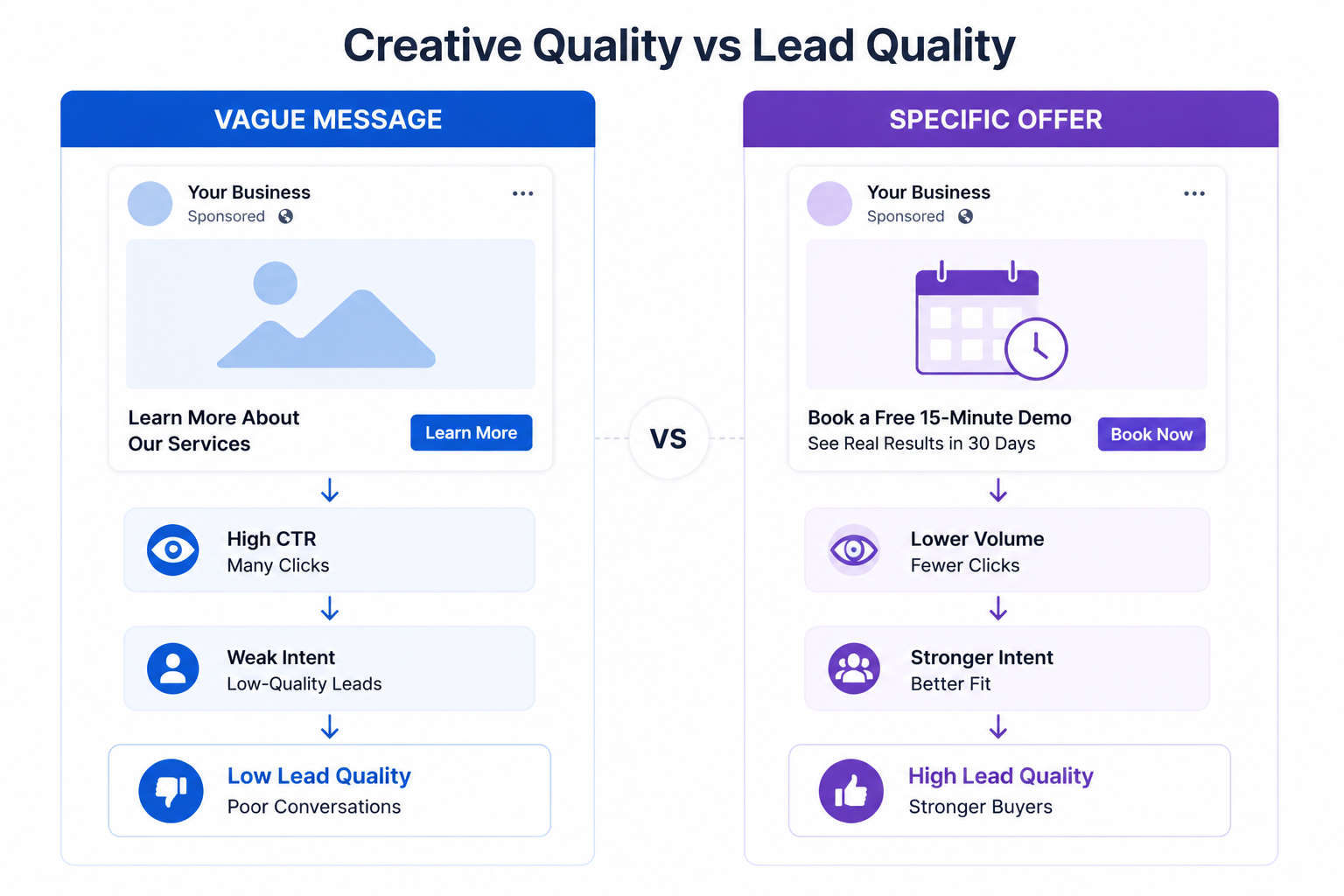
For example, a generic message like “Learn More About Our Services” usually produces weaker intent than an ad clearly explaining pricing, timelines, or expected outcomes. The more specific the offer feels, the more likely the lead understands what happens after submission.
This becomes visible inside Ads Manager faster than many advertisers realize.
You often see weak creative filtering through patterns like:
- High CTR combined with poor booked-call rates, which usually means the ad attracts attention but not serious buyers.
- Cheap CPL alongside low response rates from sales teams, because users submit impulsively without strong purchase intent.
- Large differences between placements, where Instagram Stories may generate volume while Facebook Feed produces better-quality leads.
If the ad attracts the wrong people, the form usually cannot fix the problem afterward.
Advertisers trying to improve downstream quality should also learn how to optimize Facebook lead ads for higher conversion rates.
Scaling too quickly can damage conversion rates
Meta’s Advantage+ budget system can increase delivery aggressively once the algorithm finds cheap conversion opportunities. That often looks positive during the first days of scaling.
The problem starts when the sales process cannot keep up.
A business handling 30 leads per day may respond quickly and convert efficiently. The same business receiving 300 leads overnight may suddenly create long response delays, missed calls, and lower appointment-booking rates.
Inside Ads Manager, the campaign can still look healthy because Meta continues generating submissions efficiently. The operational breakdown usually appears later inside the CRM.
This is why advertisers should monitor:
- Average lead response time, because delayed follow-up often lowers conversion probability sharply.
- CRM backlog growth, which signals that sales teams are falling behind incoming volume.
- Contact rates by day and hour, especially during aggressive budget increases.
- Cost per qualified opportunity instead of relying only on CPL.
Some businesses improve overall CPA simply by limiting lead delivery to business hours when sales teams can respond immediately.
Automatic placements improve reach, but not always lead quality
Meta recommends Advantage+ placements because the system can distribute spend across Facebook, Instagram, and WhatsApp automatically.
That often lowers advertising costs. But placement quality still varies significantly depending on the audience and business type.
Instagram Stories usually generates faster mobile submissions with lower friction. Facebook Feed often produces slower but more deliberate behavior. WhatsApp placements can work extremely well for local service businesses where direct conversations matter immediately.
The mistake many advertisers make is optimizing placements entirely around CPL.
A cheaper placement may still produce weaker customers.
Strong advertisers compare placements using business-level signals like:
- Qualified lead rate, which shows whether submissions actually match the target customer profile.
- Appointment-booking percentage, especially for service businesses dependent on consultations.
- Revenue per lead, which often reveals that expensive placements produce stronger customers.
- Lead-to-sale conversion rate, which usually matters more than raw submission volume.
Those metrics usually tell a more accurate story than CPL alone.
Better source audiences usually create better leads
Shorter forms usually convert better, but oversimplifying creates problems
Most Instant Forms perform better when they stay simple. Long forms increase friction, especially on mobile devices where typing becomes slow and annoying.
That is why Meta recommends using prefilled fields and minimizing unnecessary typing.
But advertisers often overcorrect.
A form asking only for name and email may produce huge lead volume while creating weak sales intent. On the other hand, forms overloaded with detailed qualification fields usually destroy completion rates.
The goal is controlled friction.
Multiple-choice questions often work better than open-text fields because they make qualification easier without slowing users down too heavily. Asking users to choose a purchase timeline, budget range, or preferred service category is usually more effective than requiring long written responses.
Advertisers refining qualification logic should also review which lead form fields reduce conversions.
The best-performing forms usually collect only the information sales teams actually need.
The completion screen should move users forward
Many advertisers waste the completion screen by showing only a generic thank-you message. That usually ends the interaction too early.
The strongest lead funnels continue guiding users after submission.
Some advertisers send users toward appointment scheduling. Others encourage Messenger conversations, downloadable content, or product demos while intent is still high.
This matters because user engagement drops quickly after the form closes.
A stronger completion screen often improves downstream conversion rates without changing the ad or the audience at all.
Final takeaway
Good lead ads are not built around cheap CPL alone. They work because the creative attracts the right users, the form filters intent properly, and the sales process can respond quickly after submission.
Most lead-quality problems start before the form itself. Weak audience targeting, poor messaging, and operational bottlenecks usually create more damage than the Instant Form format alone.