Lead generation campaigns rarely fail because of targeting alone. They fail because creative testing has no structure. Many advertisers launch several ads at once and wait for a winner. That approach wastes budget and slows learning.
A clear testing framework reduces guesswork. It helps you isolate variables, read data correctly, and scale with confidence. Without structure, performance looks random even when the offer is solid.
Why Creative Testing Fails in Lead Generation Campaigns
Most accounts mix testing and scaling inside the same campaign. Budgets move too fast. Ads get edited before enough data accumulates.
Lead generation adds another layer of complexity. Conversions often happen after a delay. That delay makes early signals misleading.
Common issues include:
-
Testing too many variables at once; changing headline, image, and offer together hides what caused the result.
-
Optimizing for clicks instead of lead quality; cheap traffic often produces weak leads.
-
Editing ads mid-test; frequent changes reset learning and distort comparisons.
-
Ignoring fatigue signals; rising frequency and falling click-through rate usually appear before cost per lead increases.
If you want a deeper look at structured split testing, review How to Run A/B Tests That Deliver Real Insights .
Core Principles of a Reliable Testing Framework
A strong framework answers one question at a time. Each test has a clear hypothesis. Each decision has a predefined rule.
| Variable | Example | Safe to Test Together? | Risk Level |
|---|---|---|---|
| Hook angle | Pain vs Outcome | No | High |
| Visual format | Static vs Video | Yes (same message) | Medium |
| CTA phrasing | Book Now vs Get Audit | Yes | Low |
| Offer type | Free guide vs Free consult | No | Very High |
Three basic principles matter most:
-
Isolate one variable; change only the hook, or only the visual, not both.
-
Define a minimum data threshold; compare ads after enough conversions, not after two days.
-
Keep audience and objective stable; changing targeting during a creative test breaks clarity.
Creative testing should generate knowledge, not just short-term leads.
Define the Hypothesis Before You Launch
Every test needs a clear statement. For example, “A pain-focused hook will increase qualified lead rate by 20 percent.” That gives direction and a measurable outcome.
Before launching, define:
-
The variable being tested; headline angle, visual format, or CTA phrasing.
-
The main metric; cost per qualified lead, not raw form submissions.
-
The decision rule; what level of improvement qualifies as a winner.
If you skip this step, you will chase surface metrics.
Framework 1: Angle-Based Testing
An angle is the core message behind the ad. It frames the problem and the solution. Testing angles often creates larger gains than testing design details.
For lead generation, common angles include:
-
Problem-focused; highlight a specific frustration your audience faces.
-
Outcome-focused; promise a clear and measurable result.
-
Process-focused; explain how your system works differently.
-
Risk-reduction; lower commitment with free audits or consultations.
Keep format and structure the same. Only change the message. This isolates the strategic impact.
Angle testing works best early in the campaign lifecycle.
Framework 2: Execution Testing Within a Winning Angle
Once you find a strong angle, refine execution. Now you test how the message is delivered.
Execution variables may include:
-
Static image versus short video; test scroll-stopping power.
-
Direct response copy versus story-driven copy; compare clarity against engagement.
-
Minimal design versus information-rich layout; evaluate cognitive load.
Change one element at a time. Avoid redesigning everything at once.
For practical examples of structured experimentation in Meta, see Facebook Ads Testing Strategy: How to Build a Campaign Testing Roadmap .
Framework 3: Funnel-Stage Creative Testing
Creative intent must match audience awareness. Cold audiences need education or disruption. Warm audiences need proof. Hot audiences need urgency or clarity.
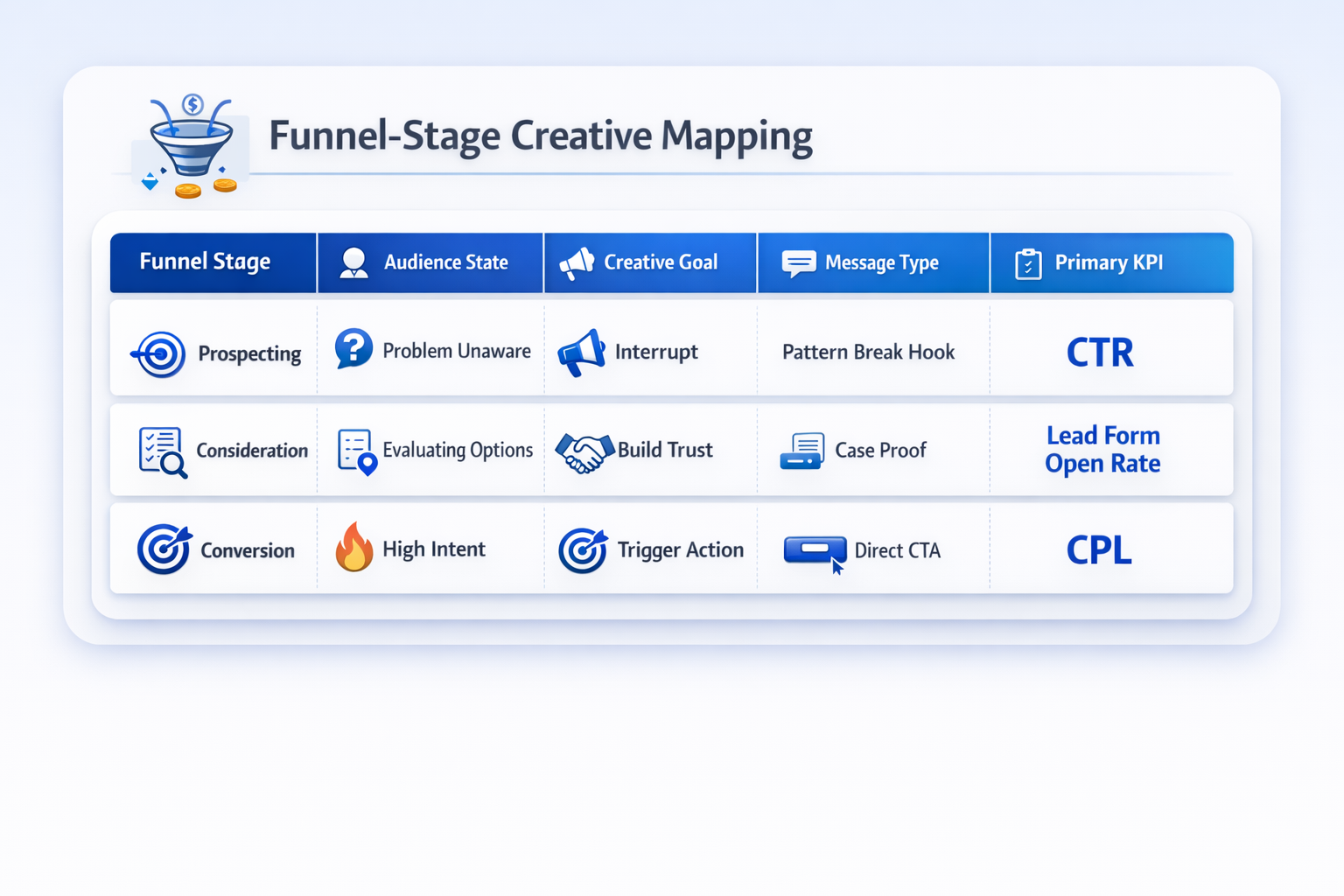
Divide creative testing by funnel stage:
-
Prospecting; test bold hooks and broad problem statements.
-
Consideration; test case studies, proof, and testimonials.
-
Conversion; test urgency triggers and direct offers.
Do not mix funnel stages in one test group. Each stage reflects a different mindset.
For a detailed breakdown of funnel structure, review Facebook Lead Generation Funnel: From Cold Traffic to Paying Customers .
Framework 4: Fatigue and Lifecycle Testing
Winning ads decline over time. Frequency rises. Engagement drops. Costs increase.
You need a refresh system, not random replacements.
Use a simple lifecycle approach:
-
Duplicate the winning ad into a scaling campaign; keep the original untouched.
-
Introduce small variations; adjust hook wording while preserving structure.
-
Monitor early fatigue signals; falling CTR often appears before rising CPL.
To understand fatigue patterns in detail, see Why Facebook Ads Performance Declines Over Time (and How to Prevent It) .
When to Stop a Test
Set stop rules before launch. For example:
-
Cost per qualified lead exceeds baseline by 30 percent after 20 conversions.
-
CTR falls significantly below account average for the same audience.
-
Lead-to-sales rate drops despite stable front-end metrics.
Clear rules remove emotion from decisions.
Data Discipline: Reading the Right Signals
Lead generation requires patience. Small samples produce unstable results. Day-to-day swings are normal.
Focus on:
-
Sufficient conversion volume before comparing variants.
-
Equal budget distribution across test ads.
-
Downstream metrics such as qualified lead rate and close rate.
Creative that brings the cheapest leads is not always the most profitable.
Turning Creative Testing Into a System
Testing should run continuously. Allocate a fixed share of budget to experimentation. Document every hypothesis and result.
Maintain a simple testing log:
-
Hypothesis and variable tested.
-
Spend and conversions.
-
Outcome and next action.
This prevents repeated mistakes and builds institutional memory.
Creative testing frameworks turn random experimentation into structured learning. When you isolate variables, define rules, and connect front-end data to real business outcomes, lead generation becomes predictable rather than reactive.