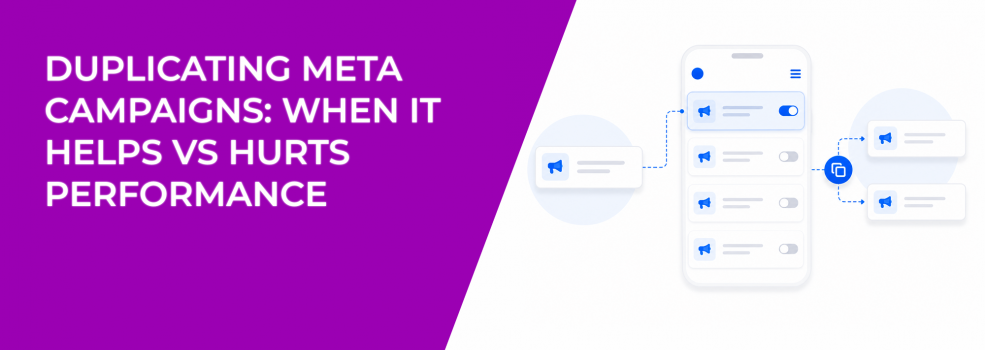
Duplicating a campaign in Meta Ads Manager feels like a quick way to scale or test new ideas. One tap, and you have a new campaign ready to run.
Meta allows duplication directly from the mobile app, either from the home screen or during ad creation.
But duplication is not just copying settings. It changes how the campaign behaves in auctions.
What actually happens when you duplicate a campaign
A duplicated campaign keeps structure, but it does not inherit delivery momentum.
From Meta’s system perspective, it’s a new campaign.
You’ll usually see:
- Learning phase triggered again;
- Higher initial CPA compared to the original;
- CPM volatility during early delivery;
Even with identical settings, the duplicated campaign competes under different conditions.
Why duplication can increase CPA during scaling
Many advertisers duplicate campaigns instead of increasing budget.
This approach often creates inefficiencies rather than scale.
Common outcomes include:
- Auction overlap; multiple campaigns target the same users, increasing competition and CPM.
- Fragmented conversion data; signals are split, making optimization weaker.
- Repeated learning cycles; each campaign must re-learn delivery patterns.
- Budget dispersion; spend spreads across campaigns without clear performance concentration.
Inside Ads Manager, this appears as unstable CPA and inconsistent spend distribution.
Advantage+ audience duplication: what changes behind the scenes
If the original campaign uses Advantage+ audience, the duplicate will use it as well.
That introduces variability.
Even with identical inputs:
- The system may explore different audience segments;
- Delivery patterns may diverge between campaigns;
- Lead quality can shift without obvious targeting changes;
You can switch to manual audience settings, but that reduces algorithm flexibility and may limit scale.
When duplicating campaigns actually makes sense
Duplication works best as a testing tool.
It’s effective when you need to isolate variables without disrupting an existing campaign.
Use duplication for:
- Testing a new creative direction;
- Trying a different budget strategy;
- Exploring a new audience segment;
In these cases, the reset is intentional and useful.
For scaling, duplication is often less efficient than optimizing the original campaign.
Why duplicated campaigns compete against each other
Meta does not treat your campaigns as a unified system.
If multiple campaigns target similar audiences, they can compete in the same auctions.
This creates:
- Increased CPM due to internal competition;
- Reduced delivery efficiency;
- Uneven spend allocation across campaigns;
You may notice one campaign dominating spend while others stall.
This reflects auction dynamics, not random behavior.
Learning phase reset: the biggest hidden cost
Every duplicated campaign enters the learning phase again.
During this period:
- Delivery is exploratory;
- CPA is usually higher;
- Conversion volume fluctuates;
Frequent duplication keeps campaigns in continuous learning mode.
That prevents stable optimization and makes scaling unpredictable.
If you want to stabilize faster, it’s important to finish the learning phase faster.
Campaign duplication vs editing: choosing the right action
A common mistake is duplicating when editing would be enough.
Editing preserves historical data. Duplication resets it.
Use duplication when:
- You need a controlled test;
- You want to isolate a variable;
Avoid duplication when:
- You are making small adjustments;
- The campaign is already performing well;
If you’re unsure how to structure changes, it helps to structure your Facebook campaigns without wasting budget.
When duplication leads to misleading performance comparisons
Advertisers often compare duplicated campaigns directly with originals.
This can be misleading.
The duplicated version:
- Starts with no optimization history;
- Enters auctions at a different time;
- May compete under different demand conditions;
As a result, early performance differences don’t reflect long-term potential.
Final takeaway
Duplicating campaigns is fast, but it introduces new variables into delivery.
Each duplicate resets learning, fragments data, and can increase auction competition.
Use duplication for testing. Avoid using it as a primary scaling method.
If performance becomes unstable after duplication, reviewing what happens when you pause and restart Facebook campaigns helps explain why results shift.