Meta lead ads are designed to collect contact information directly inside Facebook or Instagram. Instead of sending users to a landing page, advertisers can capture leads through Instant Forms, phone calls, or messaging conversations.
That sounds simple, but the delivery mechanics behind lead ads can change your CPL, sales quality, and scaling potential dramatically.
A campaign that generates cheap leads inside the Meta ecosystem may still fail if sales cannot convert the traffic into appointments or revenue.
The three lead ad formats behave very differently
Meta groups lead ads into three main categories, and each one produces a different type of buyer behavior.
Lead ads with Instant Forms reduce friction. Users stay inside the app and submit information quickly, often through prefilled fields. This format usually lowers CPL and increases lead volume.
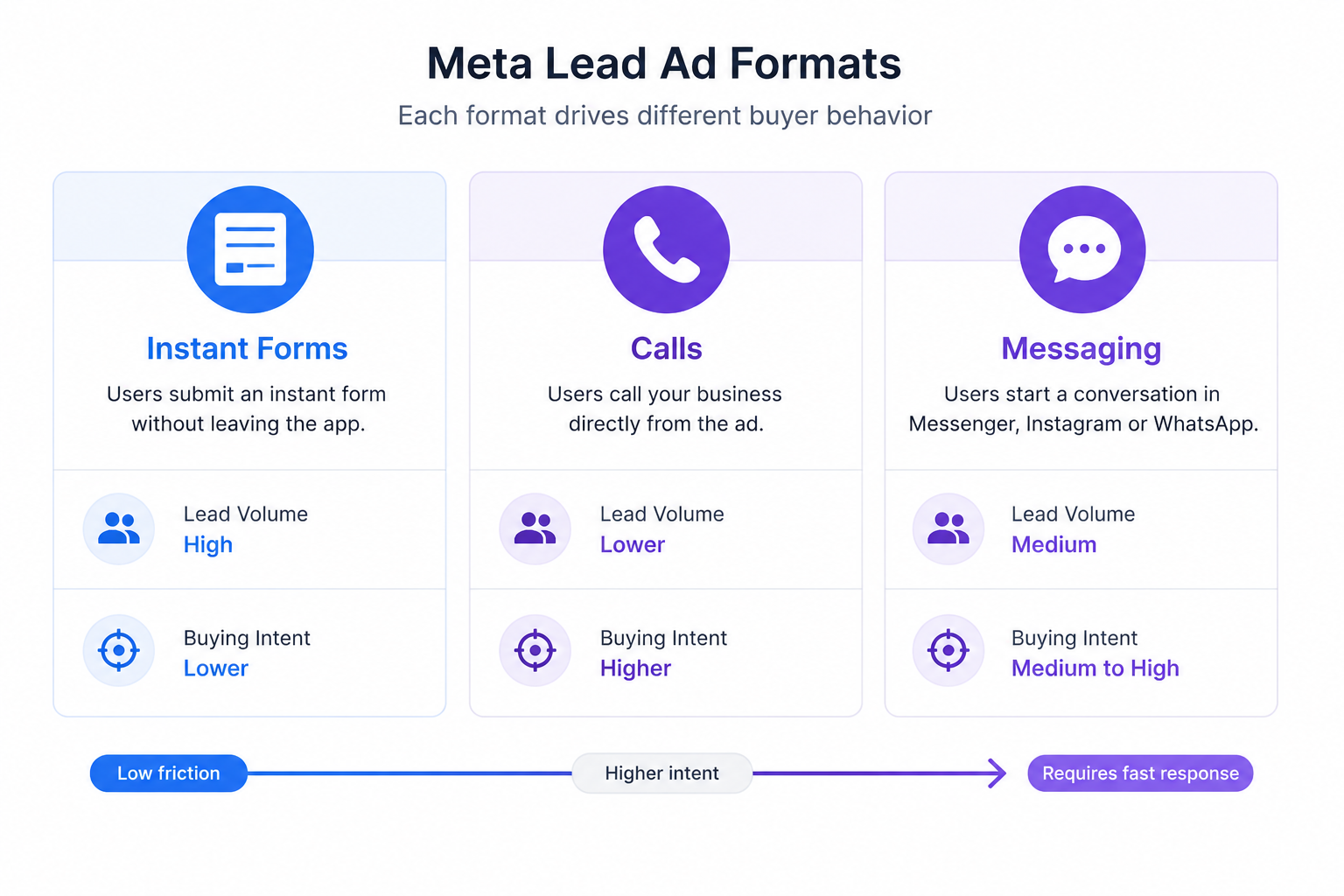
Lead ads with calling push users toward direct phone conversations. These campaigns often produce fewer leads, but stronger buying intent. They work well for services that depend on immediate conversations, appointments, or consultations.
Lead ads that click to message move users into Messenger, Instagram DMs, or WhatsApp conversations. These campaigns sit somewhere between forms and calls. They create higher engagement than forms but require fast response handling from the business.
Many advertisers compare these formats only by CPL. That usually creates the wrong optimization decision.
A call lead at $45 may outperform a $12 Instant Form lead if the close rate is three times higher.
Why Meta favors low-friction conversion paths
Meta’s algorithm optimizes toward the easiest conversion signal available. Instant Forms typically outperform landing pages on raw submission rate because users never leave the platform.
Inside Ads Manager, this often shows up as:
- Lower CPC, because users complete the conversion flow without loading an external page.
- Lower CPL, since Meta can optimize aggressively around quick submissions.
- Faster learning phase stabilization, because the campaign receives conversion signals more consistently.
- Stronger mobile conversion rates, especially on Stories and Reels placements where external landing pages often lose users.
But the same mechanism can damage lead quality.
If your form asks only for name and email, Meta may aggressively target low-intent users who complete forms casually. Sales teams usually discover the problem later when response rates collapse.
You can often spot this pattern early. CTR stays healthy, CPL falls, but booked calls or qualified opportunities flatten.
That is not a creative issue. It is a signal-quality issue.
If you are comparing lead collection methods, it helps to understand the tradeoffs between lead generation ads versus conversion campaigns.
Where advertisers usually lose money with lead ads
Most lead-gen inefficiency happens after the submission.
A campaign may generate hundreds of leads while the CRM follow-up process breaks completely. Delayed outreach, weak qualification, duplicate records, or disconnected sales tracking can destroy performance without changing Ads Manager metrics.
Common operational failures include:
- Slow lead response times, which reduce contact rates sharply when follow-up happens hours after submission.
- Overly broad audiences, where Meta finds cheap form completions from users with weak buying intent.
- Poor qualification logic, because short forms increase submission volume while reducing sales readiness.
- Disconnected CRM attribution, making it difficult to identify which campaigns actually generate revenue.
This is why experienced advertisers track qualified lead rate, not just CPL.
Many of these issues can be reduced when advertisers qualify Facebook leads without hurting conversion rates early in the funnel.
Lead ads work differently across placements
Meta lead ads can appear in Facebook Feed, Instagram Feed, Stories, Reels, Marketplace, and other placements. Performance varies heavily by placement behavior.
Instagram Stories may generate fast mobile submissions but weaker qualification. Facebook Feed often produces more deliberate form completion behavior for older audiences. Marketplace traffic can increase volume quickly but may lower purchase intent depending on the offer.
You can usually identify placement problems through delivery breakdowns.
If one placement drives cheap leads but poor downstream conversion, exclude it before changing the whole campaign structure.
Compliance issues can quietly limit scaling
Lead ads must comply with Meta’s Advertising Standards, including discriminatory practices policies. This becomes especially important for housing, employment, financial services, and other regulated categories in the US and Canada.
Meta restricts advertisers from collecting certain sensitive personal information inside lead forms. That includes questions related to age, gender, marital status, or exact location details in restricted categories.
Some advertisers accidentally recreate prohibited fields using custom questions. That can trigger disapprovals, limited delivery, or inconsistent campaign performance.
The delivery impact is often gradual. CPM rises, approvals slow down, or campaigns stop scaling consistently.
The targeting problem most lead campaigns never solve
Many advertisers rely entirely on Meta’s broad targeting system and hope the algorithm finds qualified buyers automatically.
That works only when conversion signals are strong enough.
LeadEnforce becomes useful when advertisers need stronger audience intent before Meta begins optimization. Instead of relying only on broad targeting, marketers can build audience pools from Facebook groups, Instagram followers, social engagement behavior, and profile-level interest signals.
That helps campaigns start with users who already show category relevance, which often improves lead quality and lowers wasted spend.
For B2B, local services, and niche offers, the difference becomes visible fast. CPM may stay similar while qualified lead rate improves.
Advertisers struggling with weak form completion rates should also review what makes a Facebook lead form convert before rebuilding campaign structure.
Final takeaway
Facebook lead ads are not a single format. Instant Forms, calls, and messaging campaigns all create different conversion behavior, sales intent, and optimization signals.
The best-performing campaigns usually balance three things carefully: high-intent targeting, enough friction to qualify users, and fast operational follow-up.
Cheap leads alone rarely scale profitably.