Testing is easy. Scaling is not.
Many teams run dozens of experiments but struggle to turn promising results into sustained growth. The most common reasons are unclear success criteria, inconsistent measurement, and premature scaling. According to industry benchmarks, nearly 70% of marketing experiments fail not because the idea was bad, but because the test was not structured to support a clean scale‑up decision.
Scaling requires a different mindset than testing. Tests are about learning; scaling is about repetition, predictability, and control.
Step 1: Define a Test That Can Scale
Before launching any experiment, ask one critical question: If this works, can it be repeated at 5× or 10× the volume?
A scalable test has three characteristics:
-
A clearly defined audience that can be expanded without changing its core intent
-
A single primary success metric, such as cost per lead or conversion rate
-
A stable acquisition channel that supports increased spend or reach
Tests that rely on extremely narrow audiences, one‑off creatives, or manual processes often show good early results but collapse under scale.
Step 2: Set Statistical Guardrails
Scaling decisions should be driven by data, not excitement.
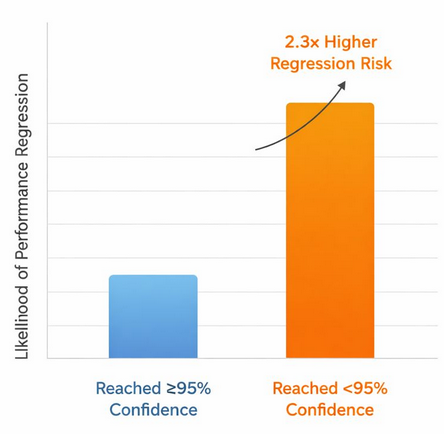
Likelihood of Performance Regression vs. Statistical Confidence
As a rule of thumb, a test should reach at least 95% statistical confidence before being considered for scale. In practical terms, this often means:
-
A minimum of 100–300 conversions per variant (depending on baseline performance)
-
Consistent results over multiple time windows
-
Performance stability after the learning phase ends
Research shows that campaigns scaled before reaching statistical confidence are 2.3× more likely to regress within the first two weeks of expansion.
Step 3: Validate Unit Economics
A test that converts well but fails on unit economics is not ready for scale.
Before increasing volume, validate:
-
Cost per lead versus lifetime value
-
Down‑funnel conversion rates (MQL to SQL, SQL to customer)
-
Payback period at current performance levels
In B2B demand generation, for example, high‑intent audiences often show 30–50% higher lead‑to‑opportunity rates, making them safer candidates for scaling even at higher acquisition costs.
Step 4: Scale in Controlled Increments
The biggest mistake teams make is scaling too fast.
Instead of doubling or tripling spend overnight, use incremental expansion:
-
Increase volume by 20–30% at a time
-
Monitor performance for 3–5 days between changes
-
Roll back immediately if key metrics deviate beyond predefined thresholds
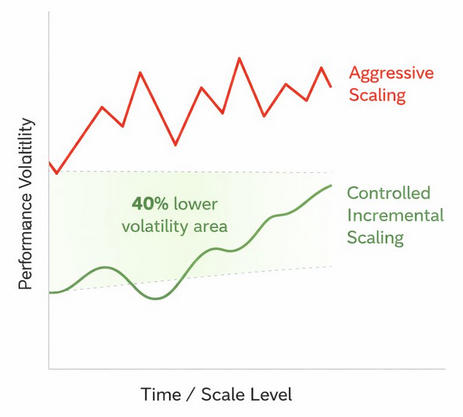
Performance Volatility Under Different Scaling Approaches
Data from performance marketing studies indicates that gradual scaling reduces performance volatility by up to 40% compared to aggressive expansion.
Step 5: Re‑Test at Every New Plateau
Scaling changes the system.
Larger audiences, higher spend, and broader reach introduce new variables. What worked at a small scale may need refinement at a larger one.
At each new volume plateau:
-
Re‑test messaging and positioning
-
Segment audiences by intent or behavior
-
Re‑evaluate frequency and saturation levels
High‑performing teams treat scaling as a series of controlled tests, not a single irreversible decision.
Common Signals You’re Ready to Scale
You are likely ready to move from testing to scaling if:
-
Performance remains stable for at least two full test cycles
-
Results hold across multiple audience segments
-
Operational processes can support higher lead volume
-
Forecasts remain profitable under conservative assumptions
Organizations that follow these criteria are significantly more likely to sustain performance beyond the first month of scaling.
Final Thoughts
Testing generates insight. Scaling generates growth.
A clear playbook bridges the gap between the two by replacing intuition with structure, patience, and measurable checkpoints. Teams that master this transition build predictable pipelines instead of chasing short‑term wins.
Suggested Reading
To go deeper into related topics, consider exploring: