For many e-commerce businesses, growth still means “spend more to get more.” But rising ad costs, lower margins, and increased competition have made this approach unsustainable.
The real advantage belongs to brands that keep customers around. Retention lowers your customer acquisition cost (CAC), improves average order value (AOV), and increases profit without requiring higher ad spend. It also feeds your paid campaigns with better data — boosting long-term ROAS.
Let’s break down why retention matters, how it supports your Meta ads, and how to build a system that compounds value with every returning customer.
Why retention matters more than acquisition
Getting someone to buy from you once is hard. Getting them to come back is easier — if you do it right. And it’s far more profitable. Retained customers drive more revenue, refer others, and respond better to marketing.
Acquisition costs are rising across channels. In Meta ads, CPMs and CPCs continue to increase, especially during competitive seasons. At the same time, consumer attention spans are shrinking, and conversion rates are harder to predict. If you rely only on new traffic, you're locked into a high-cost, low-margin cycle.
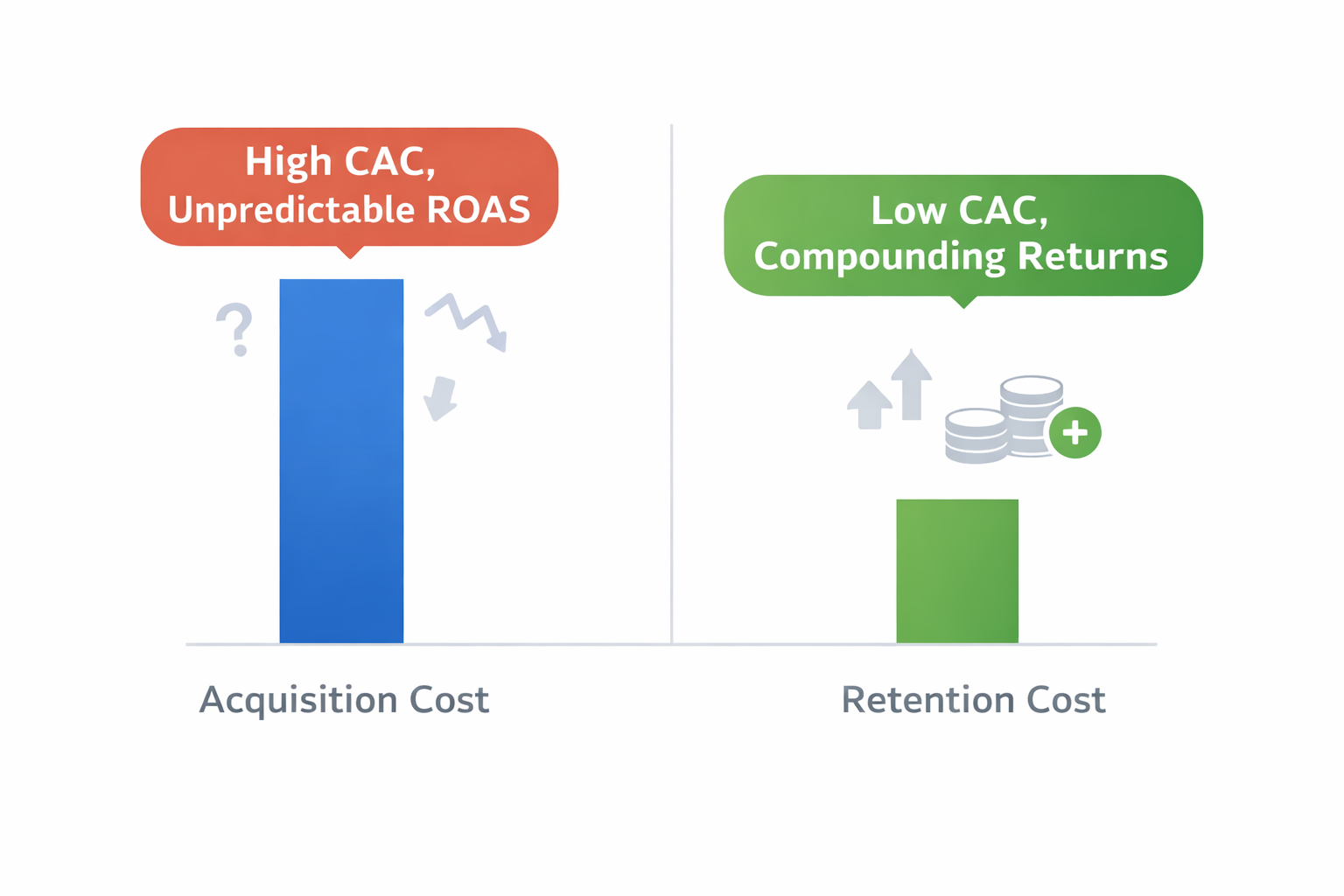
Retention changes that dynamic. A customer who has already purchased is:
-
More likely to trust your brand and product;
-
Faster to convert on future offers;
-
Less price-sensitive than first-time buyers.
This creates a compounding effect. You’re no longer paying to convert every customer from scratch. Instead, each new buyer adds to a growing base of high-LTV users.
Small brands see faster ROI from retention
Early-stage e-commerce brands often focus solely on acquisition. But small lists are easier to engage. A few simple systems — like a basic welcome flow, reorder reminders, or segmented emails — can yield disproportionate returns when your total customer base is still small.
For ideas on how to do this with limited resources, see How to Run Facebook Ads for Effective Customer Retention.
Retention improves your ad performance too
Retention doesn’t just help your email open rates. It actively improves the performance of your Meta campaigns. The Meta algorithm works best when it sees strong, fast, and consistent conversion signals. Returning customers provide exactly that.
1. More accurate targeting and faster learning
Meta's delivery system thrives on conversion feedback. When returning buyers engage with your ads, they:
-
Convert more quickly;
-
Click with clearer intent;
-
Reduce signal lag that delays optimization.
This helps your ad sets stabilize faster, especially when using broad audiences or Meta Advantage+ Shopping Campaigns. Meta learns not only who is converting, but which type of buyers bring long-term value.
2. Higher profit per click (and better scaling conditions)
With first-time customers, your ROAS may hover near break-even. But when a returning customer clicks an ad, you gain immediate margin. This improves average ROAS and makes scaling less risky. Instead of worrying about whether each new user will pay off, you build on a base of repeat buyers who require less persuasion.
For example: A skincare brand running a broad campaign saw higher 7-day ROAS after excluding first-time purchasers and targeting recent buyers with restock offers. The cost per purchase dropped 30%, while AOV increased due to bundling.
Where most e-commerce brands lose retention
Retention isn’t a setting in Klaviyo. It’s a series of decisions that either reinforce trust or erode it. Many brands lose customers not because the product is bad, but because post-purchase systems are broken or missing entirely.
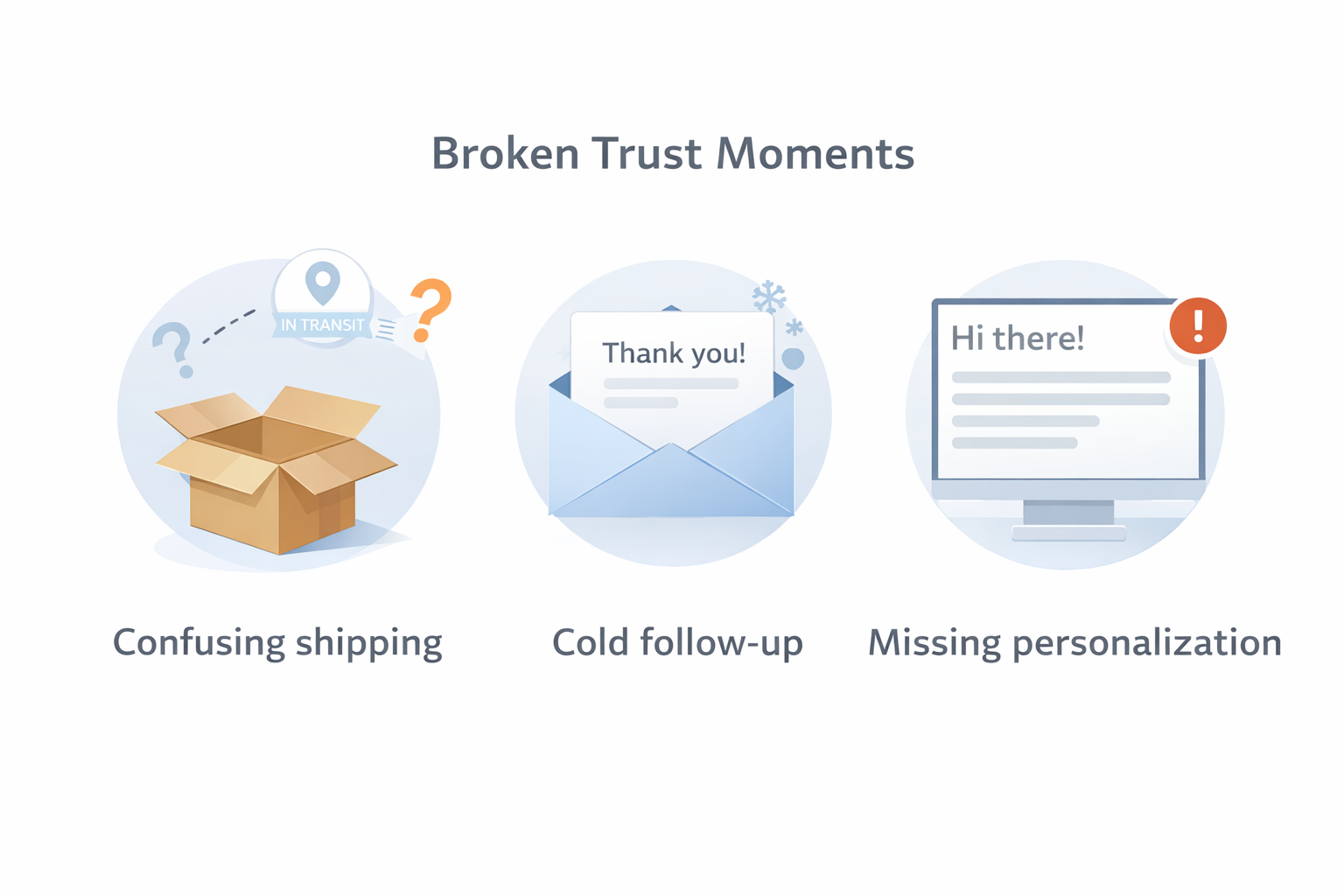
Poor post-purchase experience kills momentum
You’ve won the first sale — but then what? Too many brands treat that first purchase as the finish line. What happens next should deepen trust, not leave customers in the dark.
-
Confusing shipping updates, or none at all, create uncertainty.
-
Generic thank-you messages miss the chance to build brand affinity.
-
Lack of support around product use or setup increases return risk.
Think of this period as your "second conversion window." You're not selling again yet — you're earning the right to.
For common mistakes in this stage, see Why E-Commerce Campaigns Fail Without a Post-Purchase Retargeting Plan.
Offers that punish loyalty
If all your best discounts target new customers, returning ones feel penalized. You train users to shop once and churn — or worse, to keep creating new email addresses to chase signup offers.
Instead, give loyal customers reasons to come back that feel earned, not discounted:
-
Personalized restock timing based on order behavior;
-
Bundled recommendations based on past purchases;
-
Early access to limited drops or new collections.
Retention isn’t just about emails and coupons. It’s about making customers feel that buying again is the obvious, low-friction next step.
How to build a retention-first e-commerce system
Retention doesn't require complex tech stacks or big loyalty programs. It requires clarity, consistency, and systems that make it easier for customers to return.
Start with three foundational strategies that you can implement using Meta Ads + your owned channels.
Automate a strategic post-purchase journey
Most brands automate some post-purchase emails. But few build a journey designed to drive second and third purchases. Here’s a proven 3-step sequence:
-
Confirmation and expectation-setting
Send more than just a receipt. Use the confirmation to reinforce purchase value, estimated delivery, and how to get help if needed. -
Product education and onboarding
Especially useful for consumables, skincare, supplements, and apparel. Send a short series of how-tos, styling tips, or FAQs to increase satisfaction and reduce returns. -
Time-sensitive follow-up
Once the product has arrived and had time to make an impact, follow up with a relevant cross-sell, bundle offer, or reorder reminder.
A great post-purchase journey feels like a concierge — not a campaign. Consider pairing it with post-purchase ads designed for LTV.
Segment and personalize your paid retargeting
Many brands run one broad retargeting ad that says “come back.” But not all return customers behave the same. Your Meta strategy should reflect that.
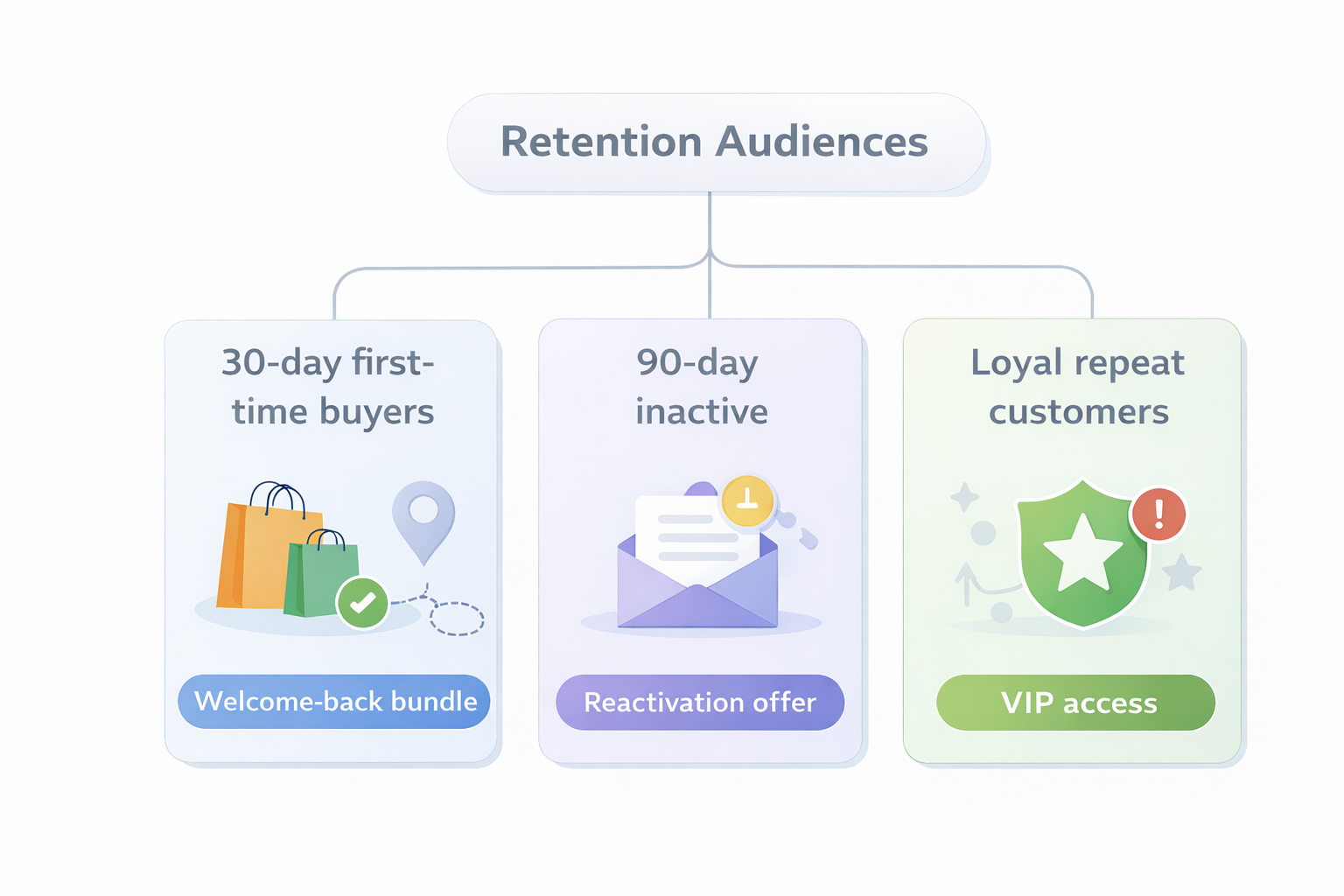
Break down your audiences by:
-
First-time buyers in the last 30 days (test “welcome back” bundles);
-
Inactive customers from 60–180 days (remind them of bestsellers or refreshed inventory);
-
Power users with 3+ purchases (incentivize referrals or VIP access).
Use tailored creative that speaks to where they are in their lifecycle — not just who they are demographically. For tips, see Facebook Ad Targeting for Repeat Purchases.
Track retention metrics that actually guide decisions
Looking at CPA and AOV alone hides your most profitable customer groups. Instead, track performance using cohort-based metrics. These give you a clearer picture of how retention behaves over time.
Key metrics to monitor:
-
Repeat purchase rate at 30, 60, and 90 days;
-
Time between orders for different product types;
-
Customer LTV by acquisition source (e.g., Meta vs. Google).
These insights help you invest in campaigns that not only convert — but convert the right kind of customers.
For deeper LTV analysis and retention frameworks, check Retention First: The New Growth Lever for Paid Social.
Retention isn’t a tactic. It’s how you make growth compound.
Most ad accounts are built to chase short-term revenue. But ads that convert one-time buyers only create temporary scale. The goal isn’t just to acquire more — it’s to acquire better, and then maximize the value of every customer.
Retention changes your economics:
-
Higher ROAS without increasing spend;
-
More stable performance during seasonal shifts;
-
A stronger brand ecosystem that doesn’t depend solely on paid media.
When retention is strong, acquisition gets easier. When it’s weak, no amount of optimization will save your funnel.