Interactive stickers can make Stories feel more active.
Polls, quizzes, sliders, countdowns, and question boxes invite users to tap. That can help organic engagement. But the same elements can create problems when the Story becomes an ad.
This matters because advertisers often boost Stories after they see strong organic response. A Story gets taps, replies, or profile visits, so the team assumes it is ready for paid spend. Then Meta blocks or rejects the promotion.
Core problem: Interactive stickers create actions that may not work in boosted Stories
Organic Stories and boosted Stories do not behave the same way.
Organic content can use native interaction tools freely. Paid promotion is more restricted because Meta needs the Story to work as an ad unit. Some stickers may not transfer, and some can trigger promotion issues.
The risky elements usually include:
- Poll stickers: They invite taps, but boosted Stories may not support them in the same way.
- Question stickers: They rely on replies instead of a clean ad conversion path.
- Sliders: They create engagement, but not necessarily buyer intent.
- Countdowns: They may not carry over cleanly into the paid version.
- Link stickers: These should usually be replaced with the ad CTA button.
The problem is not that interaction is bad. The problem is that the interaction layer can break the paid version.
Solution: Turn the interaction into a clear ad message
Do not build the paid Story around the sticker.
Instead, use the sticker idea as the creative angle. Then rebuild it as a normal ad-safe Story.
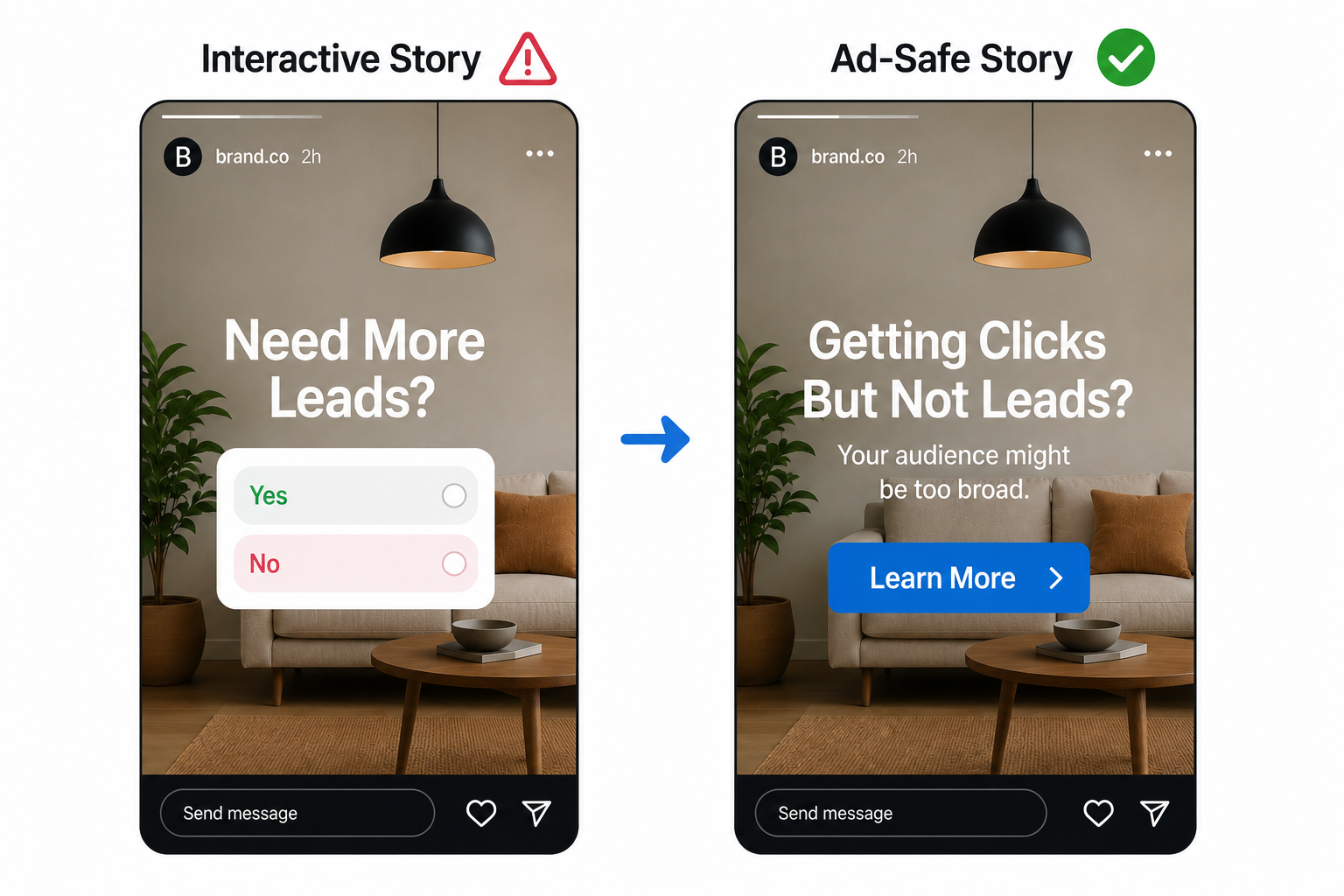
For example, a poll asking “Need more leads?” can become a direct message: “If your ads get clicks but few leads, your audience may be too broad.” The CTA can then send users to a landing page, lead form, or consultation flow.
A good replacement keeps the same intent but removes the technical risk.
You can use this structure:
- Poll idea: Turn the two choices into a comparison.
- Question sticker: Turn the question into a headline.
- Slider: Turn the scale into a visual problem level.
- Countdown: Turn the deadline into plain text inside the creative.
- Quiz: Turn the correct answer into the main takeaway.
This keeps the Story engaging without depending on interactive stickers.
For lead campaigns, it helps to design Instagram Story ads for form submissions. A form-focused Story needs clarity more than casual taps.
Why sticker engagement can hurt performance signals
Sticker taps can look useful, but they are not always strong intent.
A user may tap a poll because it is easy. That does not mean they want to buy, book, or request a quote. If your campaign trains around weak engagement, Meta may find more people who interact casually but do not convert.
This can create a familiar problem:
- The Story gets cheap engagement.
- The campaign looks active.
- Clicks or leads stay weak.
- CPA increases once the campaign needs real conversions.
For performance marketers, this is dangerous because the top-line numbers can look fine. The campaign may get views and taps, but the sales pipeline does not improve.
That is why advertisers should protect lead quality instead of chasing cheap engagement.
Real-world example: The poll that worked organically but failed as an ad
A local gym posts a Story with a poll: “Want a free trial?” The options are “Yes” and “Tell me more.”
The Story gets strong organic taps. The team boosts it, expecting cheap leads. But the poll creates promotion issues, and the boosted version does not launch.
The better version is simple. The ad says: “Try the gym for 7 days before choosing a membership.” The CTA sends users to a trial sign-up page.
The message stays the same. The interaction becomes an ad-safe conversion path.
When interactive ads still make sense
Interactive ads can work when they are planned correctly.
The mistake is using organic stickers first and trying to force them into boosted ads later. If you want polls, quizzes, or interactive experiences, build them through the right ad setup from the start.
This is where it helps to separate two goals:
- Organic interaction: Useful for replies, comments, and audience feedback.
- Paid conversion: Better for clicks, leads, purchases, and measurable funnel movement.
If your goal is engagement, interactive formats may help. If your goal is CPA or ROAS, the Story must lead users toward a clear next step. Review when polls and quizzes help engagement before using them in a paid strategy.
Final takeaway
Interactive Story elements can make organic content stronger, but they can also block or weaken paid promotion.
Before boosting, remove risky stickers and rebuild the Story around a clear ad message. Keep the idea behind the interaction, but let the ad CTA handle the conversion. That gives Meta a cleaner asset and gives your campaign better-quality signals.