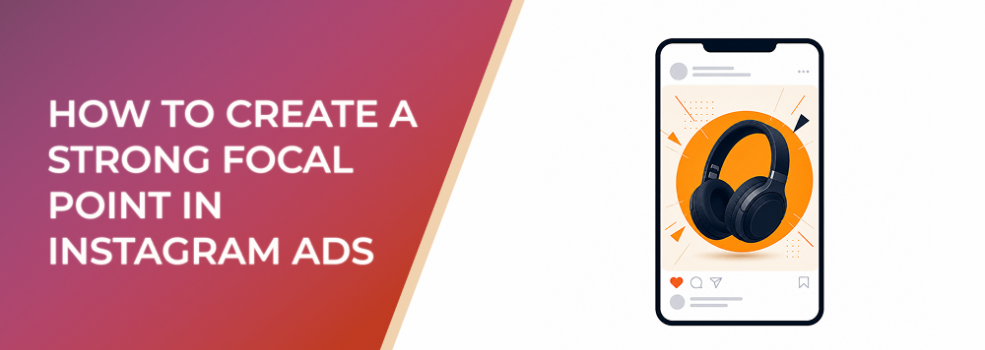
An Instagram ad can look clean and still underperform if users do not know what to look at first.
This is a focal point problem. The product may be visible, but not dominant. The offer may be included, but not obvious. The CTA may be present, but disconnected from the image. The result is an ad that receives impressions without directing attention toward the action that matters.
For performance marketers, agencies, SMB owners, ecommerce teams, startup marketers, affiliate marketers, and B2B lead-generation teams, focal point is not just a design preference. It affects how quickly users understand the ad and whether campaign data reflects real intent.
The Problem
The problem is that many Instagram ads contain important information but lack visual priority.
A focal point tells the viewer where to start. Without it, the ad forces users to scan the image and decide what matters. That slows comprehension.
In a paid social feed, slow comprehension is costly. Users may scroll before they understand the product, problem, offer, or CTA. Even if the ad is visually attractive, it may not guide attention toward the business goal.
A weak focal point can happen in several ways:
- The product is too small.
- The headline is visually weaker than the background.
- The CTA is separated from the main idea.
- The logo is larger than the offer.
- The image has too many similar-sized elements.
- A decorative object attracts more attention than the product.
- The focal point does not match the campaign objective.
The result is an ad that looks finished but does not lead the eye.
Why This Problem Hurts Performance
A weak focal point hurts Instagram ad performance because users cannot quickly identify the reason to engage.
When the main idea is unclear, CTR can drop. CPC can rise because fewer users click with intent. CPA and CAC can increase because the campaign needs more spend to generate qualified actions. ROAS can weaken because the ad does not create enough product or offer desire before the click.
A weak focal point also damages learning quality. If users click for scattered reasons, Meta receives mixed engagement signals. Some people respond to the image style. Others respond to the discount. Others misunderstand the offer. This makes it harder to identify which creative angle is actually working.
For lead-generation campaigns, a weak focal point can reduce lead quality. If the ad does not make the lead magnet, demo, audit, consultation, or outcome obvious, users may click without understanding the value exchange.
Common Scenarios Where This Happens
Ecommerce Product Ads
A product appears inside a lifestyle scene, but the background is more visually interesting than the item being sold. Users notice the mood but miss the product.
SaaS Screenshots
A software ad uses a full dashboard screenshot. The interface is real, but the viewer does not know which feature, workflow, or outcome to notice.
B2B Lead Magnets
A report ad shows the report cover, title, charts, brand logo, author photo, and CTA. The viewer cannot tell whether the focal point is the report, the insight, the author, or the signup action.
Local Service Ads
A home service ad uses a busy before-and-after image, phone number, discount, review badge, and service list. The strongest reason to book gets buried.
Retargeting Ads
A retargeting ad tries to show proof, urgency, objection handling, and product benefits in one image. Returning users need a sharper next step, not another crowded awareness visual.
Why the Problem Happens
Weak focal points usually happen because teams design from the brand’s perspective instead of the viewer’s first glance.
The brand knows what the ad means. The viewer does not.
Creative teams may also treat all information as equally important. The logo, product, benefit, testimonial, discount, and CTA all compete for space. But if everything is important visually, nothing becomes the entry point.
Another cause is unclear campaign intent. A conversion ad, lead magnet ad, awareness ad, and retargeting ad should not all use the same focal point. Each objective requires a different visual center.
For example, an ecommerce conversion ad may need the product as the focal point. A B2B audit ad may need the problem as the focal point. A webinar ad may need the outcome or topic as the focal point. A retargeting ad may need urgency, proof, or next step as the focal point.
The Solution
The solution is to choose one visual anchor before designing the ad.
Start with the campaign objective. Then decide what the viewer must notice first to take the next step.
Use this decision framework:
For Ecommerce
Make the product or product use case the focal point.
The product should be large enough to identify on mobile. Use contrast, spacing, lighting, and crop to separate it from the background. If the product benefit depends on context, show the product in use, but keep the object visually dominant.
For B2B Lead Generation
Make the outcome, problem, or lead magnet the focal point.
A checklist, report, webinar, audit, or demo ad should make the value exchange obvious. Show what the user receives or what business problem the asset helps solve.
For Local Services
Make the result or booking reason the focal point.
If speed matters, highlight same-day availability. If trust matters, lead with a credible proof point. If location matters, make the local relevance visible.
For SaaS
Make one workflow, result, or dashboard insight the focal point.
Do not show the entire platform if the viewer only needs to understand one value moment. Crop or highlight the part of the interface that supports the offer.
For Retargeting
Make the next step the focal point.
Returning users do not always need a broad introduction. They may need proof, urgency, pricing clarity, a limited offer, or reassurance.
After choosing the focal point, build the rest of the image around it. Use size, contrast, spacing, and placement to guide the eye. Supporting elements should explain or reinforce the focal point, not compete with it.
Risks and Considerations
A strong focal point can still fail if it highlights the wrong thing.
For example, making a discount the focal point may increase clicks but attract price-sensitive users who do not convert profitably. Making a logo the focal point may improve recognition but weaken direct response. Making a product image dominant may not work if the audience first needs to understand the problem.
Also be careful with text overlays. Text can strengthen a focal point when it is short and connected to the visual. It weakens the ad when it becomes another competing element.
Review the full funnel. A strong focal point should align with the caption, CTA, landing page, and conversion action. If the image points to one promise and the landing page emphasizes another, users may bounce.
Prerequisites and Dependencies
To create a strong focal point, you need:
- A clear campaign objective.
- A specific audience stage.
- A defined offer.
- One primary message.
- Placement-specific creative dimensions.
- Mobile-first review.
- Brand guidelines that allow hierarchy.
- A matching CTA.
- A landing page that continues the same promise.
- Enough budget to test focal point variations.
- Success metrics beyond likes or surface engagement.
Without these inputs, focal point decisions become subjective.
Practical Recommendations
Before designing the next Instagram ad, write one sentence:
“The viewer should notice ___ first.”
Then evaluate whether the image actually does that.
Create separate variations based on different focal point hypotheses. For example:
- Product-first.
- Problem-first.
- Outcome-first.
- Proof-first.
- Offer-first.
- CTA-first.
Do not change everything at once. Keep the audience, campaign objective, landing page, and budget stable where possible. Test which focal point creates better business behavior.
Review more than CTR. Look at CPC, outbound clicks, landing page views, form starts, qualified leads, purchases, CPA, CAC, ROAS, and conversion rate. The best focal point is not always the one that gets the most attention. It is the one that helps the right users understand the offer and take the next step.
Final Takeaway
A strong focal point makes an Instagram ad easier to understand.
When users know where to look first, they can process the product, offer, problem, or outcome faster. That creates cleaner engagement, stronger click intent, and better campaign learning. Before adding more design elements, choose the one thing that should lead the eye — then make everything else support it.
Related LeadEnforce Articles
- How To Make the Main Offer Stand Out in Instagram Image Ads — Directly relevant to choosing the main visual anchor for image ads.
- Why People Scroll Past Your Instagram Ads Without Noticing the Product — Helpful for diagnosing product visibility and weak focal points.
- Improve Instagram Ad Response With a Clear Offer in the First Visual — Supports the idea of making the primary offer clear in the opening image.
- The Most Common Design Mistakes in Instagram Ads (And How to Avoid Them) — Covers focal point problems as part of broader Instagram ad design mistakes.