Many advertisers search for “winning creatives” the wrong way.
They launch one image ad, one video ad, or one headline variation and judge the entire audience based on that result. If the campaign underperforms, they assume the audience is weak or the offer is not attractive enough.
In reality, the problem is often incomplete testing.
Different audiences respond to different creative formats, visual styles, and messaging angles. A weak-performing image does not necessarily mean the offer is weak. A low-performing video does not automatically mean the audience lacks interest.
Sometimes the audience simply prefers a different way of receiving the message.
This is why comparing images, videos, and copy angles properly becomes one of the fastest ways to improve Facebook ad performance.
The goal is not just finding a “good ad.” The goal is understanding which creative structure produces the strongest audience response.
Problem: Most Facebook Creative Testing Is Too Narrow to Reveal What Actually Works
Many Facebook campaigns test too few creative variables.
Advertisers often launch:
- one static image,
- one video,
- or one copy version,
then optimize the campaign based on those limited results.
That creates shallow performance data.
The campaign may generate clicks, but the advertiser still cannot answer important questions:
- Does the audience prefer visual demonstrations or direct problem statements?
- Do shorter videos perform better than static graphics?
- Does emotional copy outperform practical messaging?
- Are users responding to the visual itself or to the headline?
Without comparison, these patterns stay hidden.
This becomes especially expensive during scaling because Meta starts optimizing around incomplete signals. The algorithm may favor a creative that produces cheap clicks while ignoring another variation that could generate stronger purchases or better lead quality.
For example:
A SaaS advertiser may run only polished UI screenshots with feature-focused copy. CTR remains average, and the advertiser concludes the audience is difficult to convert.
Meanwhile the audience might actually respond much better to:
- workflow breakdown videos,
- problem-focused hooks,
- comparison-style graphics,
- or customer pain-point messaging.
The campaign never discovers those preferences because the testing environment was too narrow.
This is one reason why testing Facebook ad creative properly usually produces stronger long-term performance than constant targeting adjustments.
Solution: Compare Creative Formats and Messaging Angles Systematically
Better Facebook ad creatives usually come from comparison, not inspiration.
The strongest advertisers rarely guess what the audience wants. They create controlled comparisons that reveal behavioral patterns directly inside Ads Manager.
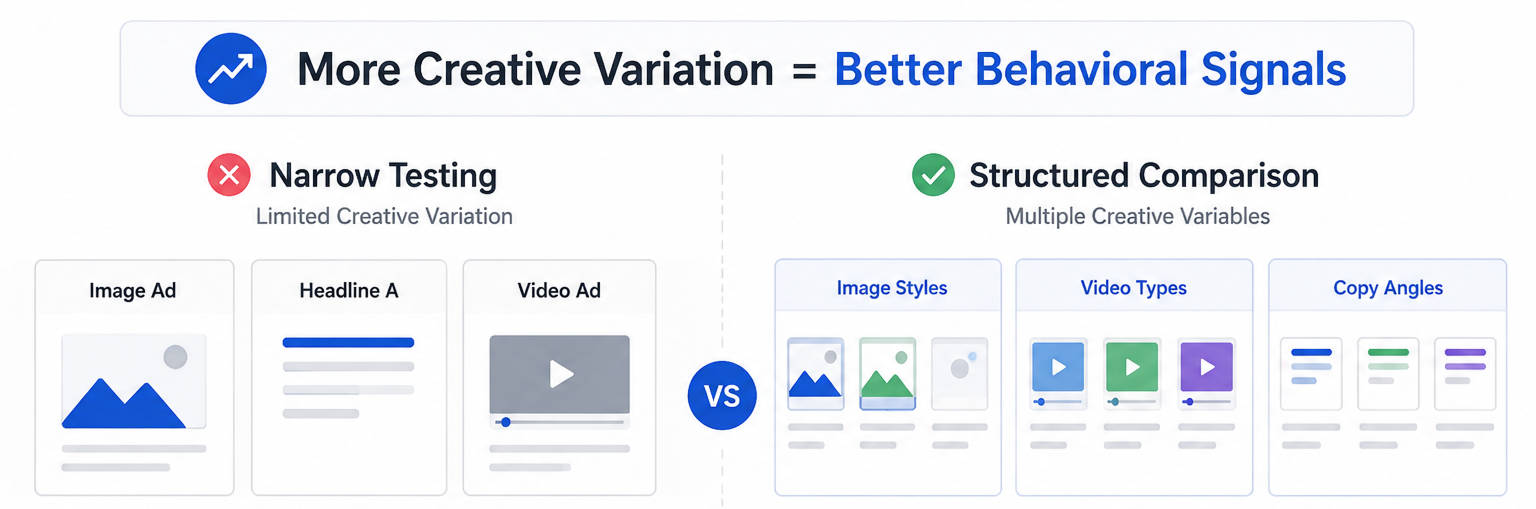
The most useful comparisons usually happen across three areas:
- visual format,
- copy angle,
- and information depth.
Compare Images Against Videos
Images and videos interrupt scrolling differently.
Static images depend heavily on instant clarity. Users process them in less than a second. Videos rely more on movement, pacing, and retention.
This creates very different engagement behavior.
Static images often work better when:
- the offer is easy to understand quickly,
- the audience already knows the problem,
- or the hook is visually strong.
Videos often perform better when:
- the product needs explanation,
- the transformation requires demonstration,
- or the audience needs more context before clicking.
Many advertisers assume videos automatically outperform images because Meta favors video engagement. That is not always true.
Short videos can lower CPM while still producing weak conversion quality. Meanwhile static images sometimes convert better because users process the message faster and with less friction.
This becomes easier to spot when experimenting with different ad formats inside the same campaign structure.
Compare Different Copy Angles Around the Same Offer
Many advertisers change visuals but keep identical messaging across every creative.
That limits learning dramatically.
Different audiences react to different emotional triggers. One group may respond strongly to pain-focused messaging while another reacts better to efficiency or outcome-focused language.
For example, the same Facebook ad offer could use:
- a frustration angle,
- a time-saving angle,
- a cost-reduction angle,
- or a growth-focused angle.
Each one attracts slightly different behavioral patterns.
A practical example:
A lead generation campaign for marketing agencies could test:
- “Your Facebook ads are wasting budget.”
- “Lower CPA without increasing spend.”
- “Fix weak lead quality fast.”
- “Scale Facebook campaigns more predictably.”
The service stays the same. The emotional entry point changes. That difference often affects CTR, lead quality, and conversion intent more than the design itself.
Why Some Creatives Get Clicks but Weak Conversions
One of the biggest advantages of creative comparison is identifying misleading performance signals.
High CTR does not automatically mean strong creative quality.
Some creatives attract attention but generate weak buying intent.
This often happens when:
- hooks create curiosity without qualification,
- videos entertain instead of educating,
- or copy over-promises outcomes too aggressively.
You can usually spot this pattern inside Ads Manager when:
- CTR looks strong,
- CPC stays low,
- but conversion rates remain weak.
That usually means the creative attracts the wrong type of attention.
Comparing multiple angles helps diagnose this faster because the advertiser can see which creatives attract:
- cheap engagement,
- strong purchases,
- higher-quality leads,
- or longer session behavior.
Without comparison, advertisers often scale the wrong ad simply because it generated the cheapest clicks first.
What You Should Actually Compare Inside Facebook Creative Tests
Many advertisers accidentally create chaotic testing environments.
They change audiences, creatives, offers, placements, and landing pages simultaneously. Once results come in, there is no way to identify what actually caused the performance difference.
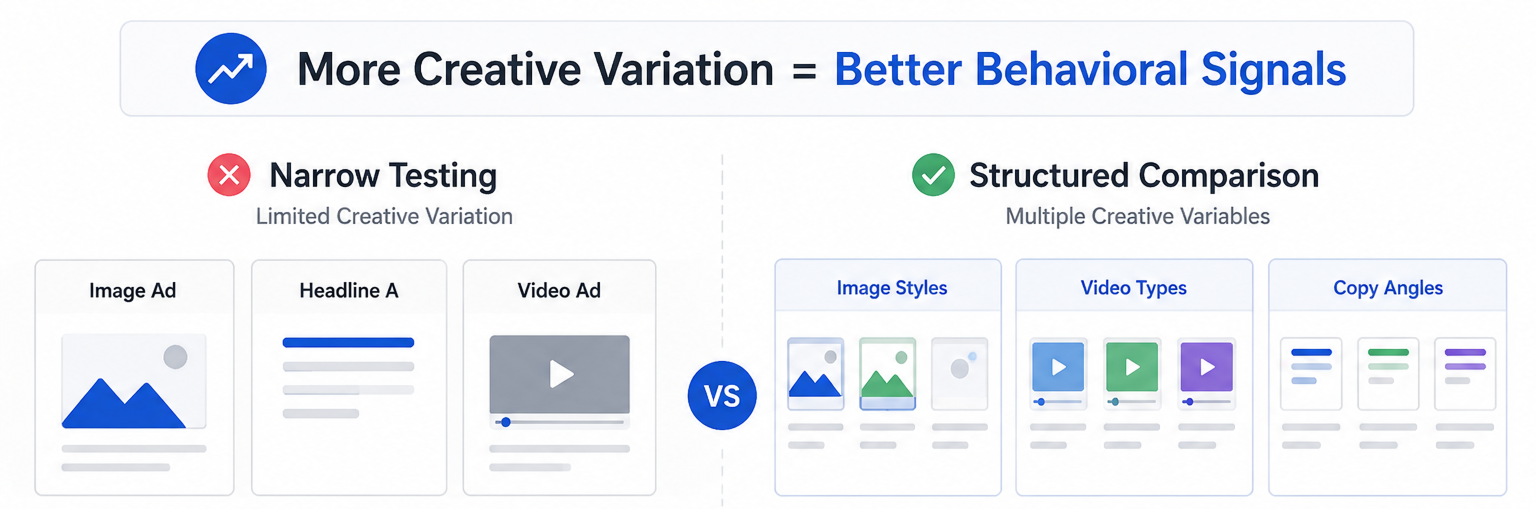
A cleaner structure isolates one major variable at a time.
A practical creative testing framework looks like this:
- Keep the audience stable.
Do not change targeting while testing creative differences. - Keep the offer identical.
Otherwise conversion differences become difficult to interpret. - Compare one major creative variable.
Example: image vs video or pain-focused vs benefit-focused copy. - Watch post-click behavior, not only CTR.
Strong creatives usually improve both click quality and conversion quality. - Remove weak variations gradually.
Avoid resetting the entire campaign too quickly.
This creates much cleaner learning signals inside Meta’s delivery system.
Why Better Creative Usually Comes From Audience Understanding
The best-performing Facebook creatives rarely start with design trends.
They start with audience psychology.
Some audiences want speed and simplicity. Others need detail and explanation before trusting the offer. Some respond better to emotional storytelling while others prefer direct proof and clarity.
Creative comparison helps expose those preferences.
For example:
- ecommerce buyers often react strongly to visual demonstrations,
- B2B buyers usually need more informational depth,
- local service audiences often trust testimonial-style creatives,
- while SaaS users frequently respond better to workflow explanations.
Without testing multiple images, videos, and messaging angles, these differences stay hidden.
That usually leads advertisers to optimize around assumptions instead of actual audience behavior.
Final Takeaway
Better Facebook ad creatives usually come from structured comparison, not random experimentation.
When advertisers compare images, videos, and copy angles systematically, campaigns begin revealing what the audience actually responds to instead of relying on guesses.
That process improves much more than CTR.
It helps identify:
- stronger hooks,
- better conversion drivers,
- higher-quality traffic,
- and more scalable creative structures.
The strongest Facebook advertisers rarely rely on one creative style. They continuously compare formats and messaging angles to understand how different audiences react across placements, buying stages, and engagement patterns.