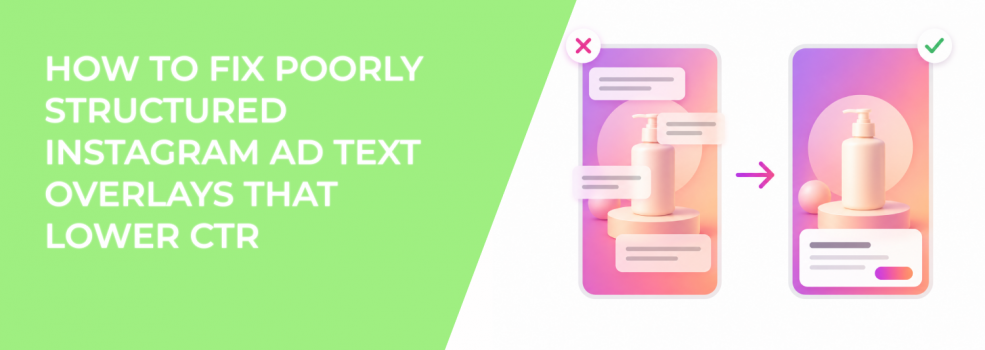
Poorly structured text overlays make Instagram ads harder to scan, harder to understand, and easier to ignore.
Many creatives contain the right information but present it in a way that overwhelms users visually. Headlines compete with secondary text, spacing feels inconsistent, and multiple overlay elements fight for attention at the same time.
The problem is not always the offer itself. Often the layout simply makes the message too difficult to process quickly.
That usually lowers CTR before advertisers even realize the issue comes from structure.
Why poorly structured overlays hurt Instagram ad performance
Instagram users process ads extremely fast. They expect to understand the main message almost immediately.
When overlays feel cluttered or disorganized, several problems appear:
- Users cannot identify the primary message quickly.
- Secondary text competes with the headline.
- The CTA becomes visually weak.
- Reading flow breaks apart across the creative.
A common example is an ecommerce ad containing a discount badge, multiple product labels, several callouts, and oversized CTA graphics all inside the same image.
Instead of creating clarity, the overlay system creates visual noise.
Another common issue appears in lead generation ads where several different value propositions sit inside the same creative without clear hierarchy. Users notice the information but struggle to determine what matters most.
This usually creates weaker click intent even when impressions remain healthy.
For more guidance on keeping creatives readable, review how to maintain clarity when running multiple ads.
How cluttered overlays reduce readability and CTR
Overlay clutter increases cognitive load. Users spend more energy decoding the structure instead of understanding the offer itself.
This often creates measurable campaign problems:
- Lower CTR despite strong reach.
- Higher bounce rates after the click.
- Reduced engagement quality from cold audiences.
- Rising CPA during scaling phases.
Many advertisers try solving this with new audiences or larger budgets. In reality, the layout itself may be slowing message recognition before users even consider clicking.
The issue becomes more visible on mobile because Instagram feed behavior is extremely fast and vertical. Small hierarchy problems become amplified during scrolling.
How to structure Instagram ad overlays for faster comprehension
The best-performing overlay systems simplify aggressively.
Users should instantly recognize:
- The primary message.
- Supporting information.
- The intended action.
Several structural fixes usually improve this quickly:
- Use one dominant headline instead of several competing messages.
- Increase spacing between unrelated text elements.
- Reduce decorative graphics around important copy.
- Create stronger size contrast between primary and secondary text.
Good overlays guide the eye naturally instead of forcing users to search for information.
The article on design mistakes in Instagram ads explains additional layout problems that reduce readability and engagement.
Why structured overlays improve conversion quality
Clear overlay structure improves more than aesthetics. It changes how users process the offer emotionally.
When the message feels easy to understand, users feel more confident clicking through. That usually improves both click quality and downstream conversion behavior.
If the overlay structure feels chaotic, even high-intent users may scroll away before understanding the offer.
For more insight into how layout influences engagement, review how colors and layouts affect CTR.
The strongest Instagram ads are usually the easiest to process. They remove unnecessary overlay complexity, guide attention clearly, and make the core message obvious within the first second of scrolling.