Instagram video ads have become one of the most important creative formats inside Meta's ecosystem. They appear across Reels, Stories, Feed, and Explore, often becoming the first interaction a prospect has with a business.
Yet many advertisers experience the same frustrating pattern. The video receives views, engagement looks acceptable, and delivery remains stable, but conversions never follow. CPC starts climbing, CPA rises, and the campaign struggles to scale profitably.
When this happens, advertisers frequently blame the audience, the offer, or Meta's optimization system. Sometimes those factors contribute. In many cases, however, the problem starts much earlier.
The viewer simply never reaches the part of the video that explains why they should buy.
The Problem: Viewers Leave Before They Understand The Offer
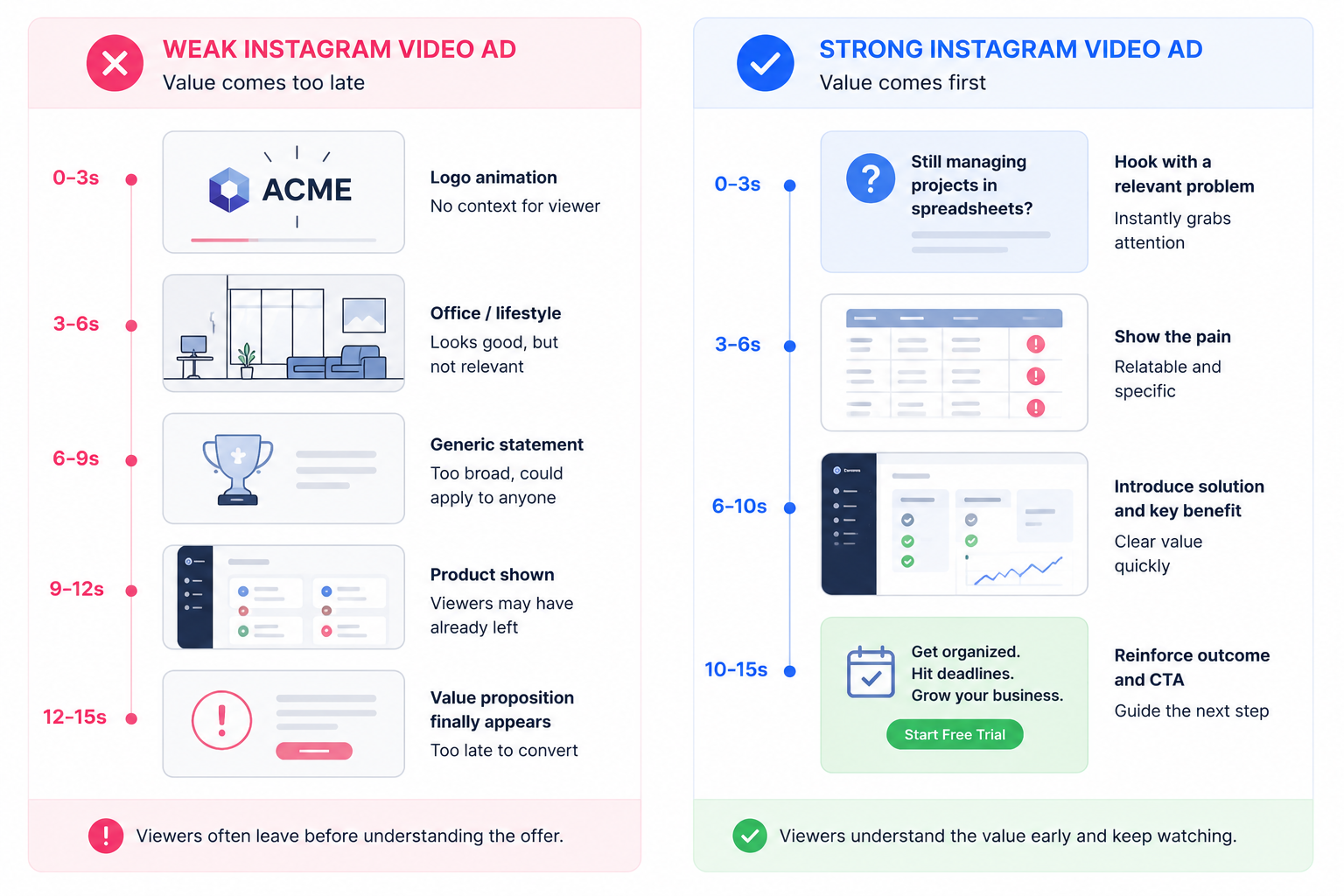
Most weak Instagram video ads suffer from a sequencing problem rather than a creative quality problem.
The visuals may look professional. The editing may be smooth. The production value may exceed competitors. None of that matters if the most important information appears too late.
Instagram users make decisions extremely quickly. As they scroll through a feed filled with content, they continuously evaluate whether something deserves additional attention. This is why advertisers need to earn attention in the first three seconds without wasting that opening on brand filler.
A common mistake is spending the opening seconds on information that does not help the viewer make that decision.
Many advertisers start with:
- Brand introductions.
- Logo animations.
- Generic lifestyle footage.
- Product close-ups without context.
- Broad statements that could apply to anyone.
The problem is that none of these elements explain why the viewer should continue watching. Imagine a local accounting firm promoting tax planning services for small businesses.
The video opens with aerial footage of the office, transitions into the company logo, introduces the firm's history, and only after several seconds explains that business owners may be overpaying taxes.
The campaign loses qualified prospects before reaching the actual value proposition. This problem becomes visible inside Ads Manager.
Advertisers often see:
- Healthy video views but weak outbound CTR.
- High reach with limited landing page traffic.
- Strong engagement metrics but poor lead generation.
- Stable CPM alongside rising CPA.
The platform successfully generates attention. It fails to generate intent.
As a result, Meta receives weaker conversion signals and struggles to identify users who resemble eventual buyers.
The Solution: Structure The Video Around The Buying Decision
Strong Instagram video ads follow the same logic as a strong sales conversation.
The most relevant information appears early.
Instead of introducing the brand first, the video introduces the problem, goal, or opportunity that matters to the audience. This is where scripting short-form video ads becomes useful, because the order of the message matters as much as the visual idea.
The viewer should understand three things almost immediately:
- Who the ad is for.
- What problem it solves.
- Why they should keep watching.
A practical structure often looks like this:
- Lead with the problem or desired outcome.
- Introduce the product or service quickly.
- Demonstrate proof or differentiation.
- End with a clear next action.
Consider the same accounting firm. Rather than opening with company branding, the video starts with: "Most small businesses overpay taxes because they miss these three deductions."
Immediately, the right audience understands the relevance. The service then appears as the solution. The video can show expertise, explain results, and conclude with a consultation offer.
Every scene supports the buying decision instead of delaying it.
This approach often improves campaign efficiency because viewers who continue watching are more likely to have genuine interest in the offer. Meta receives stronger engagement and conversion signals, which can improve optimization over time.
If the same core message needs to run across Feed, Stories, Reels, and Explore, the next step is adapting creative for different placements rather than forcing one version into every environment.
Final Takeaway
Weak Instagram video ads often fail because the offer appears too late.
The campaign may attract attention, but attention alone does not generate conversions. If viewers leave before understanding the value proposition, Meta cannot build the quality signals needed for efficient optimization.
The most effective fix is usually structural rather than visual.
Show the problem early, introduce the solution quickly, and guide viewers toward the next step before they have a chance to scroll away.