Most Facebook campaigns show deterioration signals before CPA actually spikes.
The problem is that many advertisers only react after performance becomes expensive. They watch cost per result, panic when ROAS drops, and start changing campaigns without understanding what shifted earlier inside delivery.
Strong media buyers monitor leading indicators instead.
They look for the signals that usually appear before conversion efficiency collapses. That allows them to correct delivery problems while the campaign is still stable enough to recover cleanly.
Why CTR Alone Usually Misleads Advertisers
CTR is one of the most misunderstood Facebook metrics.
A campaign can produce excellent CTR while attracting weak traffic. This happens frequently when the creative creates curiosity instead of purchase intent.
For example, a flashy ecommerce video may generate a 3% CTR because users want to see the product demonstration. That does not automatically mean those users are likely to buy.
The campaign may still experience:
- falling conversion rate,
- rising CPA,
- weaker add-to-cart quality,
- unstable remarketing performance.
Advertisers who only optimize around clicks usually teach Meta to prioritize cheap engagement instead of qualified traffic.
This is why experienced operators often analyze Facebook ad performance beyond CTR and CPC before making optimization decisions.
Which Signals Usually Predict Performance Decline First
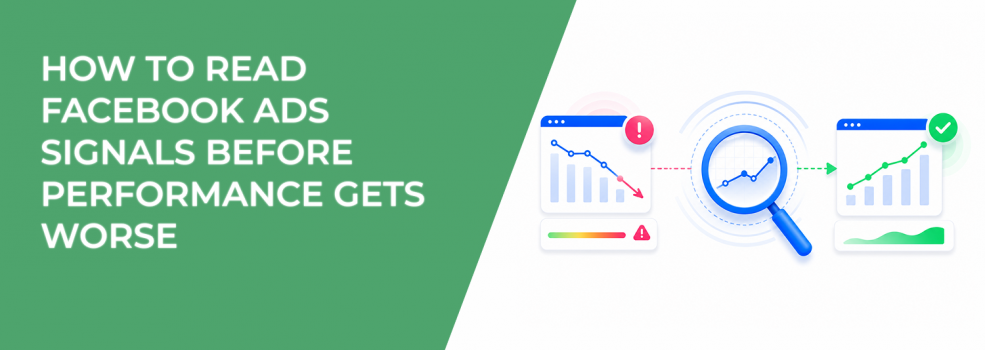
Most campaigns weaken through patterns rather than one catastrophic metric change. Several signals usually shift together before advertisers notice severe efficiency loss.
The most reliable early indicators include:
- Stable CTR with weaker conversion rate. The ad still attracts clicks, but Meta is expanding delivery into lower-intent users.
- Rising frequency with slowing reach growth. The campaign starts recycling impressions into the same audience clusters repeatedly.
- Increasing CPM while engagement stays flat. Audience competition inside the auction becomes more aggressive.
- Higher outbound clicks with shorter landing page engagement. The creative attracts attention, but the offer-message alignment weakens after the click.
These are the same diagnostic patterns discussed in the five ad metrics that actually matter when optimizing campaigns.
The key is understanding how the metrics interact together instead of evaluating them independently.
Why Spend Allocation Often Reveals Problems Earlier Than CPA
One of the most overlooked diagnostics inside Ads Manager is spend concentration.
Meta naturally allocates more budget toward the ad set or creative generating the strongest short-term response signals. That sounds efficient, but the platform does not automatically optimize for long-term profitability.
A campaign may shift 80% of spend into a low-quality ad set simply because the leads appear cheap at the platform level.
This creates a common lead generation problem.
The campaign reports strong CPL, but sales teams reject most leads because the traffic quality deteriorated while Meta kept optimizing for low-cost submissions.
Advertisers should regularly compare:
- spend share by ad set,
- conversion quality,
- CRM feedback,
- downstream sales acceptance.
The platform only sees part of the funnel.
Business outcomes usually reveal deterioration earlier than Ads Manager alone.
Why Signal Reading Matters More During Scaling
Small inefficiencies become expensive during scaling.
A campaign losing 12% efficiency at $150 daily spend may become completely unprofitable at $4,000 daily spend because Meta expands aggressively into weaker audience segments.
This is why predictive monitoring matters most before major budget increases.
Advertisers reviewing early warning signs of underperforming Facebook ads usually catch delivery deterioration before scaling amplifies the problem.
That creates a major competitive advantage. Instead of reacting after CPA doubles, they stabilize the campaign while performance is still recoverable.
Why Audience Quality Makes Signals Easier To Interpret
Broad audiences often create noisy optimization data.
Too many behavioral types interact with the campaign differently, which makes diagnosis harder. One audience segment may respond well while another silently damages conversion efficiency.
LeadEnforce helps advertisers build more focused targeting structures using Facebook groups, Instagram followers, and social profile-based audience segmentation.
That often improves signal clarity because the campaign starts with stronger behavioral consistency. Instead of interpreting mixed-intent traffic patterns, advertisers can evaluate more stable audience behavior across creatives and placements.
For example, a B2B campaign targeting niche founder communities usually produces cleaner optimization signals than a campaign built from broad startup interests layered together randomly.
This makes post-launch decision-making faster and more reliable.
Final Takeaway
Facebook campaigns rarely collapse without warning. The signals usually appear earlier through shifts in frequency, conversion rate, spend concentration, audience responsiveness, and traffic quality.
Advertisers who understand these patterns optimize proactively instead of reactively.
The goal is not monitoring more metrics. The goal is identifying which signals actually predict future performance deterioration before CPA and ROAS fully break down.