Facebook ads are often ignored before users consciously decide to ignore them.
The creative appears in the feed, blends into surrounding content, and disappears under the next thumb movement. The user may not dislike the ad. They simply do not process it long enough to understand why it matters.
That is a serious performance problem. If users do not notice the ad, Meta receives weak engagement signals. CTR drops, CPC can rise, and the campaign has fewer meaningful actions to learn from.
The solution is not always louder creative. Often, it is simpler creative that makes one idea easier to see, understand, and act on.
Problem: Users ignore ads when the creative asks for too much attention
Most users are not scrolling Facebook with full focus.
They are moving quickly through posts, comments, videos, updates, and recommendations. Your ad has to compete with all of that. If the creative contains too many details, the user has to slow down to understand it.
Most will not.
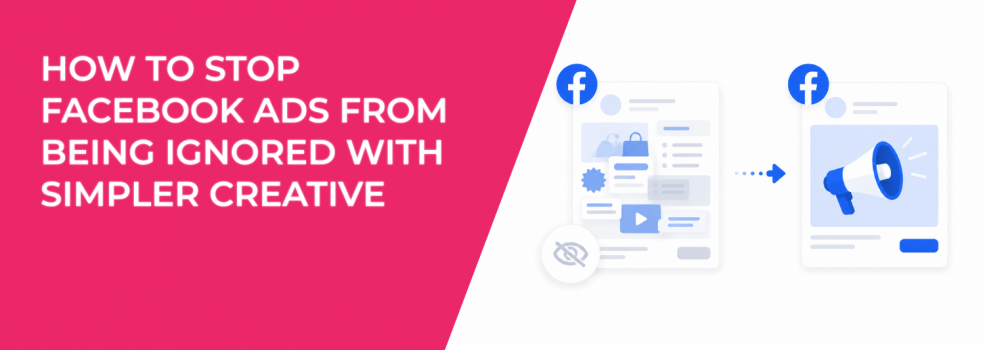
This is why complex creative can underperform even when the offer is strong. A busy ad may include a polished product image, long headline, badge, testimonial, feature list, discount, and CTA. Each element may be useful, but together they create too much processing work.
In Ads Manager, this often shows up as low CTR, weak engagement, short video watch time, or higher CPC. The ad is being delivered, but it is not earning enough attention to create useful action.
That is the core issue behind why audiences ignore ads. Users do not respond to what they do not notice or understand quickly.
Solution: Simplify the creative around one clear idea
A simpler Facebook ad starts with one decision: what should the user understand first?
That one idea should control the visual, hook, supporting detail, and CTA. If the ad is about wasted ad spend, every element should make that problem easier to recognize. If the ad is about better lead quality, the creative should not also try to explain every feature, proof point, and pricing angle.
This is where many ignored ads become easier to fix. You do not need to redesign everything. You need to remove anything that slows down the first impression.
Start by giving the ad one clear job:
- Show the problem. This works well when users already feel the pain, such as rising CPA, weak leads, or poor conversion rates.
- Show the contrast. A simple before/after or old way/new way frame can stop the scroll without adding clutter.
- Show the product in context. This works when the product is easy to understand visually.
- Show one proof point. Use this when trust is the main barrier, but keep the proof tied to the core message.
Once the job is clear, the creative becomes easier to edit.
A simple ad usually needs one focal point, one short hook, one supporting detail, and one CTA. The focal point tells the user where to look. The hook explains why it matters. The supporting detail makes the claim more believable. The CTA gives the next step.
Anything beyond that needs to earn its place.
For example, a SaaS ad promoting better lead quality does not need a dashboard screenshot, three icons, a testimonial, a “limited spots” badge, and two CTA buttons in the same frame. A stronger version might show one simple contrast: “100 form fills” versus “8 sales-ready leads.” The user understands the issue before they scroll past.
This is why why basic Facebook ads often win is not just a design argument. Simple ads often win because they reduce the effort required to understand the offer.
Simplicity also helps with native feed behavior. Highly polished creative can sometimes look like a brand poster, especially when it uses generic lifestyle shots, smooth gradients, broad slogans, and stock-style visuals. Users recognize it as an ad and move on.
A cleaner screenshot, direct comparison, product-in-use frame, or plain visual metaphor can feel more useful. The point is not to make the ad look unfinished. The point is to make it look easy to process.
This is closely tied to what makes people stop on ads. People stop when the ad gives them a fast, recognizable reason to care.
The hook should also stay specific. “Grow your business faster” is easy to ignore because it could apply to almost anything. “Stop paying for leads your sales team never calls” is harder to ignore because it names a real campaign problem.
Specific hooks filter attention. The wrong users keep scrolling; the right users understand the relevance faster.
Before launching, test the simplified version against the polished or more detailed version. Keep the offer, audience, and CTA consistent so the result is easier to read. Compare CTR, CPC, landing page conversion rate, CPL, CPA, ROAS, and lead quality.
If the simpler version gets fewer clicks but better conversion quality, it may still be the stronger ad. If it improves both CTR and downstream results, the original version was probably being ignored because it was too hard to process.
Audience relevance also matters. Simple creative works best when the audience already recognizes the problem. If targeting is too broad, the ad has to explain more and filter harder.
For example, an ad about lead quality can be much more direct when shown to agency owners, niche service providers, or people connected to relevant business communities. The ad does not need to explain the entire category. It can focus on the pain point and next step.
Final takeaway
Facebook ads are ignored when users cannot quickly see why they matter.
That does not always mean the creative needs more movement, more text, more proof, or more design. In many cases, the fix is to remove friction and make one idea easier to process.
Give the ad one job. Make the focal point obvious. Use a short hook. Add only the detail that supports the main message. Test simple versions against polished ones, and judge performance beyond CTR.
The goal is not to make ads basic. It is to make them easier to notice before the user scrolls past.