Instagram ads rarely collapse overnight.
Most campaigns slowly lose efficiency. CTR declines. Frequency rises. CPM becomes unstable. Then CPA suddenly spikes even though the campaign setup stayed the same.
This usually happens because advertisers stop testing once performance becomes “good enough.”
Instagram campaigns are not static systems. Audience behavior changes constantly. Competitors refresh creatives. Meta’s algorithm shifts delivery toward newer engagement signals.
Without continuous testing, campaigns eventually stall.
Why Instagram Ads Lose Performance Over Time
A campaign that performs well during week one can behave very differently by week four.
Meta gradually exhausts the strongest engagement pockets inside an audience. The same users begin seeing the ad repeatedly, especially in smaller targeting pools.
At the same time, the creative generates weaker engagement signals:
- Fewer saves and shares.
- Lower outbound CTR.
- Rising frequency with flat conversions.
You can often see this pattern before ROAS drops hard.
One common mistake is waiting until CPA doubles before making changes. By then, the campaign already lost delivery momentum.
This is why experienced advertisers continuously test small variations instead of running the same setup for months unchanged.
Most Advertisers Reset Campaigns Instead of Improving Them
When Instagram ads weaken, many advertisers overreact. They duplicate campaigns, replace all creatives, change audiences, and aggressively increase or cut budgets.
Large edits often reset optimization behavior and create unstable delivery.
A better approach is controlled iteration.
Instead of rebuilding campaigns completely, strong advertisers test one variable at a time:
- New hooks.
- Different opening frames.
- Updated CTAs.
- Alternative audience segments.
- Placement-specific creative versions.
This creates fresh engagement signals without destroying campaign stability.
If you need a cleaner structure for this process, this beginner’s guide to creative testing explains how to run manageable tests without fragmenting spend.
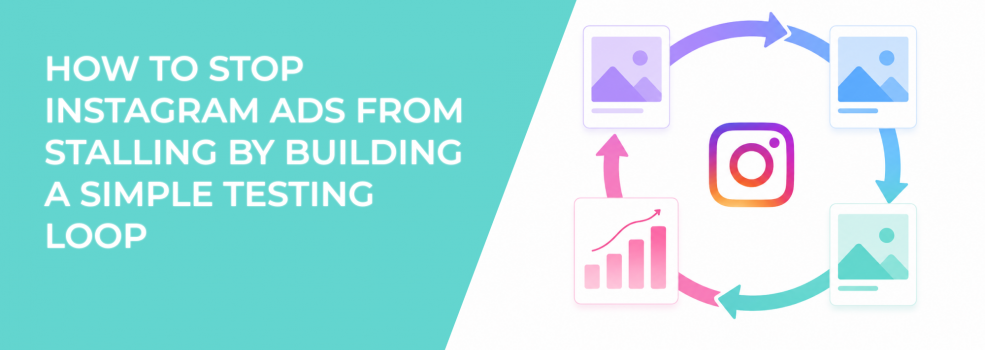
The Simple Testing Loop That Keeps Campaigns Improving
Most Instagram advertisers do not need complicated experimentation systems.
A simple loop usually works better:
- Watch directional patterns, not daily fluctuations.
Rising frequency combined with falling CTR usually signals creative fatigue early. - Isolate one variable per test.
Testing multiple changes simultaneously makes results difficult to interpret. - Launch small variations beside stable winners.
Incremental changes preserve optimization history while generating new learning signals. - Feed winning insights into future creatives.
The goal is not finding one perfect ad. The goal is building repeatable learning cycles.
This process helps campaigns adapt continuously instead of collapsing every few weeks.
A more advanced version of this system is explained in build a learning loop that keeps ads improving.
Why Audience Quality Affects Testing Accuracy
Creative testing becomes unreliable when audience quality constantly changes.
One ad may receive colder traffic while another reaches stronger engagement clusters. Results then become difficult to compare fairly.
This is why many advertisers now combine testing with higher-intent audience segmentation.
Instead of relying entirely on broad targeting, they test creatives against:
- Instagram engagers,
- niche creator followers,
- competitor-adjacent audiences,
- warm engagement pools.
LeadEnforce helps advertisers build these high-intent audience segments using Instagram followers, engagers, and social audience data. That often creates cleaner testing conditions and more stable optimization signals.
Most Instagram Metrics Don’t Tell the Full Story
Many advertisers optimize around CTR alone.
That creates misleading decisions.
Some creatives generate cheap clicks but weak conversion intent. Others produce lower CTR but stronger lead quality and lower CAC over time.
Instagram advertisers should evaluate:
- Outbound CTR.
- Landing page engagement.
- Cost per qualified lead.
- Conversion rate.
- Sales quality.
This is where learning how to analyze Instagram ads performance and turn insights into action becomes more useful than watching surface-level engagement metrics alone.
Final Takeaway
Instagram ads stall when campaigns stop evolving. Creative fatigue, repetitive delivery, and outdated engagement signals slowly weaken performance until costs rise sharply.
A simple testing loop prevents that decline. The advertisers who maintain stronger ROAS over time are usually not launching more campaigns.
They are learning faster from the campaigns already running.