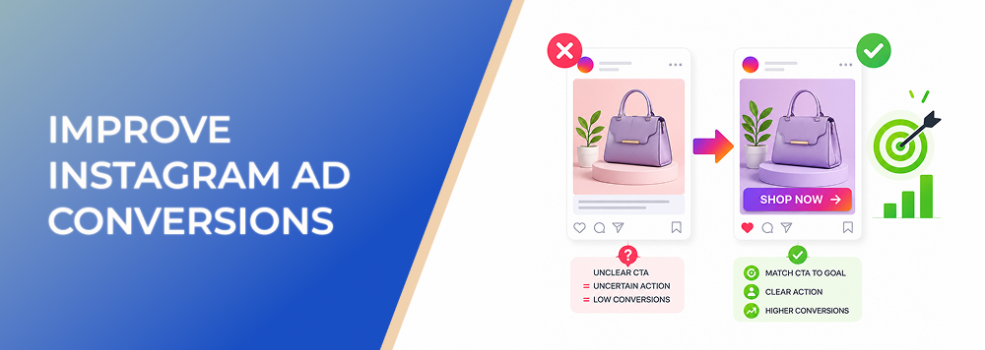
Instagram ad conversions often fall apart when the CTA asks for the wrong action.
The ad may have a good offer and relevant creative, but the CTA does not match what the campaign actually needs the viewer to do.
This mismatch creates mixed signals. The platform, the viewer, the creative, and the destination are not all pushing toward the same outcome.
Meta’s guidance emphasizes choosing an Instagram ad objective that aligns with the business goal, and CTA buttons are designed to encourage a specific action from the person viewing the ad.
The Problem
The problem is CTA-action mismatch.
This happens when the CTA language, campaign objective, user readiness, and destination do not point to the same behavior.
For example:
The campaign wants leads, but the CTA says “Learn more.”
The campaign wants sales, but the CTA sends users to a broad educational page.
The campaign wants demo bookings, but the CTA suggests a self-serve signup.
The campaign wants messages, but the creative tells users to visit the website.
These mismatches create friction because the viewer does not receive a consistent instruction.
Why This Problem Hurts Performance
A mismatched CTA can damage conversion performance even when the rest of the ad is strong.
It may reduce conversion rate because users arrive at the wrong destination with the wrong expectation. It may increase CPA because the campaign attracts clicks that do not match the desired action. It may weaken ROAS because purchase-intent users are sent into a soft education path instead of a buying path.
For lead generation, mismatched CTAs can reduce lead quality. A soft CTA may produce more cheap leads, but those leads may not be ready for sales follow-up.
For agencies, CTA mismatch also makes reporting harder. If performance drops, it is difficult to know whether the issue is creative, audience, offer, objective, or destination because the campaign is not structurally aligned.
Common Scenarios Where This Happens
A SaaS company wants demo requests but uses “Start now,” making users expect immediate product access instead of a sales-assisted demo.
An ecommerce brand wants purchases but uses “Learn more,” sending users into passive browsing mode when the ad could have pushed product evaluation.
A local contractor wants quote requests but uses “Contact us,” which is less specific than “Request your estimate.”
A B2B team promotes a gated guide but uses “Book a call.” The audience may be interested in the content, but not ready for a sales conversation.
A startup wants trial signups but sends users to a homepage with multiple competing paths.
Why the Problem Happens
CTA mismatch usually happens when campaign setup is treated as a sequence of isolated tasks.
One person chooses the objective. Another writes the copy. Another builds the landing page. Another selects the CTA button. If there is no shared definition of the desired action, each part of the campaign can point in a slightly different direction.
Another cause is defaulting to familiar CTA language. “Learn more” may feel safe. “Get started” may feel flexible. But flexible CTAs can become unclear if they do not match the exact conversion path.
The problem also happens when teams avoid deciding how much intent they want. A campaign cannot simultaneously optimize for low-friction education and high-intent sales action without tradeoffs.
The Solution
The solution is to choose the desired action first, then match every CTA decision to it.
Start with this question:
“What user action would make this ad successful?”
Then choose the CTA based on that action.
If the desired action is a purchase, use a CTA such as:
“Shop now.”
“Shop the collection.”
“Buy the bundle.”
“Claim the offer.”
If the desired action is a lead, use:
“Request a quote.”
“Book a consultation.”
“Get the pricing guide.”
“Download the checklist.”
If the desired action is product evaluation, use:
“Watch the demo.”
“Compare plans.”
“See how it works.”
“View product details.”
If the desired action is conversation, use:
“Message us.”
“Ask about availability.”
“Talk to an advisor.”
The campaign objective, CTA button, caption, creative, and destination should all reinforce that same action.
Risks and Considerations
A more action-matched CTA does not always mean a harder CTA.
If the audience is cold, jumping straight to “Buy now” may reduce response. If the audience is warm, staying with “Learn more” may underuse intent.
Match the CTA to both the business goal and the user’s readiness.
Also evaluate the destination. A perfectly matched CTA will still fail if the landing page is slow, confusing, or inconsistent with the ad promise.
Be careful when comparing CTA tests. One CTA may generate more clicks while another generates fewer but better conversions. The better CTA is the one that improves business outcomes, not necessarily engagement volume.
Prerequisites and Dependencies
You need a clear campaign objective and one primary conversion action.
You also need to understand the audience stage. Cold users may need education or proof. Warm users may need comparison or reassurance. Hot users may need a direct purchase, booking, or quote path.
The destination must support the CTA. A “Book now” CTA needs a booking flow. A “Download” CTA needs a download page. A “Shop now” CTA needs a product or collection page.
Tracking should capture the desired action, not only surface metrics. Measure purchases, qualified leads, booked calls, completed forms, registrations, and revenue where applicable.
Practical Recommendations
Create a simple CTA alignment table before launch.
Include four columns:
Campaign goal.
Desired user action.
CTA language.
Destination.
For example:
Lead generation | Request pricing | “Get the pricing guide” | Pricing guide landing page.
Sales | Buy product | “Shop the bundle” | Product bundle page.
Evaluation | Watch demo | “See the product in action” | Demo page.
Local service | Book appointment | “Reserve your appointment” | Booking page.
Use this table to catch mismatches before spend begins.
When optimizing, review whether the CTA is attracting the right action. If clicks are high but conversions are weak, the CTA may be too soft, too broad, or misaligned with the destination.
Final Takeaway
Instagram ad conversions improve when the CTA matches the action the campaign actually needs.
Do not choose CTA language in isolation. Choose the desired action first, then align the objective, creative, button, caption, and destination around that action. A matched CTA makes the path clearer for users and the performance data cleaner for marketers.
Related LeadEnforce Articles
- How to Add a CTA Button in Meta Ads Manager (Step-by-Step + Tips) — Directly relevant for understanding CTA setup and campaign logic.
- Improve Instagram Ads Engagement by Sending Users to the Right Place — Useful for aligning the CTA with the post-click destination.
- How to Analyze Instagram Ads Performance and Turn Insights into Action — Helps interpret whether CTA changes improve performance.
- What to Do Before Launching Your First Instagram Ad: A Practical Checklist — Supports pre-launch alignment between objective, creative, landing page, and CTA.