Marketing Mix Modeling (MMM) is a statistical method that quantifies how different marketing channels and external factors influence sales or conversions. It helps teams see what truly drives performance—beyond attribution limitations—and offers a future-facing lens for budget planning.
MMM uses historical data and regression-based models to estimate the incremental contribution of each channel. The result: clarity on what works, what doesn’t, and how to invest the next dollar.
Why MMM Matters Now
With rising data privacy restrictions and increasingly fragmented user journeys, relying solely on platform attribution or pixel-based tracking creates blind spots. MMM steps in to give a holistic, privacy-resilient view of performance.
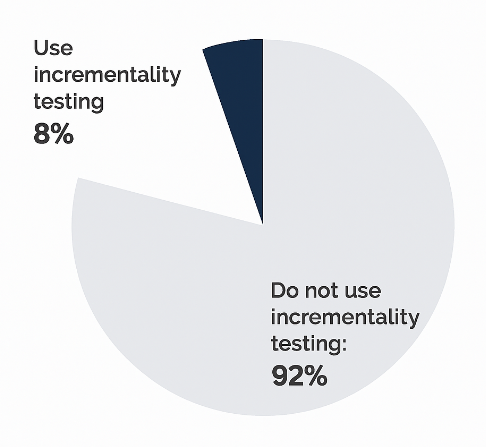
Only 8% of marketers rely on incrementality testing — the vast majority remain dependent on attribution or no causal measurement
Relevant statistics increasingly show its value:
-
Brands using MMM as part of quarterly planning observe up to 15–30% stronger budget efficiency.
-
Cross-channel models reveal that 10–40% of attributed conversions on individual platforms are often overstated by last-click tracking.
The Core Components of an MMM Toolkit
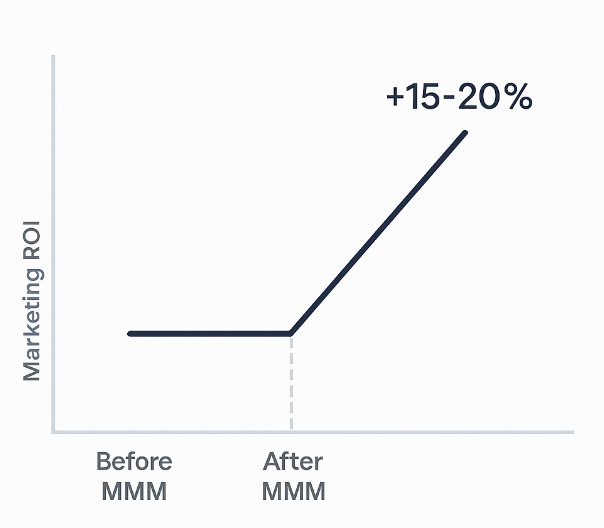
Typical uplift in marketing ROI after reallocation of spend based on MMM insights: +15–20%
1. Clean, Structured Historical Data
MMM relies on at least 1–3 years of data. This includes:
-
Spend by channel (paid social, paid search, display, email, offline media)
-
Revenue, conversions, or leads
-
External factors such as seasonality, promotions, pricing changes, or macroeconomic trends
Data quality is the single biggest determinant of model accuracy. Missing, noisy, or inconsistent records significantly weaken predictive power.
2. Regression Modeling Framework
MMM typically uses multivariate regression to estimate how each input contributes to the output. You’ll need to prepare:
-
Variables for ad spend
-
Controls for external effects
-
Adstock parameters (for estimating how long advertising impact lasts)
-
Diminishing returns functions
A helpful early heuristic: diminishing returns curves often show that the first 30–50% of spend delivers disproportionate impact, with marginal efficiency decreasing afterward.
3. Adstock and Lag Effects
Advertising doesn't only affect the day it runs. Adstock models quantify the "memory" of marketing.
-
For many digital channels, decay rates fall between 30–60% week over week.
-
For brand channels, such as video or TV, impact can persist for 6–12+ weeks.
Understanding lag helps avoid misallocating credit to short-term performers.
4. Scenario Planning and Budget Simulation
Once the model is trained, you can simulate:
-
Increasing or decreasing spend by channel
-
Introducing new channels
-
Planning seasonal campaigns
Early simulations often uncover that 10–25% of budgets can be reallocated without hurting performance—and often increasing total conversions.
5. Model Validation and Iteration
MMM is not a once-a-year exercise. Validate using:
-
Holdout periods
-
Cross-validation
-
Performance drift monitoring
A strong model should maintain 70–90% accuracy on out-of-sample predictions.
Starter Workflow for Marketing Teams
Follow this lightweight roadmap to get started:
-
Consolidate 12–36 months of spend, sales, and operational data.
-
Normalize spend across campaigns and channels.
-
Build a baseline regression model.
-
Introduce adstock and saturation parameters.
-
Run budget optimization simulations.
-
Refresh data monthly or quarterly.