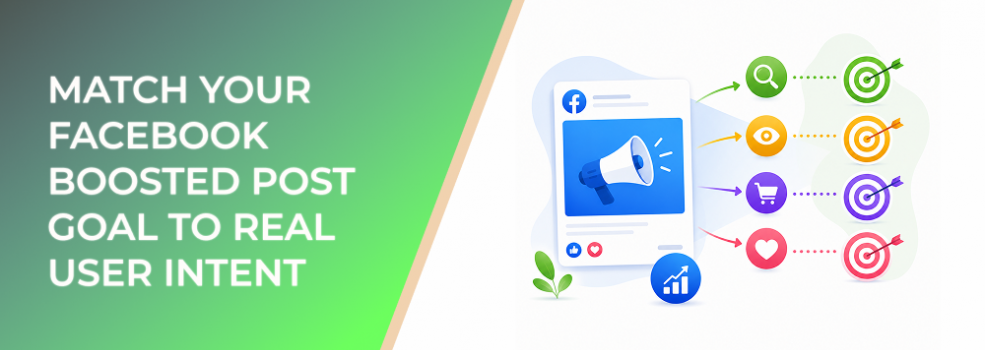
A boosted post does not fail only because the creative is weak or the audience is broad. Many boosted posts fail because the selected goal does not match the real intent the advertiser needs.
This matters because the goal influences delivery. Meta’s performance-goal guidance describes the selected goal as an instruction to the delivery system about which result to pursue efficiently.
So if the goal is matched to the wrong intent, the campaign may optimize exactly as instructed while still missing the business outcome.
The Problem
The problem is optimizing Facebook boosted posts for surface behavior instead of real intent.
A user who likes a post is showing light interest.
A user who clicks may be curious.
A user who asks a pricing question may be closer to commercial intent.
A user who submits a form, books a call, or purchases is showing a deeper action.
These behaviors are not interchangeable.
When advertisers select a goal based on the easiest visible action, they may train the campaign toward low-intent users. The post looks active, but the funnel does not improve.
Why This Problem Hurts Performance
Intent mismatch damages almost every important performance metric.
CPC may look attractive because low-intent users are often cheap to reach or engage.
CPA may rise because the campaign is not finding users likely to complete the action that matters.
CAC may become inefficient because spend is allocated toward shallow behavior.
ROAS may decline because attention does not automatically become revenue.
Lead quality may drop because the campaign attracts users who are willing to interact but not ready to buy, book, or qualify.
The campaign can also create false learning. If you optimize for engagement and then complain that leads are weak, the test did not really test lead intent. It tested engagement intent.
Common Scenarios Where This Happens
A local business wants appointment requests but boosts for engagement because the post already has comments.
A B2B team wants qualified pipeline but promotes a discussion post without a lead-focused CTA.
An ecommerce brand wants purchases but boosts lifestyle content that attracts reactions, not product evaluation.
A startup wants waitlist signups but optimizes for traffic without checking whether visitors are completing the signup path.
An affiliate marketer wants conversions but chooses the goal that creates cheap clicks from broad curiosity.
In each case, the campaign is not necessarily broken. It is optimized toward a lower-intent action than the business needs.
Why the Problem Happens
This happens because marketers often confuse activity with intent.
Engagement is visible. Clicks are easy to count. Messages feel personal. But none of those signals automatically prove purchase readiness or lead quality.
Another cause is funnel-stage confusion. Cold audiences may need awareness. Warm audiences may be ready for traffic or lead capture. Retargeting audiences may be ready for a stronger offer. If the goal ignores funnel stage, delivery can chase the wrong users.
A third cause is weak KPI discipline. If the KPI is not defined before launch, marketers often judge whatever metric looks strongest after the campaign runs.
The Solution
Fix boosted-post optimization by mapping the goal to the user intent you need.
Start with the intent level.
For awareness intent, choose a goal that supports visibility, reach, or broad engagement. The goal is to make the right audience notice the message.
For interaction intent, choose a goal that supports comments, shares, reactions, saves, or profile engagement. The goal is to validate interest or build social proof.
For consideration intent, choose a traffic or message-oriented path only when the post gives users a clear reason to learn more.
For lead intent, the post should include a clear offer, qualification path, and next step. The goal should support lead capture or meaningful conversations, not only activity.
For purchase intent, a boosted post may be too limited unless the post, audience, offer, product page, and measurement path are strong. If revenue is the goal, consider a structured campaign with more control.
Then define the success metric before launch. Do not judge a lead-intent campaign by likes. Do not judge a purchase-intent campaign by CPC alone.
Risks and Considerations
Intent matching requires honesty.
A post may not be ready for the intent level you want. A funny post may be good for engagement but poor for lead generation. A founder update may be good for trust but weak for ecommerce sales. A product post may need stronger proof before it can support purchase intent.
Audience fit also matters. If the campaign reaches people outside the ICP, even the right goal can produce weak results.
Tracking and post-click alignment matter too. If the landing page, form, message flow, or checkout path is poor, intent may disappear after the click.
Prerequisites and Dependencies
Before matching goal to intent, define the funnel stage, target audience, business outcome, and primary KPI.
You also need a post that supports the desired action. The message, creative, CTA, and destination should all make sense together.
For lead-generation teams, that means a qualification process. For ecommerce, it means product clarity and a purchase path. For local businesses, it may mean a booking link, phone call path, or message response workflow.
Practical Recommendations
Use a simple intent check before every boosted post:
Is this post trying to create attention, interaction, consideration, leads, or sales?
Then ask:
Does the selected goal optimize for that level of intent?
Does the post make that action logical?
Does the audience have enough reason to respond?
Does the KPI prove the action mattered?
If the answer is no, change the goal, improve the post, or move the campaign into a fuller setup.
Do not ask an engagement goal to prove sales intent. Do not ask a traffic goal to prove lead quality. Do not ask a boosted post to carry a conversion strategy it was not built to support.
Final Takeaway
Facebook boosted-post optimization works best when the goal matches real user intent.
The issue is not whether engagement, traffic, messages, leads, or sales are “good” goals. The issue is whether the selected goal matches the action your business actually needs. Match intent first, then spend.
Related LeadEnforce Articles
- Match Facebook Boosted Posts to the Right Outcome Before You Spend — Closely aligned with outcome and intent matching.
- Choosing the Right Facebook Ad Objective: What Most Advertisers Get Wrong — Explains how objective choice shapes campaign behavior.
- How to Start a Facebook Ad From Your Page Without Skipping Key Settings — Helps advertisers avoid setup mistakes that distort optimization.