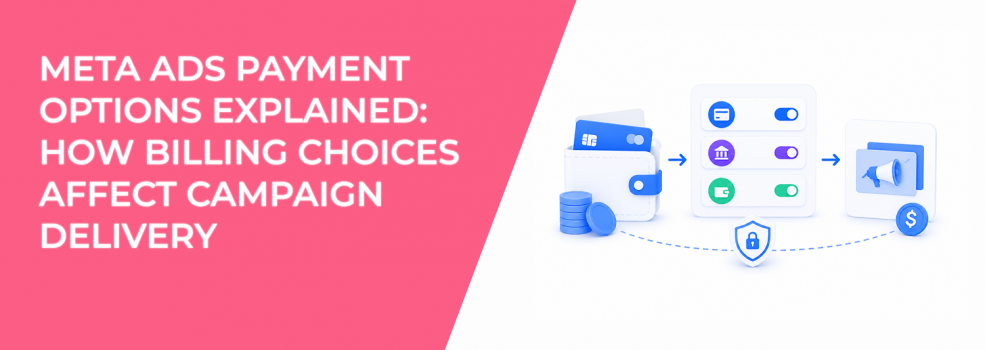
A Meta campaign can stop spending even when the ads, audience, and budget look fine. The issue may sit outside the campaign settings. Sometimes the real problem is how the ad account pays for delivery.
Meta gives advertisers two main payment options: available funds and automatic billing. Some accounts can use both together. In certain cases, Meta chooses the payment setup based on your location, available payment methods, and account history.
For media buyers, this is more than a finance setting. Your payment setup affects delivery continuity, budget pacing, CPA stability, and how cleanly you can read campaign performance.
Why payment setup affects campaign performance more than most advertisers realize
A billing interruption rarely looks dramatic at first. Spend simply slows down or stops. Then CPC rises, lead flow drops, and the campaign loses delivery momentum.
Inside Ads Manager, this usually appears as:
- Spend freezing before the daily budget is exhausted.
- Delivery status warnings.
- Sudden learning instability.
- Uneven hourly spend distribution.
- Campaigns restarting after payment recovery.
Many advertisers react by editing targeting or creatives too quickly. That often creates a second problem because unnecessary edits can reset learning signals.
This is one reason why Facebook Ads ‘Not Delivering’ Status: What It Means and How to Fix It becomes important during troubleshooting. Billing issues often look identical to weak delivery issues at first glance.
Automatic billing works best for advertisers running always-on campaigns
Automatic billing is the most common Meta payment setup. Ads run first, then Meta charges your saved payment method once your account reaches a payment threshold. Remaining costs are charged on your monthly bill date.
For scaling advertisers, this setup creates smoother delivery because campaigns do not depend on manually adding funds every few days.
The main advantage is continuity. Campaigns keep spending unless payment fails.
That matters during:
- Lead generation campaigns with consistent daily volume.
- E-commerce retargeting campaigns.
- High-frequency remarketing.
- Seasonal promotions.
- Multi-campaign scaling periods.
A stable billing setup helps keep campaign pacing cleaner. That makes performance analysis more reliable because spend interruptions do not distort CPA and ROAS readings.
The weakness is obvious: failed charges pause campaigns fast.
A card expiration, bank fraud check, or spending limit can interrupt delivery during strong-performing periods. If this happens during a scaling phase, Meta may redistribute spend unevenly once campaigns resume.
One practical strategy is adding backup payment methods immediately after launch. Meta supports multiple cards for automatic billing. Agencies should also ensure billing alerts reach the media buyer, not only finance teams.
This pairs naturally with Ad Budget Pacing: Keep ROAS on Track, because pacing problems are often tied to payment interruptions rather than audience quality.
Available funds give stronger spend control but increase pause risk
Available funds work differently. You manually preload money into the ad account before ads run. Meta deducts spend from that balance daily.
This setup gives advertisers tighter cost control because campaigns cannot spend beyond the available balance.
For startups and SMBs, that can reduce financial surprises. It also works well in countries where local payment methods are more reliable than recurring card charges.
But the tradeoff is operational risk.
Once funds run out, campaigns pause immediately.
A small e-commerce brand might preload $1,000 for a product launch weekend. If the campaign scales faster than expected and burns through the balance Saturday evening, ads stop during peak purchase hours.
The advertiser sees lower Sunday ROAS and assumes the offer weakened. In reality, the campaign simply disappeared from auctions during the best conversion window.
This setup works best when:
- Campaign budgets are predictable.
- Spend caps matter more than delivery continuity.
- Finance teams require prepaid control.
- Short-term tests have strict limits.
If your account supports auto-reload for available funds, use it. Auto-reload automatically adds balance when funds fall below a threshold. That reduces the risk of overnight pauses.
Combining available funds with automatic billing creates a safer scaling setup
Some advertisers can combine available funds with automatic billing. In this setup, Meta uses prepaid funds first. If costs exceed the available balance, Meta charges the recurring payment method.
This hybrid structure is often the safest option for growing advertisers.
It creates two protection layers:
- Preloaded balance absorbs early spend.
- Automatic billing prevents hard delivery stops.
This setup becomes valuable during scaling windows. If campaigns suddenly increase spend after strong conversion signals, the prepaid balance handles initial delivery while automatic billing keeps campaigns active afterward.
The operational mistake is assuming prepaid balance alone is enough. You still need a valid recurring payment method. If that method fails after available funds are exhausted, campaigns can still stop.
A useful scaling habit is separating billing changes from budget increases.
Do not:
- Change payment methods.
- Raise budgets.
- Duplicate campaigns.
- Launch new creatives.
all on the same day.
When multiple variables change together, diagnosing performance becomes messy.
This is one reason experienced advertisers rely on How to Manage Ad Spend Fluctuations Without Hurting Campaign Stability. Stable delivery creates cleaner performance signals.
Payment pauses distort CPA, ROAS, and conversion data
A billing interruption does not directly damage ad quality. It damages consistency.
Meta’s delivery system depends on stable auction participation. When campaigns stop unexpectedly, spend distribution changes. The algorithm may re-enter auctions differently after delivery resumes.
That can create:
- Temporary CPM spikes.
- Unstable CPC.
- Delayed conversions.
- Weaker retargeting efficiency.
- Inconsistent lead quality.
A B2B advertiser running weekday lead generation may lose the strongest morning conversion window because available funds ran out overnight. The next day’s CPA report looks worse, even though audience quality stayed identical.
The same pattern appears in e-commerce.
A campaign paused during high-intent evening traffic can reduce next-day ROAS without any creative fatigue or audience decay.
Before rebuilding campaigns, check:
- Payment threshold timing.
- Available balance.
- Billing warnings.
- Account spending limits.
- Failed charges.
- Delivery interruptions.
Many advertisers optimize campaigns before fixing infrastructure.
That usually creates more noise.
Spending limits can quietly block campaign scaling
Payment setup alone does not control ad costs. Budgets and spending limits still matter.
Meta allows advertisers to use:
- Campaign budgets.
- Ad set budgets.
- Account spending limits.
These systems interact differently depending on the payment setup.
With available funds, the balance itself acts as a hard ceiling. With automatic billing, the account spending limit becomes more important because campaigns can continue delivering until the limit is reached.
The problem is visibility.
Advertisers often forget old account spending limits exist. Campaigns perform well, budgets increase, then spend suddenly stops mid-scale.
Inside Ads Manager, this often looks like:
- Campaigns active but not spending.
- Delivery dropping despite high audience size.
- Flat spend curves during scaling.
Before major budget increases, check the account spending limit manually.
This becomes even more important during Q4 scaling or product launches when campaigns move through payment thresholds faster than usual.
Practical strategies to avoid billing-related delivery interruptions
A stable payment setup removes unnecessary volatility from campaign performance.
Use these operational habits before scaling:
- Add at least one backup payment method for automatic billing.
- Review payment thresholds before increasing budgets aggressively.
- Enable auto-reload if using available funds.
- Check account spending limits before launch periods.
- Keep billing alerts visible to campaign operators.
- Separate payment changes from campaign edits.
- Monitor hourly spend after failed-payment recovery.
One small process improvement can prevent a full day of disrupted delivery.
That matters more than many advertisers realize because Meta’s learning system responds better to stable delivery patterns.
Stable billing does not solve weak audience quality
Payment stability helps campaigns stay active. It does not guarantee profitable traffic.
If delivery is smooth but lead quality keeps declining, the issue usually sits in targeting, funnel structure, or audience intent.
This is where LeadEnforce becomes relevant.
Advertisers can use LeadEnforce to build high-intent audiences from:
- Facebook groups.
- Instagram followers.
- Instagram engagers.
- Social profile data.
That gives advertisers more precise targeting inputs than broad audience expansion alone.
For B2B campaigns especially, audience quality often matters more than raw scale. A smaller high-intent audience can outperform a broader audience with cheaper CPCs but weaker conversion intent.
Keep billing boring so campaign data stays readable
The best Meta payment setup is usually the least noticeable one.
Automatic billing supports continuity. Available funds create tighter spend control. Hybrid setups reduce scaling friction. Each option solves a different operational problem.
The important part is consistency.
When billing stays stable, advertisers can trust their campaign signals more confidently. CPC trends become easier to interpret. CPA volatility becomes easier to diagnose. ROAS shifts become easier to explain.
That clarity leads to better optimization decisions and safer scaling over time.