Many advertisers scale their Facebook and Instagram campaigns by chasing cheap clicks or high ROAS. But this often leads to short-term wins and long-term waste.
To grow sustainably, you need to focus on how much your customers are worth over time — not just what they buy on day one.
That’s where LTV-based budget allocation becomes your strongest lever.
What is LTV and why does it matter?
LTV (lifetime value) tells you how much revenue a customer brings in over their relationship with your brand.
Most advertisers focus on ROAS. That shows how much you earn right after the click. But ROAS can be misleading — especially for brands with longer buying cycles or repeat purchase potential.
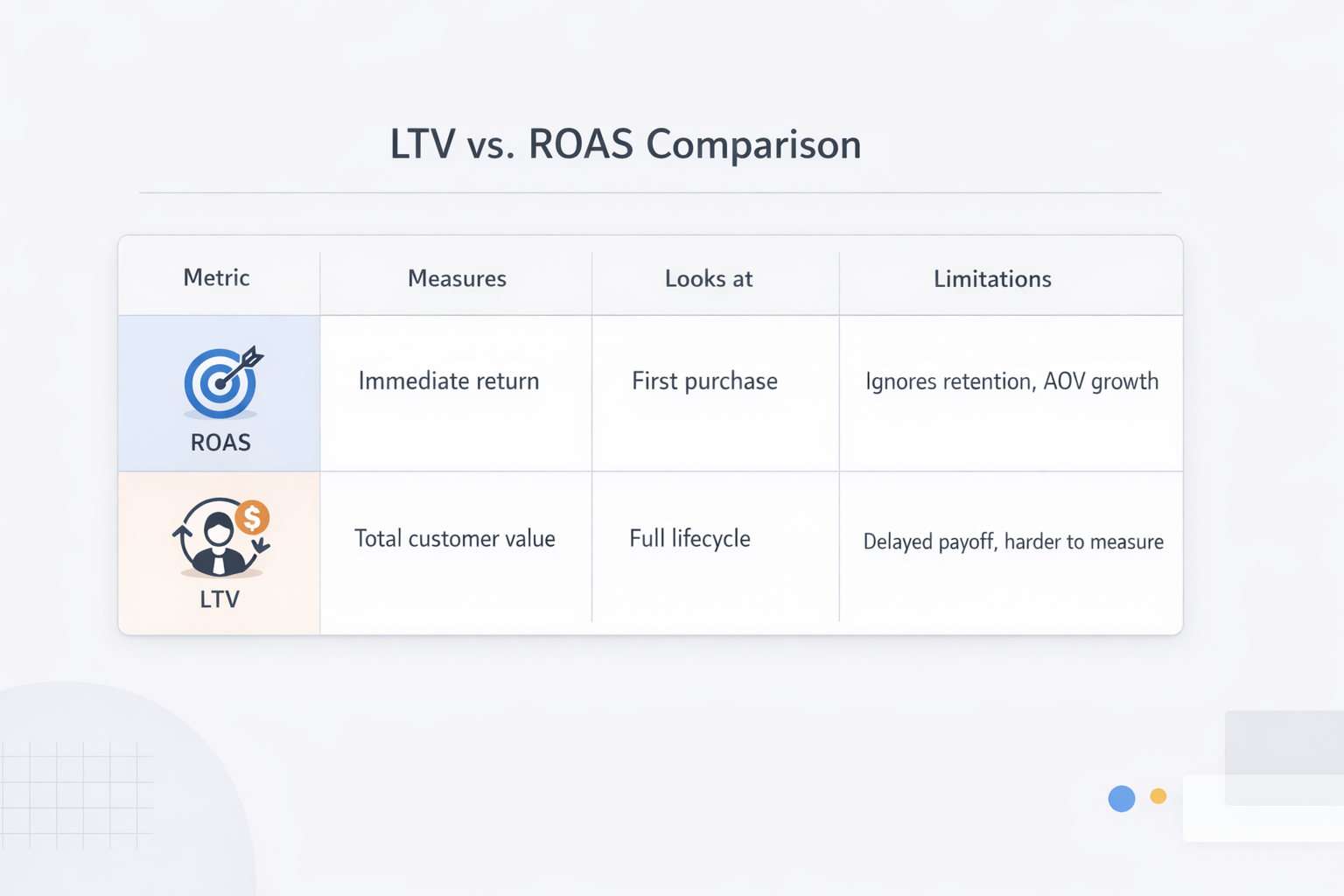
LTV helps you:
-
Identify high-quality customers who come back and buy again;
-
Spend more confidently, even when initial conversions are expensive;
-
Reduce over-reliance on short-term optimizations.
Want to go deeper into how ROAS and LTV relate? Check out Why You Should Pair ROAS With Customer Lifetime Value (LTV).
Understanding your customers’ long-term potential makes it easier to justify higher acquisition costs — especially when competing in crowded ad auctions.
Step 1: Get accurate data first
LTV-based decisions are only as good as the data you use. That’s why the first step is fixing your tracking and attribution.
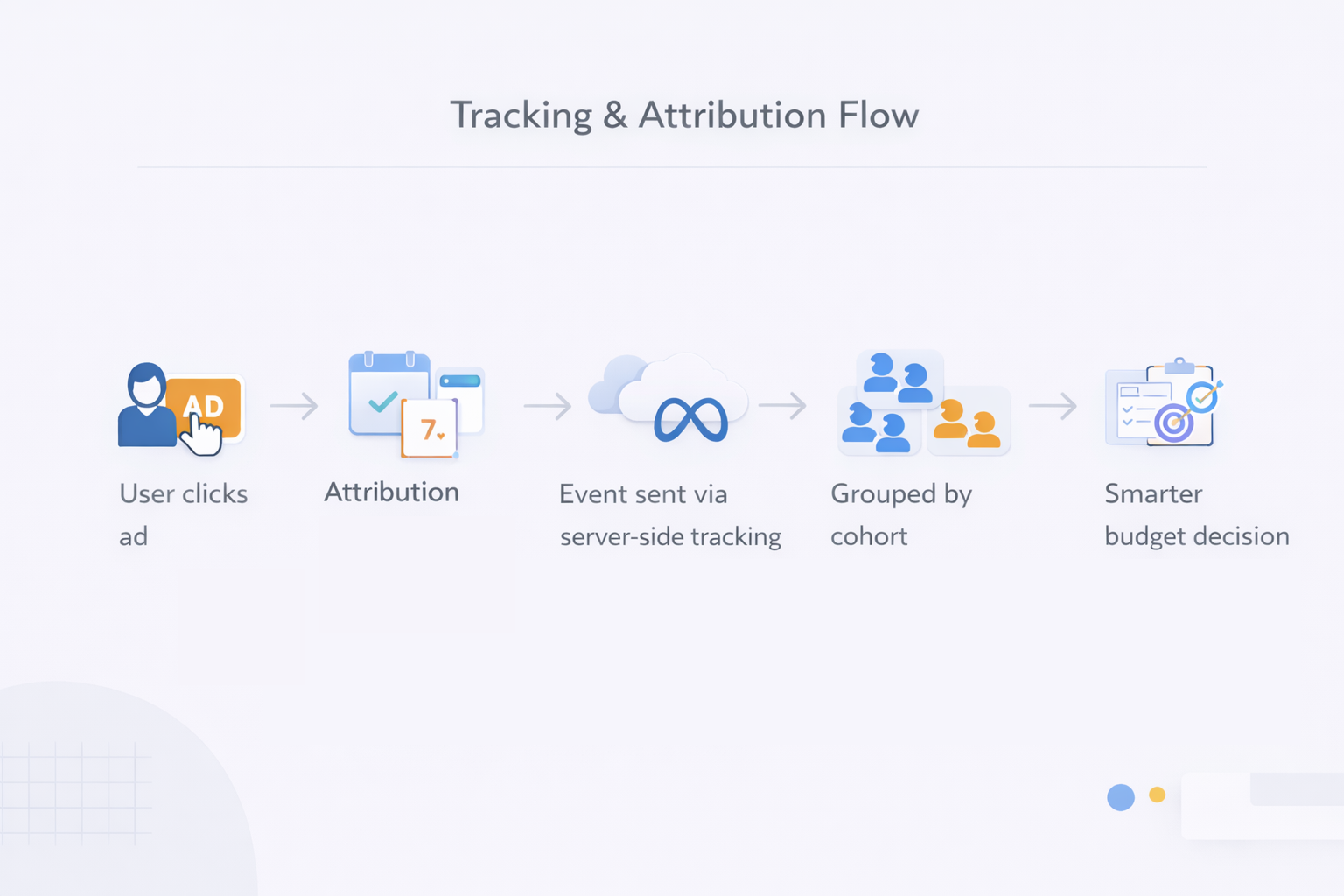
Make sure you:
-
Extend attribution windows — A 1-day window won’t capture delayed purchases. Use 7-day click and 1-day view as a baseline;
-
Use server-side tracking — Browser-based pixels miss a lot. Tools like Meta’s Conversions API help plug the gaps;
-
Track cohorts — Don’t lump all customers together. Track them by acquisition date or source to compare their behavior over time.
For help setting this up, see Server-Side Tracking for Facebook Ads: A Beginner’s Guide.
These steps ensure you don’t make budget decisions based on partial or misleading performance data — especially important for evaluating LTV.
Step 2: Segment by actual customer value
Not all customers behave the same. Some buy once and bounce. Others stick around for months and generate consistent revenue.
To make smarter decisions, group customers by how valuable they are after the first purchase.
Useful segment types:
1. Source-based segments
Where a customer first engages with you can say a lot about their future behavior.
-
Instagram Stories may drive fast clicks, but often lower LTV;
-
Instagram Reels viewers might convert slower, but tend to engage more deeply;
-
Facebook feed clicks from product-focused posts often yield high AOV but fewer repeat purchases.
Segmenting by source helps you uncover overlooked channels that quietly deliver high-value buyers over time.
2. Behavior-based segments
Track how different buyer behaviors impact LTV.
-
Buyers who use a discount code may convert easily, but not come back;
-
Customers who purchase bundles or subscriptions usually have higher LTV;
-
Repeat page viewers or email subscribers often become multi-buyers.
Explore more here: Behavior-Based Facebook Targeting: The Secret Weapon of Top E-commerce Brands.
Behavioral signals help you predict future value early — often within days of a customer's first session or purchase.
Step 3: Adjust how you build and test audiences
With your segments in place, you can build higher-quality audiences to target in future campaigns.
Instead of relying on broad interests or default lookalikes, focus on:
-
Seed audiences made from high-LTV customers;
-
Excluding low-LTV segments from cold campaigns;
-
Retargeting based on valuable behaviors, like browsing bundles or subscribing.
Even small changes in audience inputs can dramatically improve the quality of customers you acquire. A lower CPM does not help if it brings low-value buyers. A higher CPM can be profitable if the audience converts into repeat customers.
Step 4: Budget by LTV tiers — not just ROAS
Now that you understand where your best customers come from, allocate your ad budget accordingly.
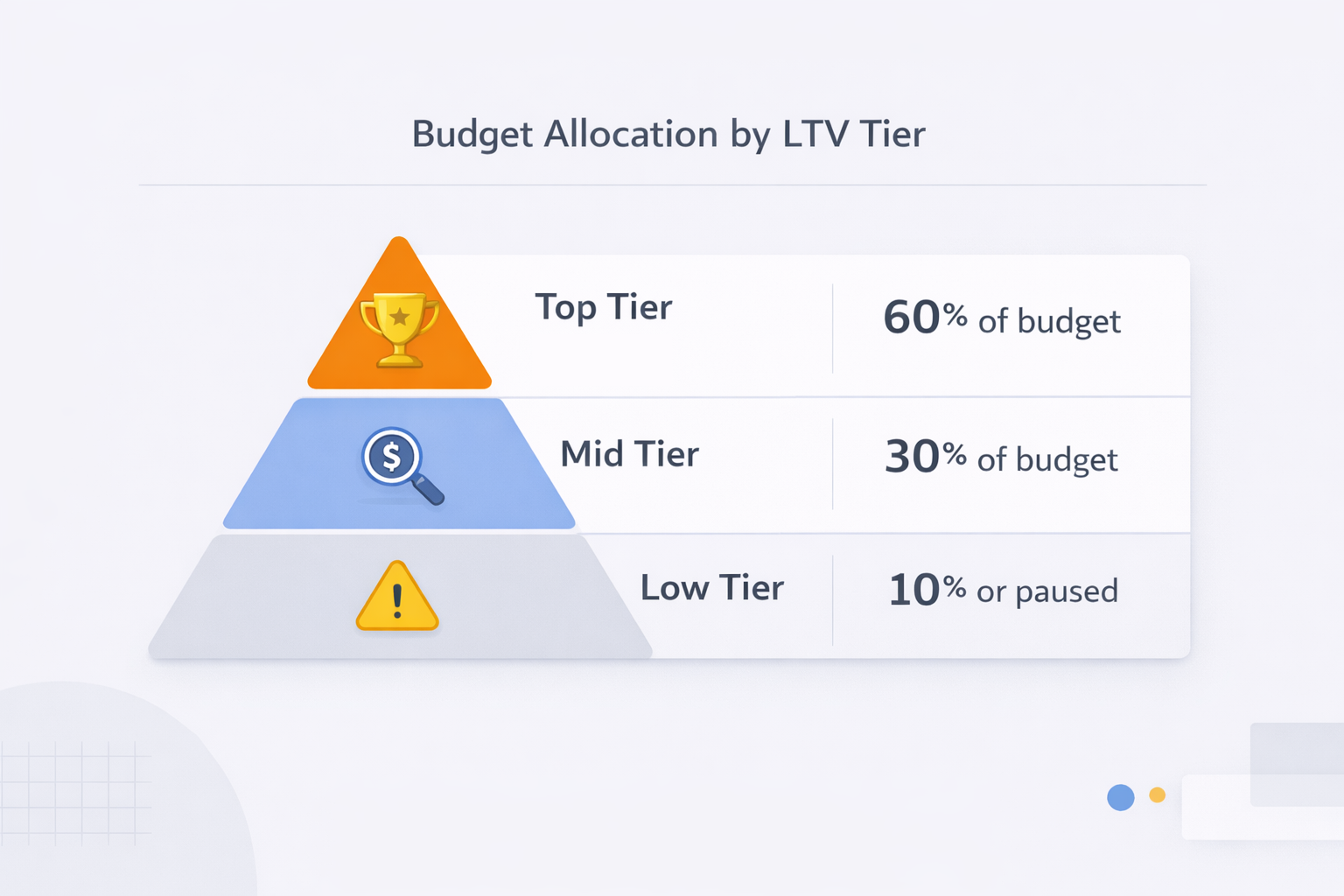
Group your campaigns into three tiers:
-
High-LTV campaigns — These bring in repeat buyers, subscribers, or bundle purchasers. Scale these. Test new creatives weekly. Expand audiences cautiously;
-
Mid-LTV campaigns — These are consistent but not standout. Maintain current budget. Test headlines, CTAs, and retargeting angles;
-
Low-LTV campaigns — These may look good on ROAS, but lead to one-time buyers or high churn. Reduce budget. Try repositioning or limit scale.
This approach avoids the mistake of over-funding campaigns that drive short-term sales but no retention. LTV tiers create clear rules for rebalancing spend.
Step 5: Move beyond “scale if ROAS is 2x”
Scaling rules like “increase budget if ROAS is over 2x” are too simple for modern campaigns.
Instead, layer in LTV-based metrics:
-
CAC vs. LTV ratio — Aim for 1:3 or better over 60–90 days;
-
Payback period — How many days it takes to earn back your CAC;
-
Early retention signals — Are people coming back to browse, open emails, or interact on social?
Related read: How to Analyze Campaign Performance Beyond ROAS: The Full Funnel View.
This lets you scale campaigns that may look weak up front — but actually produce strong customer value over time.
Step 6: Boost LTV after the click
You can’t control everything in the ad platform. But you can increase LTV with better post-click experiences.
Here’s how:
-
Send welcome emails immediately after purchase with offers or education;
-
Use loyalty perks like VIP tiers or discounts for repeat buyers;
-
Promote bundles or subscriptions to increase average order value;
-
Retarget recent buyers with useful add-ons, upsells, or how-to content.
Retention and cross-sell strategies not only increase LTV — they also improve ad performance metrics like ROAS and CPA.
Step 7: Make LTV part of your weekly ad routine
This isn’t a “set it and forget it” strategy. Build LTV reviews into your weekly process.
Try a rhythm like:
-
Monday — Look at cohort-level LTV changes;
-
Wednesday — Shift budget from low-tier to high-tier sources;
-
Friday — Refresh ads for top segments. Kill or pause anything underperforming.
Tracking trends over time helps you spot when an audience or offer starts to decay — and lets you fix it before performance drops.
Final thoughts: scale what lasts
Scaling your campaigns isn’t just about finding more clicks. It’s about finding better customers.
If you use LTV as your guide, you’ll know:
-
Where to spend more;
-
What to scale slowly;
-
And which campaigns to pause entirely.
The goal isn’t to grow faster — it’s to grow smarter.