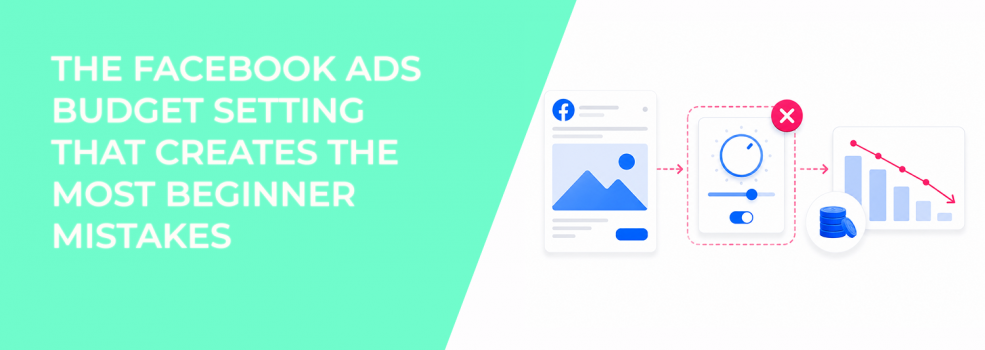
The daily budget setting creates more beginner mistakes than almost any other option inside Facebook Ads Manager.
Not because the feature itself is technically difficult, but because advertisers misunderstand what Meta is actually controlling. Most new advertisers expect smooth pacing, equal daily spend, and predictable delivery patterns.
Meta’s system does not work that way.
The problem: beginners expect daily budgets to behave like hard spending limits
When advertisers select a $25 daily budget, they usually assume Meta will distribute spend evenly throughout the day.
Then the campaign suddenly spends aggressively during the evening or accelerates delivery over the weekend. The advertiser assumes something is wrong because pacing no longer matches expectations.
The real issue is that Meta optimizes around conversion probability, not visual pacing consistency.
If stronger purchase intent appears during certain hours, the platform increases delivery automatically. If auctions become expensive or conversion probability weakens, pacing slows down.
To inexperienced advertisers, that behavior feels unstable even though the algorithm is operating normally.
The article on what every first-time advertiser needs to know about Facebook campaigns explains why campaign behavior often looks inconsistent during the early stages of optimization.
Why beginners damage campaigns by reacting too quickly
Most beginner advertisers optimize emotionally instead of operationally.
A campaign launches at 9 AM. CPC looks high by 2 PM. The advertiser lowers budget, edits targeting, or pauses delivery before the system stabilizes.
That reaction often hurts performance more than the original pacing fluctuation.
Meta’s optimization engine needs stable conversion signals to identify which behavioral patterns produce efficient results. Constant edits interrupt that learning process repeatedly.
This becomes especially harmful in:
- lead generation campaigns with attribution lag,
- higher-ticket products with slower conversion cycles,
- small-budget campaigns with limited auction volume.
Small budgets exaggerate normal volatility
Low-budget campaigns create unstable reporting patterns very quickly.
A campaign spending $15/day enters far fewer auctions than a campaign spending $300/day. One expensive traffic cluster can distort CPC, CPM, and CPA dramatically.
That often creates false conclusions like:
- “the audience stopped working,”
- “Meta is overspending,”
- “the creative died.”
In reality, the campaign often lacks enough delivery volume to stabilize optimization properly.
The article about Facebook ad mistakes that drain your budget explains why excessive editing frequently creates instability inside smaller ad accounts.
The solution: optimize using longer evaluation windows
Most beginners improve results simply by reducing unnecessary interventions.
Experienced media buyers rarely optimize campaigns from hourly reporting patterns. Instead, they evaluate:
- Rolling 3-day CPA trends. This removes temporary auction volatility from optimization decisions.
- Stable conversion volume. Consistent lead flow matters more than isolated CPC spikes.
- Frequency and CPM behavior. These metrics reveal delivery pressure much more accurately than emotional pacing observations.
- Conversion lag patterns. Some campaigns need more time before attribution stabilizes properly.
This creates much cleaner optimization decisions.
Actionable ways beginners can avoid budget mistakes
Here are the most practical changes new advertisers should make immediately:
- Leave campaigns untouched for at least 48–72 hours during learning. Constant edits reset optimization patterns repeatedly.
- Avoid changing multiple variables simultaneously. Budget edits combined with targeting changes make performance diagnosis extremely difficult.
- Start with realistic acquisition math. Do not expect enterprise-level lead volume from extremely small budgets.
- Review campaigns weekly instead of hourly. Short-term volatility is normal inside Meta’s auction environment.
The article on beginner’s guide to Facebook Ads provides a broader framework for understanding how Meta campaigns stabilize over time.
Final takeaway
The biggest beginner mistake is assuming daily budget controls exact pacing behavior.
Meta optimizes dynamically around conversion probability, audience behavior, and auction conditions. Advertisers who stop reacting emotionally to short-term fluctuations usually build much more stable campaigns and make significantly better optimization decisions over time.