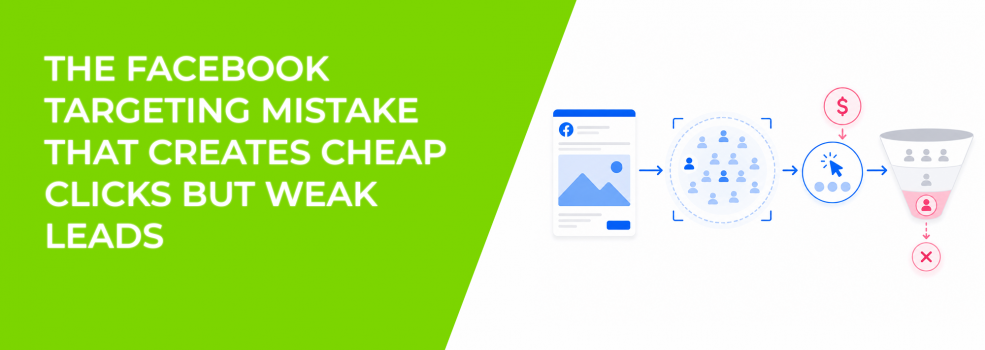
Some Facebook campaigns look successful inside Ads Manager while quietly damaging pipeline quality.
CTR increases. CPC drops. CPM becomes cheaper after delivery stabilizes. At the same time, booked calls decline, close rates weaken, and sales teams reject more leads.
This usually happens when Meta optimizes toward low-intent engagement instead of qualified demand.
The campaign generates activity, but not enough buyers.
Why cheap clicks can hide weak audience intent
Meta prioritizes scalable actions.
If an audience contains many users likely to click but unlikely to buy, the algorithm can still make the campaign look efficient. It finds cheap engagement because cheap engagement is easier to reproduce than qualified conversions.
You can usually identify weak-intent traffic through:
- High lead-form completion with poor reply rates. Users submit forms, but they do not behave like serious prospects.
- Demo bookings without attendance. The campaign creates calendar activity, but not meaningful sales conversations.
- Short landing-page sessions despite high CTR. Users click because the ad attracts curiosity, then leave quickly.
This is where advertisers confuse low CPC with efficient acquisition. The real question is whether the audience produces pipeline quality.
Why broad targeting creates misleading performance signals
Broad audiences often reduce CPC because Meta can access cheaper inventory.
A B2B advertiser targeting broad “marketing” or “business owner” interests may attract students, freelancers, junior employees, and casual content consumers. Those users may click often, but they rarely become strong opportunities.
That creates a false optimization loop. Advertisers scale because platform costs look good, while the sales funnel weakens underneath.
This is why lead quality versus lead volume matters more than front-end efficiency in lead generation campaigns.
How to target for stronger lead quality
Lead quality improves when advertisers give Meta stronger intent signals before scaling.
Instead of optimizing around everyone who clicks or submits a form, build audiences from users already showing category-specific behavior. Facebook group targeting for lead generation works well when the groups reflect real buyer problems, industry roles, or active purchase discussions.
LeadEnforce can help advertisers build these audiences from followers of Facebook groups and Instagram accounts. That gives campaigns a better chance of reaching people with stronger commercial relevance.
To reduce weak leads, advertisers should:
- Build lookalikes from qualified opportunities instead of all leads. A poor seed audience teaches Meta to find more poor-fit users.
- Separate educational traffic from conversion campaigns. Beginner-level content consumers should not always compete with high-intent prospects.
- Exclude audiences that repeatedly click without progressing. Some segments generate engagement but never produce revenue.
For campaigns struggling with intent, finding high-intent Facebook audiences is usually more valuable than widening targeting.
How to diagnose cheap clicks before they drain budget
A low CPC campaign should not be judged by Ads Manager alone.
Check the campaign against funnel behavior within the first few days of lead volume. If Meta is finding the wrong users, the warning signs usually appear before CPA fully breaks.
Compare each audience by:
- Lead-to-reply rate. If users submit forms but do not answer email, phone, or calendar follow-ups, the audience is probably too low-intent.
- Cost per qualified lead. A campaign with higher CPC can still win if more leads match your sales criteria.
- Sales-stage drop-off. If one audience creates many leads but almost no booked calls or opportunities, Meta is optimizing toward form fillers rather than buyers.
For example, a campaign may produce leads at $8 each from a broad business-interest audience, while a Facebook group-based audience produces leads at $18 each. The second audience can still be more profitable if its booked-call rate is three times higher.
That is why audience testing should include both platform efficiency and CRM quality. Cheap traffic is only useful when it moves users toward revenue.
Final takeaway
Cheap clicks are not always a positive signal. Low-CPC campaigns often underperform because Meta optimizes toward scalable engagement instead of commercial intent.
Performance improves when advertisers target users with stronger behavioral relevance and judge campaigns by qualified pipeline, not click cost alone.