Impression share is one of the most overlooked levers in Meta campaign optimization. While most advertisers obsess over cost per result, CTR, or ROAS, impression share quietly determines how much visibility your ads actually receive.
At its core, impression share tells you: how many times your ad was shown, compared to how many times it could have been shown.
Here’s a simplified formula:
Impression Share = Delivered Impressions ÷ Total Eligible Impressions
But here’s the twist — Meta doesn’t display this number directly in Ads Manager. You have to read between the lines using performance signals and delivery diagnostics. That’s why many advertisers don’t realize they’re losing valuable reach or scaling opportunities — even when their ads seem to be “working.”
For more on how impressions are tracked, check out What Facebook Ad Impressions Really Mean (And What to Do With Them).
Why Impression Share Matters (Even If You’re Getting Results)
Just because you’re getting conversions doesn’t mean you’re getting your full share of the opportunity. If your impression share is low, it often means you’re leaving results — and revenue — on the table.
Here’s what low impression share really signals:
-
You're being outbid. Competitors are entering auctions you’re missing due to low budget, poor performance, or relevance issues.
-
Your ads are artificially throttled. Meta restricts delivery when you hit internal limits, even if your performance is solid.
-
You’re not scaling efficiently. A campaign could be highly profitable at $50/day, but unable to scale to $500/day because of impression share limitations.
Consider this example:
You’re running a profitable campaign with a ROAS of 4.0, but your daily spend is stuck at $30. Even after increasing the budget, delivery barely rises. You check your diagnostics and see frequency is low, CPM is stable, and CTR is strong — but you're still not getting volume. In this case, low impression share is the silent bottleneck.
What Affects Impression Share in Meta Campaigns?
Impression share isn’t random. It’s the result of how your campaign stacks up in Meta’s auction — which weighs budget, bid strategy, audience, creative quality, and historical performance.
| Factor | Impact on Impression Share |
|---|---|
| Budget-to-Audience Ratio | Determines frequency of auction entry based on the budget and audience size. |
| Bid & Optimization Strategy | Affects how often your ad wins in the auction, and whether your budget is optimized for the right action. |
| Creative Quality | Ads with high engagement (CTR, relevance score) increase impression share. |
| Ad Fatigue | High frequency can lower your impression share due to reduced user engagement. |
Several key factors influence whether Meta shows your ads or skips them:
1. Budget-to-Audience Ratio
Your budget determines how often your ad enters the auction. But if your audience is too large, your impressions are diluted.
Examples:
-
A $5/day budget targeting 10 million people may only reach 0.05% of them.
-
A $50/day budget targeting a focused 1 million-person audience could yield 10x the impression density.
Tip: Use reach diagnostics or frequency trends to spot when your budget is spread too thin. You can dive deeper into how budget impacts CPM by reviewing What Influences CPM on Facebook Ads (and How to Keep It Low).
2. Bid and Optimization Strategy
Meta prioritizes ads that are most likely to hit the chosen objective at the lowest cost. That means your optimization goal must align with the audience’s readiness.
Examples:
-
Don’t use the “Purchase” objective for top-of-funnel audiences with no pixel data.
-
If you're in a niche with high purchase intent, use manual bidding to stay competitive during high-demand periods.
Strategy: Start with “Landing Page Views” or “Add to Cart” to build data, then optimize for Purchase after a few dozen conversions.
3. Creative Quality and Engagement Score
Your ad’s ability to stop the scroll, hold attention, and get interaction directly affects impression share. Meta prioritizes ads that create good user experiences.
Weak creatives = low engagement = lower auction wins.
| Creative Quality | Example of Low-Quality Ad | Example of High-Quality Ad |
|---|---|---|
| Visual Design | Stock photo, no movement | UGC, motion, authentic visuals |
| Headline | Vague, generic headline | Specific, benefit-driven headline |
| User Experience | Slow-loading landing page | Fast-loading, mobile-friendly page |
Examples of low-quality ads:
-
Stock photos that look generic.
-
Headlines with no emotional pull or specificity.
-
Slow-loading landing pages that cause bounce.
Strategy: Test 3–5 variations of creatives per ad set. Refresh every 7–10 days. Prioritize user-generated content, short videos, and motion-based formats.
4. Ad Fatigue and Frequency Capping
Once users see your ad 3–4 times, performance drops. Meta may suppress your delivery to protect user experience — this reduces your active impression share.
Signs of fatigue:
-
CTR drops sharply over a few days.
-
Frequency stays flat but conversions fall.
-
Comments indicate people are seeing your ad too often.
What to do:
-
Set frequency caps on Reach or Awareness campaigns.
-
Rotate creative regularly, especially in retargeting ad sets.
-
Monitor ad-level performance daily once frequency passes 2.5.
How to Spot Low Impression Share Without a Dashboard Metric
Even though Meta doesn’t give you a clean “impression share” number, you can still detect it using indirect signals.
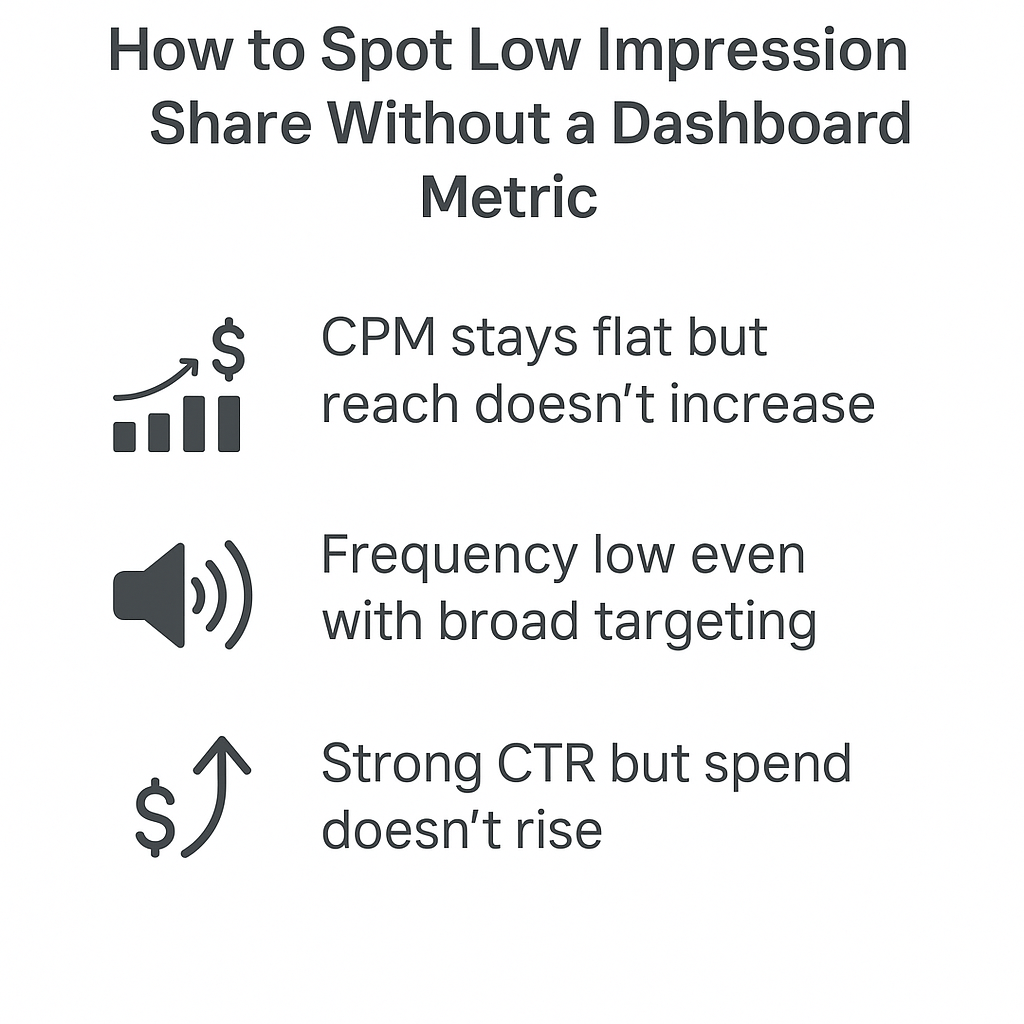
Here’s what to watch:
-
CPM stays flat or drops, but reach doesn't increase. You're budget-limited, not audience-limited.
-
Frequency remains low, even with broad targeting. Suggests Meta is holding your ads back.
-
Strong CTR and ROAS, but spend doesn’t rise. Implies Meta wants to give you more volume but you’re hitting internal limits.
Pro Tip: Compare your audience size, daily budget, and CPM to calculate your approximate reach %. If you're only reaching 2% of a retargeting audience daily, you're under-delivering.
Strategies to Increase Impression Share and Unlock Scale
Once you’ve diagnosed a low impression share, the next step is to remove the constraints limiting your delivery.
Here’s how:
1. Raise Budgets Gradually to Prevent Learning Disruption
Avoid sudden jumps. Increase budgets by 15–20% every 3 days if performance remains stable.
Example:
-
If you're spending $50/day with good ROAS, test $60, then $70, monitoring frequency, CPA, and CTR at each step.
Bonus Tip: Use Advantage Campaign Budget (CBO) to let Meta allocate spend across ad sets more efficiently.
2. Improve Creative Relevance to Win More Auctions
Meta scores your ads based on engagement, click-through rate, and post-interaction behavior.
To increase relevance:
-
Add motion (even slight animation) to static creatives.
-
Use native formats: Reels, Stories, vertical video.
-
Localize creatives by language or cultural cues for better relevance in GEO-targeted campaigns.
3. Refine Your Audience or Layer In High-Intent Signals
Broad audiences can dilute your performance. But overly narrow ones can choke delivery.
Strategies:
-
Use lookalikes based on high-value actions (e.g., 180-day purchasers, not just site visitors).
-
Segment by funnel stage: cold vs. warm vs. hot audiences.
-
Run Advantage+ Shopping Campaigns if you have a large catalog and conversion history — Meta optimizes audience reach using first-party signals.
4. Match Optimization Goal to Where the User Is in Their Journey
Meta’s algorithm performs best when it knows what to optimize for.
| Funnel Stage | Suggested Objective | Example |
|---|---|---|
| Top-of-Funnel | Landing Page Views | Drive traffic to product page |
| Mid-Funnel | Add to Cart | Encourage action on product pages |
| Bottom-of-Funnel | Purchase | Close the deal with strong purchase intent |
Examples:
-
For cold prospecting, start with “Landing Page Views” to feed the pixel.
-
In retargeting, switch to “Add to Cart” or “Purchase.”
-
For high-ticket or lead-gen offers, test “Leads” with a custom conversion event tied to form submission.
Advanced Tip: Use conversion value rules to prioritize certain geos or actions. This can signal Meta to value higher-quality events more — increasing delivery in the right areas.
When You Shouldn't Chase Higher Impression Share
Higher isn’t always better. In some cases, lower impression share can be more efficient.
Here’s when it’s okay:
-
Your audience is small but high-intent. Stretching frequency helps reinforce the message.
-
You’re testing creatives. Lower exposure helps avoid skewing results during a controlled test.
-
You’re in a niche with limited inventory. Impression caps can reduce wasted spend and lower CPA.
Remember: The goal is profitable delivery, not just wide delivery.
Key Takeaways
Impression share isn’t just about visibility — it’s a powerful indicator of whether Meta is giving your ads the chance to succeed.
If you're not winning enough impressions:
-
Your ads can’t perform, no matter how good your product or funnel is.
-
You’ll struggle to scale, even with strong ROAS.
-
You risk interpreting underdelivery as a creative or targeting failure — when the real issue is Meta’s auction.
What To Do Next
If you suspect low impression share is holding your Meta ads back:
-
Check frequency, CPM, and budget pacing.
-
Improve creative quality and engagement.
-
Align optimization goals with funnel stages.
-
Gradually scale budget while monitoring performance.
-
Test different placements, formats, and audience breakdowns.
Scale doesn’t come from guessing. It comes from winning more auctions — and impression share is how you measure that.