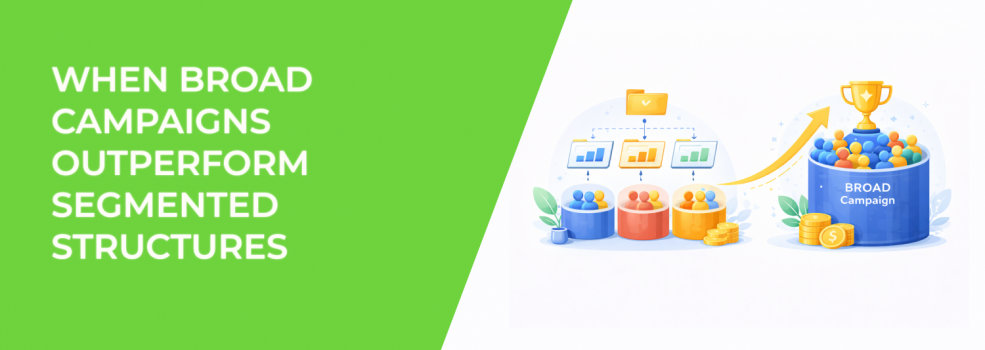
Segmentation feels disciplined. It promises control, clarity, and precision. Yet many Meta accounts perform better after consolidation.
Broad campaigns often outperform segmented structures when data volume and signal quality matter more than targeting theory. The difference is structural, not tactical.
Why Segmentation Fails in Mature Accounts
Segmentation works when signals are dense and budgets are high. Most accounts do not meet those conditions. Fragmentation weakens optimization before performance metrics show decline.
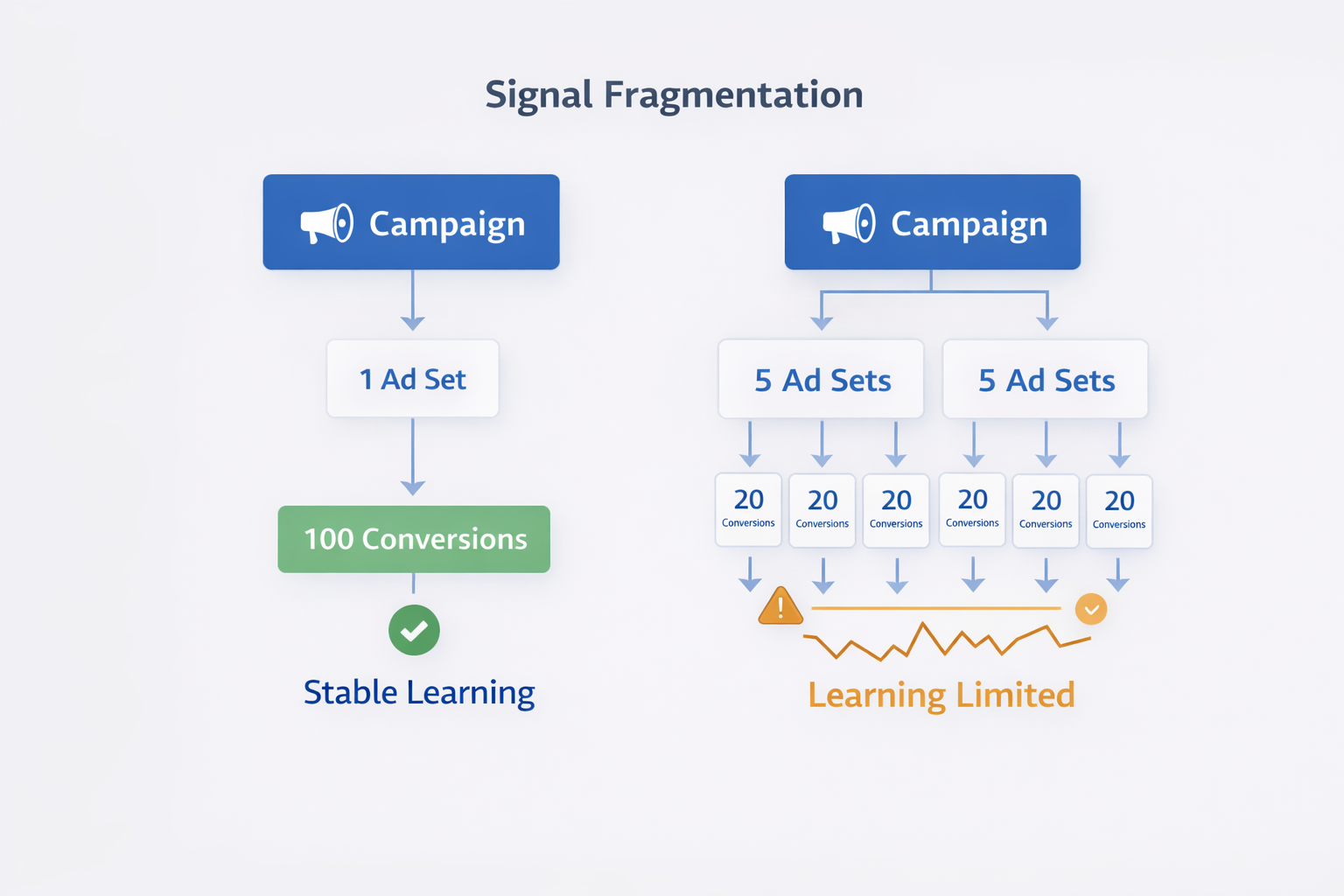
Meta’s algorithm optimizes at the ad set level. Each split reduces data concentration. That reduction changes learning speed and auction competitiveness.
If you want a deeper breakdown of structural inefficiency, review over-segmentation in Facebook Ads and its impact on efficiency.
Signal Dilution Reduces Learning Stability
Every additional ad set divides conversions. Fewer events per ad set slow the learning phase. Performance becomes volatile and harder to interpret.
Watch for these patterns:
-
Less than 50 optimization events per week per ad set; learning status remains unstable and CPAs fluctuate sharply.
-
Similar performance across multiple segments; no structural differentiation justifies separation.
-
High impression overlap; segments compete against each other in the same auction.
When signals are thin, broad targeting restores density. The system stabilizes faster and optimizes toward real conversion behavior.
Auction Overlap Creates Internal Competition
Segmented interest stacks often reach the same users. Behavioral signals overlap more than advertisers expect. Separate ad sets bid against each other.
This leads to:
-
Rising CPMs; internal competition inflates auction pressure.
-
Inconsistent delivery; budget shifts unpredictably across similar segments.
-
Artificial performance gaps; one segment wins auctions while others starve.
If you suspect internal competition, study how ad set cannibalization affects Facebook campaigns.
Broad campaigns remove internal bidding wars. The algorithm allocates budget based on performance rather than structural separation.
When Broad Structures Win
Broad targeting does not mean random targeting. It shifts control from manual assumptions to algorithmic pattern recognition. That shift works under specific conditions.
For a direct comparison framework, see broad targeting vs precise targeting decisions.
High-Quality Conversion Signals
Broad campaigns rely on clean event data. If optimization events reflect real revenue, expansion improves efficiency.
Broad works best when:
-
The account optimizes for Purchase, not Add to Cart; financial commitment guides learning.
-
CRM feedback refines offline conversions; low-quality leads are excluded from optimization.
-
Attribution windows align with actual sales cycles; delayed conversions still inform the model.
If the signal is weak, broad amplifies noise. If the signal is strong, broad amplifies patterns.
For objective alignment, revisit how Facebook ad objectives influence lead quality.
Creative Differentiation Replaces Audience Splits
Many segmented structures compensate for weak creative. Advertisers create audience buckets to force variation. Broad structures require creative to carry positioning.
In broad setups:
-
Messaging segments behavior implicitly; different ads attract different intent clusters.
-
Hooks filter users early; strong problem framing qualifies attention.
-
Offers sort demand; price and positioning shape self-selection.
The algorithm matches each creative to users most likely to respond. Audience targeting becomes secondary.
Diagnosing Over-Segmentation
Structural issues hide behind stable top-line metrics. Leads may increase while profitability declines. Broad often exposes hidden inefficiencies.
Check Structural Redundancy
Audit the account for unnecessary splits.
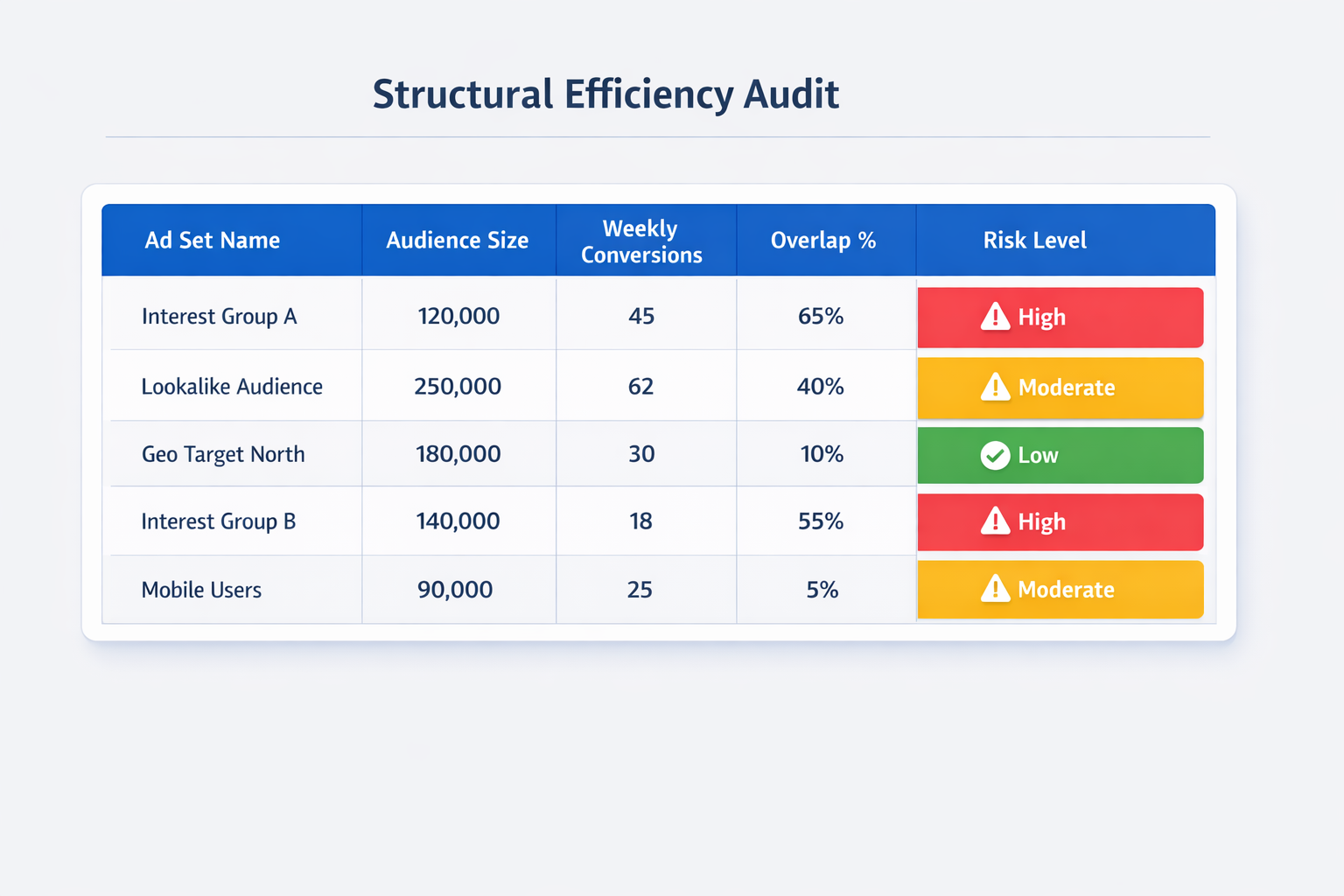
Look for:
-
Multiple interest stacks with similar audience sizes; segmentation exists without strategic difference.
-
Geographic splits without logistical variation; same product, same fulfillment, separate ad sets.
-
Device splits without performance gaps; structure persists without evidence.
If segments share messaging, pricing, and funnel, consolidation usually improves stability.
Evaluate Data Per Dollar
Budget allocation influences learning quality. Ten small ad sets dilute feedback. One consolidated ad set compounds it.
Compare:
-
Conversions per ad set per week; fewer than 50 signals weak optimization.
-
Cost per opportunity across segments; minimal variance signals structural redundancy.
-
Revenue per thousand impressions; broad often improves this metric through better matching.
Broad structures concentrate spend and accelerate model adaptation.
Common Misconceptions About Broad Campaigns
Many advertisers equate broad with lack of strategy. The opposite is true. Broad requires stricter discipline around signal quality and creative logic.
Broad Does Not Eliminate Control
Control shifts from audience definitions to performance thresholds. You control budget caps, bid strategies, and optimization events.
You also control:
-
Creative testing cadence; new variations refresh learning without structural resets.
-
Exclusion logic; existing customers and recent converters remain filtered.
-
Scaling pace; budget increases follow stable cost per acquisition trends.
The structure is simpler, but management remains active.
Broad Is Not Universal
Broad fails when fundamentals are weak. Poor landing pages, unclear offers, and inconsistent tracking undermine performance.
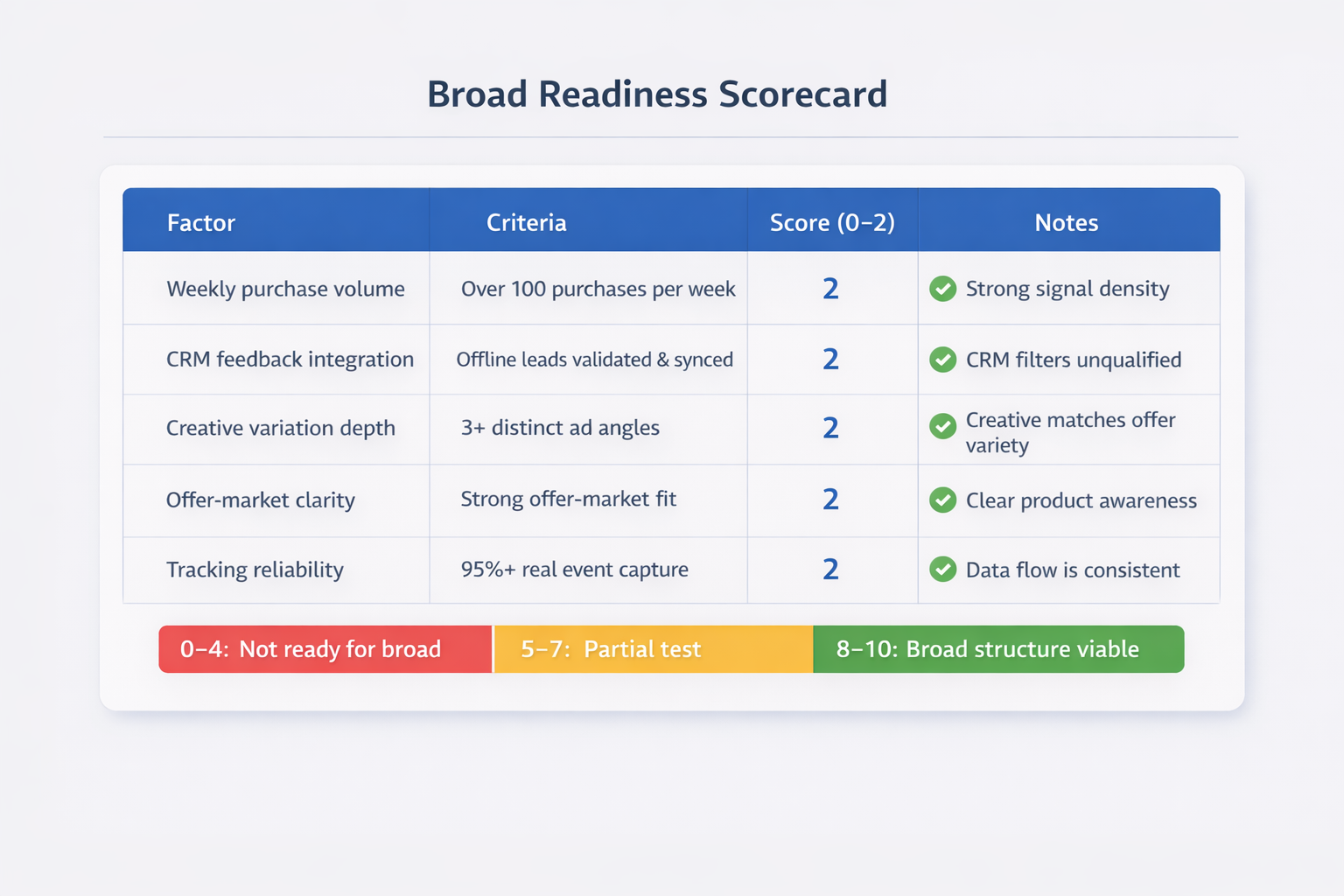
Avoid broad if:
-
Conversion tracking is unreliable; duplicated or missing events distort optimization.
-
Sales cycles exceed attribution windows; late revenue cannot inform learning.
-
The offer lacks clear demand; creative cannot compensate for product-market misfit.
Structural simplification amplifies strengths and weaknesses equally.
A Practical Transition Framework
Moving from segmented to broad requires controlled consolidation. Abrupt changes can reset learning and distort benchmarks.
Step 1: Identify Redundant Segments
Export performance by ad set. Group segments by similar metrics and overlapping targeting logic. Highlight those with no meaningful variance.
Pause the weakest segments first. Monitor blended CPA and volume for one week.
Step 2: Merge Budgets Strategically
Create a new broad ad set with consolidated budget. Maintain the same optimization event and attribution settings. Keep creative constant to isolate structural impact.
Track:
-
Cost per acquisition; compare against blended historical average.
-
Conversion volume; ensure no significant drop in total results.
-
Learning phase duration; broad often exits learning faster.
Step 3: Shift Segmentation to Messaging
Once structure is consolidated, differentiate through creative angles. Segment by pain point or awareness stage within the same broad audience.
For example:
-
Problem-aware users see ads focused on urgency and consequences; messaging emphasizes friction removal.
-
Solution-aware users see comparison-focused creatives; messaging highlights differentiation.
-
Offer-ready users see direct response ads; messaging reinforces price or guarantee.
Segmentation moves from targeting inputs to communication outputs.
Broad Campaigns as Structural Leverage
Broad campaigns outperform segmented structures when signal density drives performance more than manual targeting. The advantage comes from data concentration and auction efficiency.
Segmentation has a place when strategy justifies it. Without that justification, it fragments learning and inflates costs.
When signals are strong and creative is differentiated, broad becomes a structural advantage rather than a compromise.