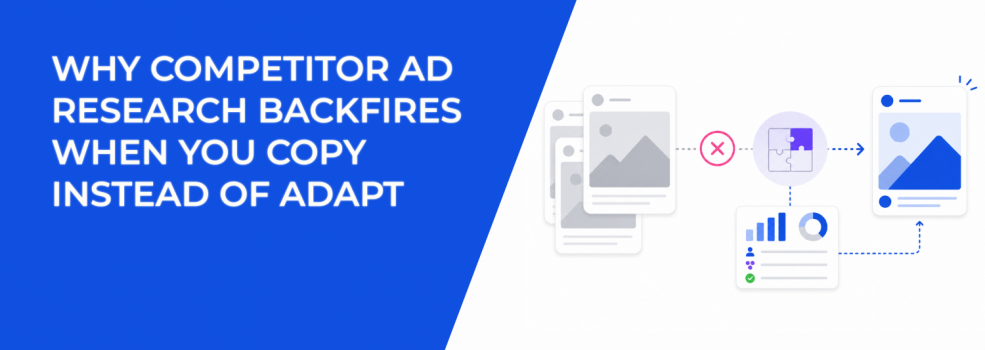
Competitor research becomes dangerous when advertisers confuse inspiration with duplication. The problem usually starts with urgency.
A campaign underperforms. The team opens Meta Ad Library, screenshots winning ads from larger competitors, then rebuilds similar creatives as quickly as possible.
At first, this feels efficient. In practice, copied creative often performs worse because it removes the original context that made the ad work.
Why copied ads lose effectiveness quickly
Instagram users react to patterns faster than advertisers realize. If a creative looks identical to multiple competitors in the feed, users stop processing the message carefully. The ad blends into category noise.
This becomes more noticeable in crowded niches like:
- skincare,
- SaaS,
- coaching,
- ecommerce supplements,
- and finance.
The copied ad may reproduce the visuals but miss the underlying audience relationship behind the original campaign. A successful competitor ad often works because:
- the brand already built trust,
- the audience recognizes the positioning,
- the creative matches prior campaigns,
- or the offer aligns with existing customer expectations.
Copying the surface-level execution does not recreate those conditions.
Creative angles matter more than visual cloning
Two advertisers can use similar visual formats and achieve completely different outcomes. The angle usually determines performance more than the design itself.
A strong competitor analysis focuses on:
- emotional trigger patterns,
- positioning logic,
- CTA structure,
- and audience awareness level.
This is why creative angle matters more than format during competitor research. The visual execution should support the message, not replace strategic thinking.
How copied creatives damage campaign learning
Meta’s algorithm relies heavily on differentiated engagement behavior.
If your ad resembles dozens of similar campaigns, user reactions become less distinct. Engagement quality weakens because the creative does not create a unique response pattern.
That can lead to:
- lower CTR,
- weaker conversion quality,
- unstable CPM,
- or faster creative fatigue.
A copied creative may even attract the wrong audience segment because the original messaging context changed.
For example, a luxury skincare brand may use minimalist visuals successfully because its audience already recognizes the brand. A smaller advertiser copying the same layout may look generic instead of premium.
The safer way to study competitor ads
A better approach is adaptation. Strong advertisers extract patterns instead of cloning executions.
A useful process looks like this:
- Identify repeated category behaviors.
Study what themes appear consistently across active campaigns. - Separate structure from aesthetics.
Ask why the ad works operationally, not whether the design looks attractive. - Translate the angle into your own positioning.
The message should still sound native to your brand voice. - Compare audience fit carefully.
Some creative styles only work for specific buyer groups or price points.
Using a safe workflow for competitor ad research helps advertisers avoid reactive copying behavior during creative slumps.