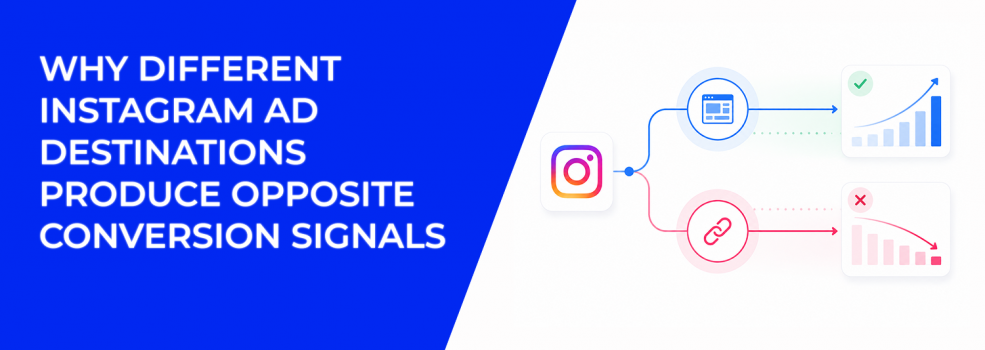
Many Instagram advertisers assume all clicks signal the same type of interest.
They do not.
A user who opens an Instagram profile behaves differently from a user who taps into a product page. Someone starting a DM conversation often carries different intent from someone visiting a landing page directly.
The problem is that these behaviors frequently get grouped into the same engagement metrics. That creates misleading optimization signals.
Problem: Different Destinations Reflect Different Types of User Intent
Instagram destinations produce opposite conversion patterns because users interact with each environment differently.
A website visit usually signals higher commitment because the user agrees to leave Instagram and continue exploring externally. A profile tap often signals trust-checking behavior instead of purchase readiness. DM starts usually indicate hesitation, clarification needs, or service-related intent.
These actions should not be interpreted equally.
But many advertisers still optimize campaigns using blended click metrics. That hides important behavioral differences inside the funnel.
For example, two campaigns may generate similar CTRs while producing opposite outcomes:
- one campaign drives high product-page engagement and purchases;
- another generates mostly profile visits with weak downstream conversions.
Inside Ads Manager, both campaigns can initially appear successful.
This is why the signal vs intent framework matters in Instagram advertising. The interaction itself is not enough. The destination changes what the interaction actually means.
The issue becomes more obvious during scaling.
Meta starts optimizing toward whichever interaction pattern receives the strongest engagement momentum early in delivery. If profile taps dominate performance, the platform may keep finding users likely to repeat low-commitment browsing behavior. If product-page visits dominate, the algorithm often shifts toward users with stronger commercial intent.
That is why two campaigns with similar click volume can produce completely different CPA trends over time.
Solution: Evaluate Each Destination as a Separate Conversion Environment
The best way to diagnose destination behavior is to treat every destination type as its own intent layer instead of combining all engagement together.
The most important distinction is understanding what each destination naturally encourages users to do.
Instagram Profiles Usually Produce Validation Signals
Profile visits often happen when users need more trust before committing.
They check posts, comments, highlights, follower quality, and posting consistency. This behavior is common with cold audiences, creator brands, local businesses, and visually driven offers.
High profile activity is not automatically negative.
But it becomes a weak signal when users repeatedly stop there without progressing toward DMs, website visits, or purchases.
Website Visits Usually Produce Higher Commitment Signals
Website taps require users to leave Instagram completely.
That usually means stronger commercial intent, especially when users continue exploring product pages, pricing sections, or checkout flows afterward.
But website traffic also exposes friction immediately. Weak landing pages, slow load times, confusing messaging, or poor mobile UX often cause sudden drop-offs after otherwise strong ad engagement.
This is why destination behavior often explains performance problems faster than CTR does. Articles about how user intent differs across Meta platforms show this pattern clearly.
DM Starts Often Signal Clarification Intent
DM conversations behave differently from both profiles and websites.
Users entering DMs usually want answers before making a decision. This is especially common in service businesses, high-ticket offers, coaching, local services, or products requiring customization.
The quality of the conversation matters more than the message start itself.
A campaign generating fewer clicks but stronger DM conversations can outperform a campaign producing massive low-quality website traffic.
Product Page Visits Usually Signal the Strongest Purchase Intent
Users tapping directly into product pages often show the clearest buying behavior.
These visitors are usually closer to commercial action, especially when paired with:
- add-to-cart behavior;
- checkout progression;
- repeat visits;
- low bounce rates.
This is why high buying intent matters far more than engagement volume alone.
A smaller amount of strong product-page traffic often outperforms large volumes of profile browsing behavior.
Why Misreading Destination Signals Leads to Poor Optimization
The biggest mistake advertisers make is optimizing every destination using the same success metric.
A profile-heavy campaign should not be judged like a direct-response product-page campaign. A DM-focused campaign should not be measured using the same logic as cold landing-page traffic.
When those distinctions disappear, optimization decisions become unstable.
Advertisers pause strong awareness campaigns too early. They scale low-intent engagement campaigns incorrectly. They rebuild creatives when the real issue sits inside destination behavior.
This is why articles explaining high buying intent and behavioral signal quality matter so much for Instagram optimization.
Destination-level analysis fixes the problem because it reveals where intent strengthens and where it collapses.
Final Takeaway
Instagram ad destinations produce different conversion signals because users behave differently inside each environment.
A profile tap, website visit, DM conversation, and product-page click all reflect different levels of intent. Treating them as identical engagement signals usually leads to poor optimization decisions.
The advertisers who understand destination behavior correctly make better scaling decisions, diagnose funnel problems earlier, and avoid optimizing around shallow engagement patterns.