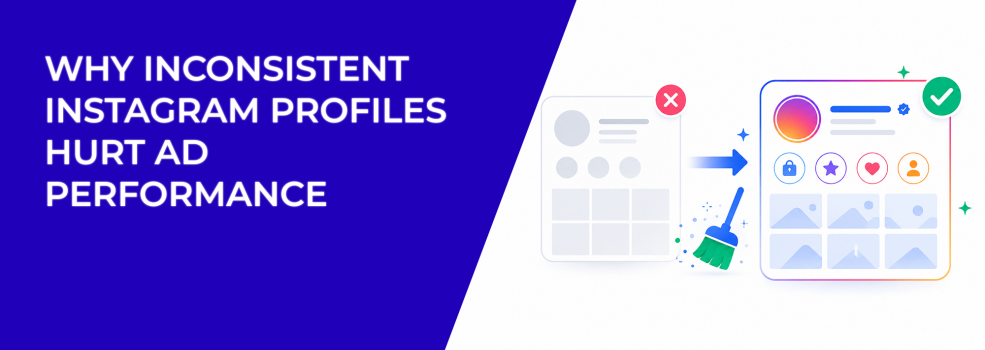
Some Instagram campaigns fail because the ad and the profile feel like two different businesses.
The ad may position the brand as premium, specialized, or highly focused. Then the user opens the Instagram account and finds random content, inconsistent visuals, outdated promotions, or messaging that does not match the campaign.
That disconnect creates friction immediately.
The problem is not always obvious inside Ads Manager because the campaign can still generate clicks and engagement. But conversion quality drops because users lose confidence once they inspect the account behind the ad.
Why Consistency Matters More on Instagram Than Other Placements
Instagram compresses brand evaluation into a very short interaction.
Users move quickly between the ad, profile, Stories, Highlights, and comments. They form an opinion before reading a landing page headline.
That makes consistency unusually important.
A mismatch between the ad and the profile often creates questions like:
- Is this the same product shown in the ad?
- Is this business still active?
- Does this brand actually specialize in this service?
- Why does the ad feel polished while the account feels random?
Those questions slow down the buying decision.
Even strong creatives struggle when the profile weakens the positioning established inside the ad itself.
How Inconsistency Quietly Reduces Conversion Rates
Most advertisers focus on CTR first.
The problem is that inconsistent profiles usually damage conversion efficiency after the click, not before it.
The campaign can still attract attention while producing weaker downstream behavior.
You often see patterns like:
- Strong engagement but weak purchase intent.
- High traffic with low time-on-site quality.
- Good lead volume with poor lead qualification.
- Rising CPA despite stable CPC.
This happens because users become uncertain midway through the decision process. The ad creates interest, but the profile introduces doubt.
Campaigns that feel structurally aligned usually convert more efficiently because users do not need to mentally “re-evaluate” the business after clicking.
That is why many advertisers run into situations where ads look great but still don’t sell, especially when the surrounding brand environment feels disconnected.
The Most Common Instagram Profile Inconsistencies
The issue is usually operational, not visual.
Many businesses build ads around one offer while the Instagram account reflects months of unrelated posting history. That weakens the campaign narrative.
Common examples include:
- Service ads leading to profiles filled with generic motivational posts.
- Ecommerce ads promoting one product while the profile pushes unrelated categories.
- High-ticket offers paired with low-quality organic visuals.
- Modern ad creatives connected to outdated branding or messaging.
Users notice these contradictions faster than advertisers expect.
The Instagram profile becomes a credibility filter. When the account feels inconsistent, the campaign starts attracting attention without maintaining confidence.
Why Native-Looking Campaigns Usually Convert Better
Instagram users respond better when the ad experience feels integrated with the platform.
That does not mean ads should look amateur. It means the transition from ad to profile should feel natural.
When the visual style, tone, offer positioning, and content structure remain consistent, the user experiences less friction.
That is one reason why brands that make Instagram ads look more native and perform better often see stronger conversion efficiency even without dramatically changing targeting.
The user stays inside a coherent experience instead of feeling pushed between disconnected messages.
How Profile Inconsistency Confuses Meta’s Optimization Signals
Profile inconsistency affects users first, but it eventually affects delivery too.
When users click the ad but hesitate afterward, Meta receives weaker behavioral feedback. The platform still sees interaction, but fewer strong conversion signals return to the system.
Over time, optimization becomes less efficient.
Meta may start finding users who react to the creative style without actually fitting the offer. That can create unstable lead quality, weaker ROAS, and inconsistent scaling behavior.
This becomes especially important for advertisers running broad campaigns or scaling aggressively. Weak post-click consistency often compounds as spend increases.
How to Align the Profile With the Campaign
The goal is not to redesign the entire Instagram account before every launch.
The goal is to create visible continuity between the ad and the account users inspect afterward.
Start with the elements users see first:
- Bio positioning.
- Pinned posts.
- Highlight categories.
- Recent content themes.
- Visual tone.
If the campaign promotes a specific offer, the profile should reinforce that offer clearly within the first few seconds.
For advertisers using LeadEnforce audiences built from Instagram followers, engagers, or niche communities, this alignment becomes even more important. Better targeting creates stronger audience intent, but the profile still needs to confirm that the business matches user expectations.
Final Takeaway
Instagram ads perform worse when the profile experience breaks the momentum created by the ad.
Users notice inconsistency quickly. If the account feels disconnected from the campaign message, trust drops before the landing page even loads.
Before changing budgets or rebuilding creatives, review whether the Instagram profile actually supports the positioning inside the ad. Cleaner message alignment often improves conversion quality faster than another round of creative testing.