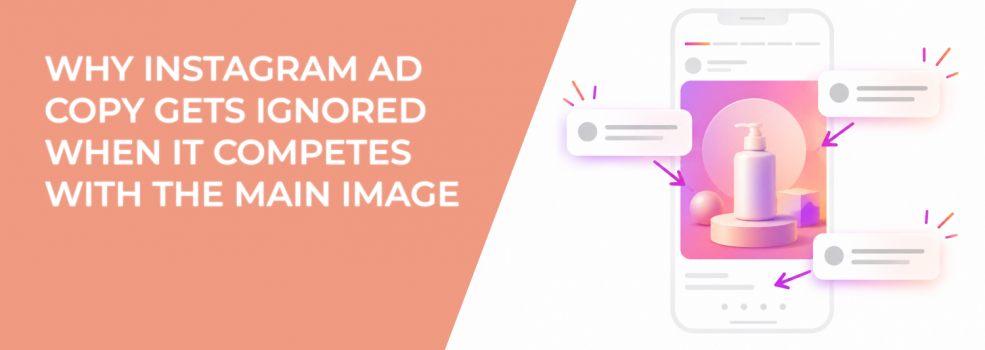
Some Instagram ads fail because the image and the copy compete against each other instead of working together.
The image grabs attention first, but the text tries to pull attention somewhere else. Users notice the creative briefly, yet the message becomes harder to process because the layout creates two competing focal points.
This usually lowers CTR and weakens conversion intent. The ad may look visually impressive, but users leave without understanding the actual offer.
Why Instagram ad copy gets ignored when the image dominates attention
Instagram is a visual-first platform. People react to shapes, faces, colors, and movement before they consciously read headlines.
When the image becomes visually stronger than the copy, the message loses priority immediately.
This often happens in:
- Lifestyle creatives where aesthetics overpower the value proposition.
- Ecommerce ads filled with bright products, badges, and overlays.
- SaaS creatives using large interface screenshots with tiny supporting text.
- Fashion ads where branding dominates while the actual offer feels secondary.
The user notices the image but fails to understand what action the ad wants them to take.
That creates shallow engagement. The ad may collect likes or video views, but click quality weakens because the copy never becomes the dominant informational signal.
The article about what people notice first in ads explains how visual dominance changes user behavior across paid social placements.
How competing visuals reduce CTR and conversion quality
Strong visuals are important, but they should support the message instead of competing with it.
When the image becomes too dominant, several performance problems usually appear:
- Users remember the visual but forget the offer.
- The creative attracts curiosity clicks instead of buying intent.
- The CTA becomes visually secondary and easier to ignore.
- The ad creates attention without creating clarity.
You can often diagnose this inside Ads Manager through patterns like high engagement combined with weak outbound CTR or unstable conversion rates.
This problem becomes expensive during scaling because Meta continues finding users who react emotionally to the visual while failing to find users who fully understand the offer.
How to stop Instagram ad copy from competing with the image
The solution is not weakening the visual completely. The goal is building hierarchy where the image and the copy reinforce the same idea.
High-performing creatives usually follow a simple structure:
- The image introduces the emotional hook.
- The headline explains the value quickly.
- The CTA completes the action path.
Several adjustments improve this immediately:
- Reduce unnecessary visual elements around the headline.
- Increase contrast behind important text.
- Simplify the focal area so users know where to look first.
- Make the primary message visually dominant over decorative elements.
This creates faster comprehension and stronger message retention.
For more insight into attention mechanics, see the psychology of scroll behavior.
Why stronger hierarchy improves campaign efficiency
Better hierarchy improves more than CTR. It also improves the quality of the traffic entering the funnel.
When users understand the message immediately, campaigns usually see:
- More qualified clicks.
- Better landing page engagement.
- Lower CPA instability.
- More consistent conversion behavior during scaling.
This matters even when targeting is strong.
LeadEnforce helps advertisers build high-intent audiences using Instagram engagement data, followers, and social profile signals. But even precise targeting performs poorly if the creative itself creates internal competition between the image and the copy.
The ad still needs one dominant attention path.
For more examples of hierarchy-driven creative structure, review how visual hierarchy determines click-through rates.
The strongest Instagram ads do not force users to choose between the image and the message. The visual supports the copy, the copy supports the offer, and the entire creative feels easy to understand within seconds.