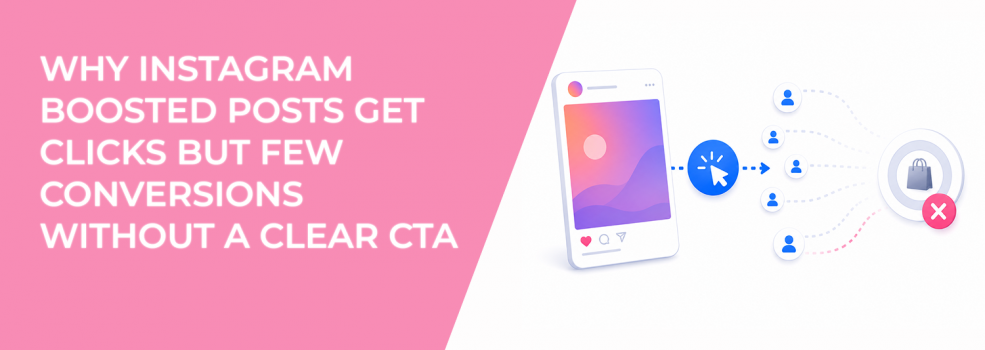
Instagram makes it easy to boost a post that is already getting attention.
A Reel collects views, a carousel receives comments, and engagement starts building. Many advertisers see those signals and put budget behind the post. The traffic arrives, but conversions remain disappointing.
When this happens, targeting is often blamed first. Sometimes the audience is the issue, but many boosted posts struggle for a simpler reason. Users never receive clear instructions about what to do after they engage with the content.
Engagement does not automatically create conversions
Organic content and advertising content often serve different purposes.
An organic post can succeed by entertaining, educating, or starting a conversation. A conversion-focused ad has a different job. It needs to move users toward a specific action that creates business value.
Problems appear when advertisers boost content that was designed for engagement but never adapted for conversion. Users consume the content, enjoy it, and continue scrolling because nothing tells them what should happen next.
This creates a common pattern inside Ads Manager. CTR may look healthy, CPC may remain reasonable, and traffic continues arriving. Meanwhile, leads, purchases, or bookings stay flat.
Users rarely create the next step on their own
Most people do not actively search for the next stage of the buying process.
A user may agree with your message, like your product, and still leave without taking action. The issue is not necessarily lack of interest. The issue is uncertainty.
Imagine a local service company boosting a customer success story. The post explains the outcome, includes attractive visuals, and generates clicks. Once users finish reading, however, they are left wondering whether they should visit the website, request a quote, send a message, or simply follow the account.
Every unanswered question increases the chance of abandonment.
What a missing CTA does to campaign performance
A missing CTA affects more than conversion rate.
When users behave inconsistently after clicking, Meta receives weaker optimization signals. Some visitors browse the website, others leave immediately, and only a small percentage continue toward conversion.
Over time, this inconsistency makes it harder for the platform to identify which users are most likely to complete the desired action.
Advertisers often notice the problem through a combination of symptoms:
- Click volume grows while conversions stay stagnant.
- Landing page traffic increases without a corresponding increase in leads.
- Cost per conversion rises despite stable CPC.
- Campaign performance looks healthy at the top of the funnel but weak at the bottom.
The campaign generates activity. It does not generate enough business outcomes.
The solution is to make the action obvious
A CTA should remove uncertainty. When users finish consuming the ad, they should immediately understand what action to take and why they should take it.
The best CTAs create a direct bridge between the content and the conversion goal. A post promoting a free consultation should clearly invite users to book a consultation. A software demo campaign should encourage users to schedule a demo. A lead magnet should tell users exactly how to access the resource.
Advertisers who learn how to structure a high-converting ad usually discover that the CTA is not a small detail added at the end. It is part of the conversion path itself.
The CTA should match the offer
Specificity matters.
Many boosted posts rely on generic prompts such as "Learn More" even when a more direct action would perform better. While broad CTAs can generate clicks, they often attract users with different levels of intent.
A company offering free estimates may see stronger results from "Request Your Estimate" than from "Learn More." The second option creates curiosity. The first creates direction.
The same principle appears in campaigns that are losing conversions because of ad copy. In many cases, the copy successfully earns attention but fails to guide users toward a clear outcome.
Better direction often improves conversion efficiency
A clear CTA helps both the user and the algorithm.
Users understand what happens next, which reduces hesitation. Meta receives stronger behavioral signals because more people follow the intended path. As the platform gathers cleaner conversion data, campaign efficiency often improves as well.
This becomes even more important when you match ad copy to funnel stage. A cold audience may respond well to downloading a guide, while a warm audience may be ready to book a consultation. The CTA should reflect the user's position in the buying journey.
Final takeaway
Many boosted Instagram posts fail after the click, not before it.
The creative succeeds in attracting attention, but attention alone does not create conversions. If users are not told what action to take next, many will leave without moving deeper into the funnel.
Before changing audiences or increasing budget, review the CTA. A clearer next step can sometimes produce a larger performance improvement than a completely new campaign.