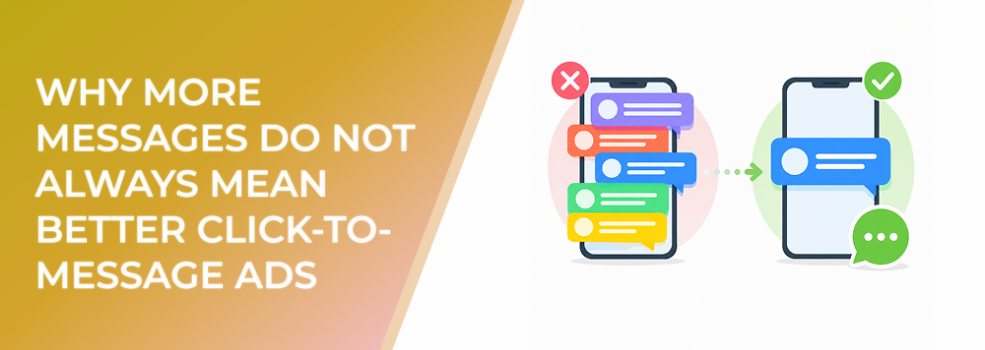
Click-to-message ads can feel like a fast win.
You launch a campaign, the inbox fills up, cost per messaging conversation looks reasonable, and the campaign seems healthier than your traffic or lead-form campaigns. For agencies, SMBs, service businesses, ecommerce brands, and B2B teams, that kind of visible engagement is encouraging.
But more messages do not automatically mean better advertising.
A campaign can generate dozens of chats and still fail to produce qualified leads, bookings, quotes, demos, purchases, or pipeline. Meta’s measurement materials position click-to-message performance as something advertisers should evaluate through Ads Manager insights, not just surface-level activity. Meta also defines cost per messaging conversation started as spend divided by attributed messaging conversations started, which means the metric is useful but still narrow.
The real question is not “How many people messaged us?” It is “How many of those conversations were worth paying for?”
The Problem
The core problem is simple: advertisers often treat message volume as proof of campaign success.
That creates a misleading picture. A user who taps a quick reply, asks “price?”, and disappears is counted very differently by the business than a user who shares their need, confirms fit, requests a quote, books a consultation, or completes a purchase.
Yet inside campaign reporting, both can appear as message activity.
This is especially dangerous in click-to-message campaigns because the first conversion step is intentionally easy. The ad removes landing-page friction and opens a direct chat. That can be excellent when the audience is qualified and the chat flow is structured. It can be expensive when the campaign attracts curiosity instead of buying intent.
The issue is not that message volume is useless. It is that message volume is an incomplete success metric.
Why This Problem Hurts Performance
When marketers optimize only for more conversations, they risk improving the cheapest visible metric while weakening business efficiency.
This can hurt performance in several ways:
A campaign may lower cost per message while raising cost per qualified lead.
Sales teams may spend more time answering vague, low-fit inquiries.
Retargeting audiences may fill with people who chatted but never showed real intent.
Budget may shift toward ad sets that create activity, not revenue.
Scaling becomes risky because increasing spend produces more inbox work without proportional sales growth.
For example, a Messenger ad might generate many cheap conversations from people asking general questions. But if only a small percentage qualify, the real cost of a useful lead is much higher than the Ads Manager view suggests.
This is how a campaign can look efficient by cost per message and inefficient by CAC, CPA, or ROAS.
Common Scenarios Where This Happens
Local service campaigns
A cleaning company, clinic, salon, or repair business runs Messenger ads offering quotes or appointments. The inbox fills up with “How much?” messages, but many users are outside the service area, not ready to book, or looking for the cheapest possible option.
Ecommerce campaigns
A store runs click-to-message ads for product questions. Users ask about sizing, stock, or delivery, but few move to checkout because the ad attracted casual browsers rather than buyers.
B2B lead-generation campaigns
A SaaS company or agency promotes a consultation through Messenger or Instagram Direct. The campaign generates chats, but many users are students, freelancers, competitors, or businesses too small for the offer.
Agency-managed accounts
The media buyer reports strong message volume. The client’s sales team reports poor lead quality. Both are technically right because they are judging different outcomes.
Startup testing campaigns
A startup sees lots of messages and assumes product-market interest. After reviewing the chats, most conversations are vague, price-sensitive, or not aligned with the intended ICP.
Why the Problem Happens
This problem usually comes from a mismatch between what the campaign is optimized to generate and what the business actually needs.
Click-to-message campaigns reduce friction. That is their strength. But lower friction also means more low-commitment actions can enter the funnel.
The most common causes include:
The ad promise is too broad and attracts curiosity.
The audience is loosely matched to the offer.
The first automated reply does not qualify intent.
The campaign reports conversation starts but not qualified outcomes.
Sales treats every message as equal.
No one compares message cost against close rate, booked-call rate, or revenue.
In other words, the campaign is producing conversations, but the business has not defined what a valuable conversation looks like.
The Solution
The solution is to shift from message volume tracking to conversation quality tracking.
A better click-to-message measurement framework should separate all conversations into practical stages.
Start with these core categories:
New message conversation: the user opened or started a chat.
Engaged conversation: the user replied beyond the first tap or quick response.
Qualified conversation: the user matched key fit criteria such as need, location, budget, timeline, company size, or product interest.
Sales-ready conversation: the user requested a quote, booked a call, asked for availability, clicked a checkout link, or accepted a handoff.
Revenue-linked conversation: the user became a customer, booked appointment, paid deposit, or entered a meaningful CRM stage.
Once you define these stages, you can calculate more useful efficiency metrics:
Cost per qualified conversation.
Cost per sales-ready conversation.
Cost per booked call or quote request.
Chat-to-qualified-lead rate.
Qualified-chat-to-sale rate.
Revenue per conversation.
These metrics reveal whether more messages are actually improving acquisition efficiency.
A campaign with fewer messages but a higher qualified-chat rate may be more profitable than a campaign with cheaper, higher-volume conversations.
How LeadEnforce Helps
LeadEnforce is relevant when message quality is partly an audience problem.
If your ads are reaching people who are too broad, too cold, or poorly matched to your offer, even a strong chat flow will struggle. LeadEnforce helps advertisers build more relevant custom audiences from high-intent social sources before the campaign starts.
For example, advertisers can build audiences from Facebook group members who are already gathered around a niche topic, Instagram followers or engaged profile audiences connected to relevant brands or creators, LinkedIn-derived professional data for B2B campaigns, and custom social-profile data where appropriate. LeadEnforce’s own feature pages describe Facebook group targeting, Instagram follower targeting, LinkedIn-based audience creation, and custom audiences from social profile links.
This does not replace qualification, creative quality, offer strength, or proper message handling. But it can reduce the chance that your click-to-message campaign starts by attracting the wrong people.
A practical workflow looks like this:
Define what a qualified message means.
Identify communities, profiles, groups, or professional segments that match that definition.
Build a more relevant audience using LeadEnforce where the source data is appropriate.
Launch click-to-message ads to that audience.
Measure qualified conversations, not just conversation starts.
This keeps LeadEnforce in the right role: improving audience relevance so the campaign has a better chance of generating conversations worth following up.
Risks and Considerations
Do not solve every message-quality problem by narrowing the audience.
Sometimes the real issue is the offer, the ad promise, the first reply, slow sales response, or weak qualification. A highly relevant audience can still produce weak outcomes if the chat experience is confusing or too slow.
Also consider audience size. If your source audience is too small, delivery may become unstable or frequency may rise too quickly. If your audience is too broad, the campaign may drift toward cheaper but weaker conversations.
For regulated industries or sensitive categories, make sure your audience strategy, ad copy, and message flow follow applicable platform rules and privacy requirements.
Prerequisites and Dependencies
Before shifting budget into click-to-message campaigns, make sure these foundations are in place:
A clear ICP and disqualification criteria.
A defined qualified-message event.
A first reply that continues the ad promise.
A short set of qualification questions.
A response process for sales or support.
Enough budget to test without overreacting to early noise.
A way to compare chat outcomes with pipeline or revenue.
Relevant source audiences if using LeadEnforce.
The campaign cannot optimize toward business value if the business has not defined business value.
Practical Recommendations
Start by auditing your last 50 to 100 message conversations. Label each as low intent, medium intent, qualified, or sales-ready.
Then compare each ad set by qualified-message rate, not only cost per message. A campaign that looks expensive at the conversation level may become the winner once qualification is included.
Rewrite the first automated reply so it moves users toward the promised next step. If the ad says “get a quote,” the first reply should start the quote path. If the ad says “book a consultation,” the first reply should ask about availability or fit.
Use audience testing to compare broad, retargeting, lookalike, and high-intent custom audiences. When using LeadEnforce, test audiences based on relevant Facebook groups, Instagram profiles, or professional segments against your current targeting.
Scale only when cost per qualified conversation and downstream conversion rates remain stable.
Final Takeaway
More messages are only valuable when they create more qualified opportunities.
Click-to-message ads should not be judged by inbox activity alone. They should be judged by how efficiently conversations move from first message to qualified intent, sales handoff, and revenue.
A smaller number of high-intent conversations will usually beat a crowded inbox full of empty chats.
To test more relevant click-to-message audiences before scaling, join the free 7-day LeadEnforce trial period.
Related LeadEnforce Articles
- How To Qualify Messenger Ad Leads Inside The Chat Before Sales Wastes Time — Useful for turning raw message volume into qualified sales conversations.
- Why The First Messenger Auto-Reply Can Break Purchase Intent In Click-To-Message Ads — Helps diagnose why interested users drop after the first chat interaction.
- Why Messenger Campaigns Need Clear Handoff Events Before Meta Can Find Buyers — Explains why advertisers need deeper outcome signals beyond conversation starts.
- How To Shorten Messenger Sales Flows Without Losing Buyer Qualification — Shows how to reduce chat friction without removing sales context.