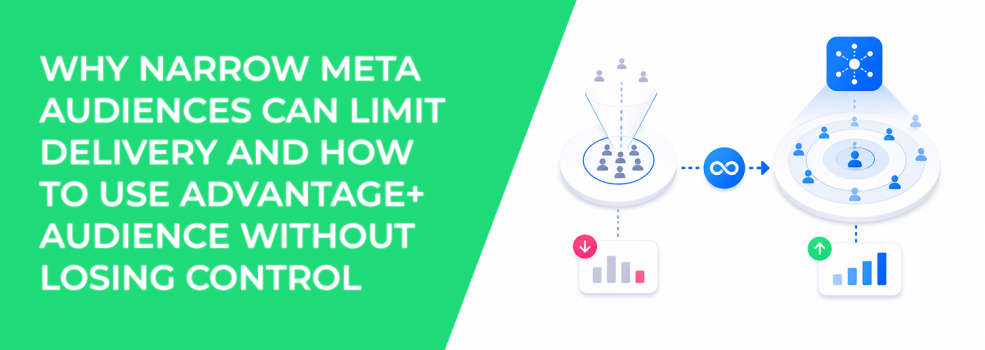
A narrow audience can look safe inside Ads Manager, especially when you know exactly who buys. The problem starts when that tight audience gives Meta too few auction opportunities to test, compare, and stabilize delivery.
This often shows up as low reach, high CPM, slow spend, or unstable CPA. The campaign may not look broken at launch, but the delivery system has less room to find conversion patterns.
Meta’s audience setup has moved away from strict manual control as the default. Advantage+ Audience gives the system more room to find likely buyers, but that freedom only works when the campaign still has clear inputs, clean constraints, and enough conversion data to learn from.
When a precise audience becomes a delivery problem
A small audience is not automatically bad. It becomes a problem when the audience is too limited for your budget, conversion volume, or campaign objective.
For example, a B2B SaaS advertiser may target only founders, in one country, with three niche interests, and a narrow age range. The setup feels logical, but Meta may only find a small number of eligible users in each auction. Once those users see the ads several times, frequency rises and CPM starts climbing.
This is why advertisers often see decent CTR but poor scaling. The creative gets attention from a small pocket of people, but the ad set cannot find enough similar users to keep CPA stable.
If your Facebook ad audience is too narrow, the issue is not always the offer or creative. Sometimes the campaign simply has no room to breathe.
How narrow targeting affects CPC, CPA, and ROAS
Narrow audiences usually hurt performance through delivery pressure. Meta must compete for a smaller pool of impressions, so auction costs can rise faster than conversion quality improves.
The most common pattern looks like this:
- CPM increases before conversion volume improves. Meta keeps entering auctions for the same limited user pool, so impression cost rises without better intent.
- Frequency climbs early. The same people see the ad again before Meta has found enough new users with similar behavior.
- Learning slows down. The ad set receives fewer conversion signals, which makes CPA more volatile.
- ROAS becomes harder to scale. A small profitable segment can work at low spend, then break when budget increases.
This is why a narrow audience may produce good early results, then fail at the first scaling attempt. The ad set is not necessarily worse. It has just reached the edge of its usable audience.
Why Advantage+ Audience needs room, not blind trust
Advantage+ Audience works best when Meta has enough freedom to search beyond your initial inputs. That does not mean you should remove every control and hope the algorithm finds buyers.
A better approach is to separate hard constraints from helpful guidance.
Hard constraints are things that truly define eligibility. Location, language, age limits, product availability, and compliance rules usually belong here. Audience suggestions are different. They help Meta understand where to start, but they should not behave like a locked box.
This distinction matters for lead generation. A local legal firm cannot advertise outside its service area. But it may not need to stack ten interests related to legal advice, small business ownership, taxes, and entrepreneurship. That kind of setup can block delivery before the algorithm has enough data.
When LeadEnforce can work as an alternative to Advantage+ targeting
Advantage+ Audience can work well when Meta already has good data.
For example, it helps when your ad account already has:
- regular purchases;
- enough pixel events;
- clear data on who usually converts.
But not every advertiser has this. New campaigns, local services, niche B2B offers, and high-ticket products often do not have enough data yet.
In that case, Advantage+ can go too broad. Meta may find people who click or fill out a form, but they may not be real buyers.
This is where LeadEnforce can help. Instead of starting with a very broad audience, you can use LeadEnforce to build a more specific audience from:
- Facebook groups;
- Instagram followers;
- Instagram engagers;
- social profile data.
For example, a SaaS company selling to agency owners may not want to target a broad “marketing” audience. That audience can include students, freelancers, creators, and people who just like marketing content.
With LeadEnforce, the advertiser can build an audience from agency-related Facebook groups or competitor Instagram accounts. This is useful when you want to build your target audience from a Facebook group, or when you need a clearer way to understand what is possible with targeting Facebook groups with ads.
So the campaign starts with people who are already closer to the market.
This does not mean going back to tiny audiences. It means giving Meta a cleaner starting point before testing broader targeting, lookalikes, or Advantage+ again.
How to loosen targeting without losing relevance
The fix is not “go broad” for every campaign. The fix is to give Meta enough auction space while feeding it better signals.
Start with the audience restriction that has the weakest performance logic. If you added an interest because it sounded relevant, not because past buyers proved it mattered, remove it first. Then watch CPM, frequency, reach, and cost per result for several days.
A practical cleanup process looks like this:
- Keep only non-negotiable constraints. Use location, language, and compliance filters where they directly affect eligibility or sales coverage.
- Move assumptions into audience suggestions. Treat interests and behaviors as starting points, not as walls around delivery.
- Use exclusions carefully. Exclude customers or unqualified segments only when they clearly waste spend.
- Judge the change by CPA and lead quality, not only CPC. Looser delivery may reduce CPC while still attracting poor-fit traffic if the signal inputs are weak.
If Advantage+ targeting becomes too broad too quickly, LeadEnforce can help you test precision before scaling. A cleaner group-based or Instagram-based audience can reveal whether the offer performs better with people already connected to the category. From there, you can decide whether to scale with Advantage+ Audience, lookalikes, or a broader prospecting structure.
How to know the audience has enough room
You do not need to guess whether the audience is too tight. Ads Manager usually gives clues.
Check whether spend is pacing normally. If the campaign struggles to spend, the audience may be too small or the bid strategy may be too restrictive. If CPM rises while CTR and conversion rate stay flat, the audience may be saturated.
Frequency is another useful signal. If frequency climbs quickly in a prospecting campaign, Meta may be cycling through the same users too often. That usually means the audience is too narrow for the budget or the creative is not opening new pockets of demand.
Final takeaway
Narrow Meta audiences create control, but too much control can block delivery. Advantage+ Audience works better when you keep real business constraints, remove weak assumptions, and give Meta enough room to learn.
LeadEnforce is useful when you do not want to rely only on Advantage+ targeting. It can help you build more intentional audiences from Facebook groups, Instagram followers, engagers, and social profile data before moving into broader scaling.
The best setup is not fully broad or painfully narrow. It is guided enough to stay relevant and open enough to keep delivery stable.