A common Instagram ads mistake happens before optimization even starts.
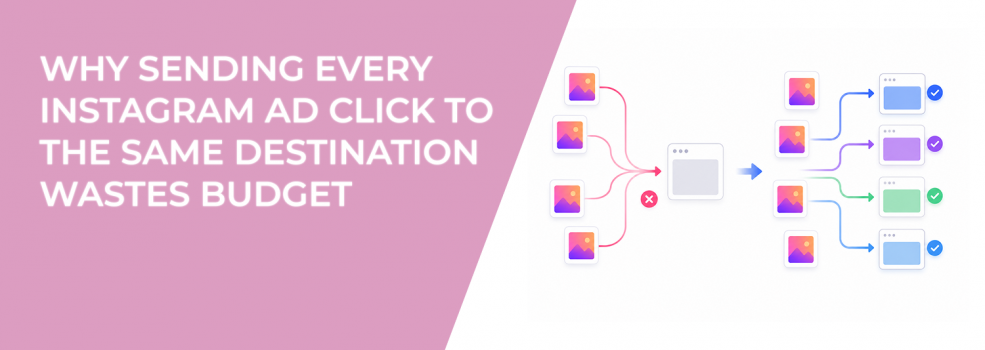
The advertiser chooses one destination — usually a website landing page — and sends every click there regardless of campaign intent, placement behavior, or audience temperature.
At first, the campaign may look healthy. CTR stays high. CPC remains acceptable. Traffic volume grows. Then CPA rises unexpectedly.
The problem is often not the creative or targeting. It is the destination strategy.
Instagram users behave differently depending on where they click. Someone tapping into a profile behaves differently from someone opening a DM conversation. A Stories viewer interacts differently than a Feed scroller.
When every interaction gets forced into the same destination flow, Meta starts optimizing around mixed signals. That usually lowers conversion efficiency over time.
Instagram users do not show the same intent across destinations
A website click is not always a buying signal.
In many Instagram campaigns, users click because they want to:
- check the brand profile before trusting the ad;
- ask a quick question in DMs;
- browse products casually;
- save content for later research;
- compare pricing with competitors.
If all traffic gets pushed directly to a landing page, a large percentage of users leave immediately.
This creates an expensive pattern inside Ads Manager:
- strong CTR;
- weak landing page engagement;
- low conversion rate;
- rising cost per purchase.
Meta still sees click activity, so delivery continues aggressively. The algorithm interprets engagement as positive momentum even when downstream intent remains weak.
That disconnect quietly burns budget.
This is especially common in Instagram placements where browsing behavior dominates purchase behavior, including Stories and Reels traffic.
Different destinations produce different conversion signals
Instagram effectively supports three major destination types:
- website;
- Instagram profile;
- direct messages.
Each creates different optimization signals.
Website traffic generates the strongest purchase-tracking visibility when pixel setup is accurate. This usually works best for high-intent offers and short buying cycles.
Profile visits often work better during early consideration stages. Users explore social proof, reviews, tagged content, and posting consistency before converting later.
DM destinations frequently outperform landing pages for service businesses, local businesses, consultants, and high-ticket products where friction reduction matters more than immediate checkout speed.
A campaign can fail simply because the wrong destination was paired with the wrong audience temperature.
A cold audience rarely behaves like branded search traffic.
Why this increases CPC and CPA over time
Meta’s optimization system reacts to post-click behavior quickly.
If landing page exits rise after clicks, the algorithm starts detecting weaker conversion probability within that audience cluster. CPM often rises shortly afterward because Meta must search wider inventory pools to maintain delivery.
This creates a familiar pattern inside performance reports:
- CTR stays stable;
- CPM slowly climbs;
- outbound conversion rate drops;
- CPA increases week after week.
Many advertisers respond by changing creatives too early.
The real issue may be that the destination no longer matches user intent.
A profile destination may have worked better for discovery-stage traffic. A DM flow may have filtered higher-intent leads faster. A lightweight in-platform interaction may have reduced bounce rates enough to stabilize optimization.
This is why advertisers trying to align your ads with buyer intent usually improve performance faster than advertisers endlessly rotating creatives.
Destination testing shows where friction actually happens
Most advertisers test creatives and audiences.
Far fewer test destinations.
That creates blind spots in optimization.
A simple destination test often reveals dramatic differences in user quality even when the same creative is used.
For example:
- Reels traffic may generate cheaper profile visits but poor website conversions;
- Feed traffic may produce stronger product-page engagement;
- Story traffic may convert better through DMs because users remain inside Instagram;
- returning visitors may prefer website checkout while cold users need profile validation first.
These differences become even more visible when comparing placements side by side using what performs better for each funnel stage frameworks.
Without destination testing, advertisers often blame the wrong variable.
High CTR can hide weak destination fit
Some of the worst-performing Instagram campaigns produce excellent click metrics. This happens because clicks measure attention, not intent.
A curiosity-driven creative may attract cheap traffic while generating almost no meaningful downstream behavior.
The destination mismatch amplifies the problem. For example, an impulse-oriented Reel may drive massive landing page traffic but weak checkout completion because users were never ready for a purchase flow.
That explains why campaigns sometimes show:
- low CPC;
- strong engagement;
- weak ROAS;
- unstable lead quality.
Advertisers dealing with low CPC but conversions stay flat are often looking at a destination problem disguised as a traffic problem.
How to structure destination testing correctly
Destination testing only works when variables stay isolated.
Do not change:
- audience;
- creative;
- optimization event;
- placements.
Change only the destination.
Run enough spend to compare downstream behavior, not just click metrics.
The most useful comparison points are:
- landing page views;
- profile engagement depth;
- DM reply rate;
- add-to-cart behavior;
- qualified lead rate;
- purchase rate by placement.
In many campaigns, profile visits create lower immediate ROAS but higher long-term conversion efficiency because they warm users before purchase.
DM flows often reduce wasted clicks by filtering users before they ever reach the website.
Website flows usually win only when purchase intent already exists.
Final takeaway
Instagram ads fail when advertisers assume every click represents the same intent. It does not.
Some users want validation. Some want conversation. Some are ready to buy immediately.
When every interaction gets forced into a single destination flow, Meta optimizes around mixed behavioral signals. CPC rises, CPA climbs, and conversion efficiency weakens.
Destination testing fixes this by matching traffic behavior to the correct next step instead of treating all clicks equally.