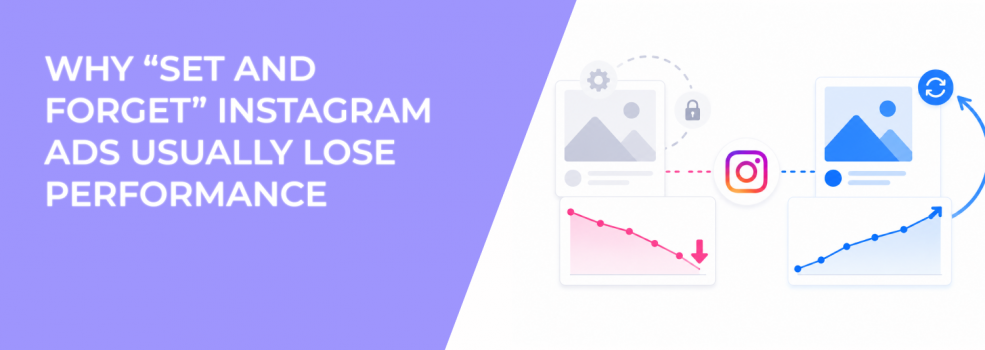
Many Instagram campaigns do not fail because the targeting is wrong or the offer is weak. They fail because nothing changes after launch.
A campaign performs well during the first few days, so the advertiser leaves it untouched. The same creatives keep running. The same hooks keep repeating. The same engagement patterns keep feeding Meta’s optimization system.
At first, results look stable. Then performance starts slipping gradually.
CTR weakens. Frequency rises. CPA becomes less predictable. Eventually, the campaign stops scaling efficiently even though the ad itself still looks “fine.”
This is one of the most common reasons Instagram ads lose performance over time.
Why Static Instagram Campaigns Gradually Stop Working
Instagram’s delivery system depends heavily on engagement freshness.
When a campaign launches, Meta quickly identifies the strongest responders inside the audience. Those users generate the cheapest clicks and strongest conversion signals early in the campaign lifecycle.
Over time, that behavior changes.
The audience becomes more familiar with the creative, and Meta starts expanding delivery toward weaker engagement clusters. The campaign keeps spending, but the quality of interaction slowly declines underneath the surface.
You can usually spot this pattern before ROAS fully drops:
- outbound CTR starts falling,
- saves and shares decline,
- frequency climbs faster than conversions,
- CPM becomes unstable despite unchanged targeting.
Most advertisers ignore these signals because the campaign is still technically generating results. They only react once CPA becomes expensive enough to force major changes.
By then, the campaign has already lost momentum.
This is why “set and forget” Instagram advertising rarely works long term.
Why Constant Rebuilds Usually Make the Problem Worse
Once performance declines, many advertisers overcorrect.
They duplicate campaigns, replace all creatives, edit targeting, and aggressively change budgets at the same time. That often resets optimization behavior and creates unstable delivery patterns.
Large campaign resets usually produce noisy data because too many variables change simultaneously.
Stronger advertisers take a different approach.
Instead of rebuilding everything, they continuously introduce small controlled variations:
- new hooks,
- revised first frames,
- different CTA structures,
- updated captions,
- alternative visual emphasis.
These smaller iterations help refresh engagement signals without destabilizing the campaign.
That is why advertisers with stable long-term performance usually operate structured testing systems rather than chasing one “perfect” ad.
This guide on build a repeatable testing process explains how experienced advertisers structure continuous optimization cycles without fragmenting spend.
Why Creative Fatigue Starts Before Most Advertisers Notice It
Creative fatigue rarely appears suddenly.
Most Instagram campaigns show weaker engagement quality long before conversion metrics collapse.
For example, advertisers often see:
- weaker profile visits,
- lower outbound CTR,
- declining watch retention,
- reduced saves and shares,
before CPA spikes significantly.
This becomes especially visible in Reels placements where repeated creative exposure loses effectiveness quickly.
One reason advertisers miss fatigue early is because CPC can remain relatively stable while click quality deteriorates underneath.
This article on creative fatigue early signals and fixes explains the engagement patterns advertisers usually overlook.
Why Better Campaign Iteration Produces Better Long-Term ROAS
The goal of Instagram advertising is not finding one winning creative and leaving it active forever.
The goal is creating a system that continuously generates new learning signals.
One hook may reveal stronger buyer intent. Another creative may attract lower-quality clicks. A revised CTA may improve conversion efficiency without increasing CPM.
Those insights compound over time when advertisers actively refine campaigns instead of passively monitoring them.
Many advertisers now pair this process with higher-intent audience segments built from Instagram engagers, creator followers, and niche communities. LeadEnforce helps advertisers build these audiences using Instagram follower and engagement data, which often creates more stable testing environments and cleaner optimization signals.
Advertisers who consistently improve performance usually are not making bigger changes than everyone else.
They are making smaller adjustments more consistently and turning campaign learnings into future optimization decisions.
This is why experienced media buyers regularly turn campaign learnings into strategy instead of treating Ads Manager like a passive reporting tool.
Final Takeaway
“Set and forget” Instagram advertising usually fails because static campaigns cannot adapt to changing engagement behavior and creative fatigue.
Instagram ads improve when campaigns continuously generate fresh learning signals through controlled iteration. The advertisers who maintain stronger ROAS over time are usually not rebuilding campaigns constantly.
They are testing, refining, and adjusting before performance collapses.