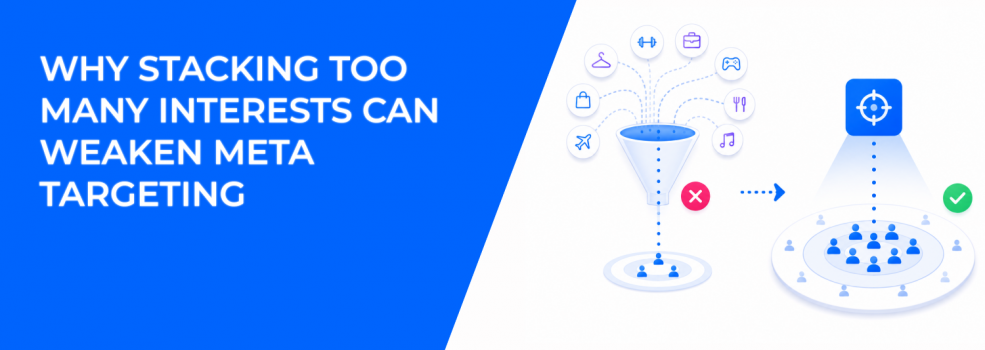
Adding more interests can feel like better targeting. You may think the more interests you add, the closer you get to the perfect buyer.
But that is not always how Meta works. When you stack too many interests, you can end up with a messy audience made of different people with very different reasons for clicking.
Why more interests do not always mean better targeting
A single interest can already be broad. For example, “digital marketing” can include agency owners, junior marketers, freelancers, students, creators, and people who just like marketing content.
If you add more broad interests on top of that, the audience may not become more precise. It may become more mixed, which makes it harder for Meta to understand who matters most.
This is a common problem in B2B campaigns. Advertisers add interests like “entrepreneurship,” “small business,” “marketing automation,” and “online advertising.” It sounds logical, but the audience may include many people who are not buyers.
So Meta starts testing different groups inside one ad set. Some people click because they are curious, while others may be closer to buying. The problem is that Meta may follow the easiest signal first.
That is why interest stacking for Facebook audience segmentation needs to be done carefully. It works better when each interest has a clear reason for being included.
How too many interests confuse Meta’s learning
Meta learns from what happens after delivery starts. If your audience includes too many different user types, Meta may not understand which group matters most.
You may see signs like:
- CTR looks good, but conversions stay low. People click, but they are not serious buyers.
- CPA changes a lot from day to day. Meta keeps testing different pockets of the audience.
- Lead quality is inconsistent. Some leads look good, but many are poor fit.
- Creative tests become unclear. A creative may win because it attracted the wrong people.
This is one of the costly Facebook Ads targeting mistakes that can be hard to spot. Ads Manager may show activity, but sales or revenue data shows the real problem.
When interest stacking can still work
Interest stacking is not always bad. It can work when every interest has a clear purpose and each ad set is built around one audience idea.
For example, an advertiser selling accounting software may test one audience around small business ownership and another around bookkeeping or accounting. That gives each ad set a clearer job.
The problem starts when advertisers add interests just because they sound related. “Related” is not enough.
Each interest should help answer a real campaign question, such as:
- Are agency owners better than general marketers?
- Do Shopify store owners convert better than broad ecommerce audiences?
- Do competitor-related audiences perform better than category interests?
If the ad set cannot answer a clear question, the audience is probably too messy. That makes the campaign harder to optimize because you do not know which group is helping or hurting performance.
How to simplify interest targeting
The fix is not always to remove interests completely. The fix is to make each audience easier to understand and easier to judge after launch.
Start by grouping interests by intent. For example, do not mix competitor interests, job-related interests, broad industry interests, and lifestyle interests into one ad set. Those people may behave very differently.
A cleaner setup:
- Group similar interests together. Keep competitor, category, profession, and problem-aware audiences separate when possible.
- Remove weak interests. If an interest only describes casual content consumption, it may not help.
- Test fewer audiences. Two clean tests are better than one large mixed audience.
- Check lead quality. A cheaper click does not matter if the lead never converts.
This also makes creative testing easier. If the audience is clearer, you can better understand whether the ad message worked or whether the targeting was the real issue.
Where LeadEnforce fits when interests are too broad
Interest stacking usually breaks when the interests describe the topic, but not the buyer.
For example, “real estate” can include agents, investors, renters, homeowners, students, and people who just watch property content. If you are selling software for real estate agents, that audience is too mixed. Adding more interests like “mortgage loans” or “property investment” may only make the audience messier.
This is where LeadEnforce can be useful. Instead of adding more broad interests, you can build an audience from people connected to more specific communities, such as:
- real estate agent Facebook groups;
- competitor Instagram accounts;
- niche coaching pages for realtors;
- Instagram users engaging with agency, brokerage, or property marketing content.
This gives you a cleaner starting point because the audience is based on actual social behavior. These people are not just matched to a broad interest label. They follow, join, or engage with sources that are closer to your market.
A simple way to test this:
- Run one clean interest audience. Keep only the strongest 1–2 interests, so you know what you are testing.
- Run one LeadEnforce-based audience. Build it from relevant groups, competitor followers, or Instagram engagers.
- Use the same offer and creative. Otherwise, you will not know whether the audience caused the difference.
- Compare lead quality, not only CPC. Check booked calls, qualified leads, sales rate, and CPA.
This works best when broad interests attract too many casual users. For example, fitness offers, real estate tools, marketing software, online courses, local services, and high-ticket B2B campaigns often need a cleaner audience than Meta’s interest labels can provide.
LeadEnforce should not be used to create another tiny, over-restricted audience. Use it to replace vague interest stacks with more specific social signals, then let performance data show whether that audience deserves more budget.
Why interest-only targeting can be risky
Interests are often based on broad platform signals. They do not always show strong buying intent, especially in markets where people consume content without planning to buy.
Someone interested in “real estate” may be a buyer, seller, investor, agent, student, or casual content follower. Those people may react to the same ad in very different ways.
That is why interest targeting should not be treated as perfect audience research. It is a starting point, not proof that the person is ready to buy.
If your campaign depends on high lead quality, check what happens after the click. Look at qualified leads, booked calls, sales rate, and purchase value. Those metrics show whether your interest stack is actually reaching the right people.
If interest targeting keeps bringing mixed traffic, it may be time to find ideal customers without relying on interests. The goal is not to make the audience look detailed in Ads Manager. The goal is to reach people who are more likely to act.
Final takeaway
Stacking too many interests can make Meta targeting weaker, not stronger. The audience may look bigger and more detailed, but it can become harder for Meta to learn who actually converts.
Use fewer interests and keep audience tests cleaner. Judge performance by lead quality, sales, and ROAS, not only clicks or CPC.