AI can transform how your Facebook and Instagram campaigns perform — but only if you use it with clear structure and purpose. Without a system, marketers end up automating noise instead of driving performance.
This article lays out a step-by-step framework that shows how to integrate AI into every stage of your ad strategy, from planning to scaling. It’s built for performance-focused advertisers, brand teams, and small business owners who need real outcomes — not just automation.
Why You Need a System — Not Just Tools
Many advertisers are using AI tools for tasks like copy generation, budget adjustments, or testing. But most aren’t getting consistent results. Why?
Because AI works best when paired with a clear optimization system. Tools alone can’t replace strategic thinking.
If you want predictable performance:
-
Tie tools to campaign goals.
-
Use AI where it enhances outcomes — not just where it saves time.
-
Build a framework that supports repeatable decisions.
For context, LeadEnforce has broken down why even strong creative fails without proper audience targeting — showing that optimization starts far before ad launch.
Step 1: Define What “Better” Actually Means
Before you start “optimizing,” define what success looks like in real numbers. AI tools make rapid changes, but those changes need to align with outcomes that matter.
For example:
-
Do you want to reduce CPA by 20% over 14 days?
-
Are you trying to increase the conversion rate on your landing page from 2.5% to 4%?
-
Do you need more purchases from new users, not repeat buyers?
Avoid vague goals like “boost ROAS” or “get more leads.” Instead, give AI a focused path.
To learn more about which campaign metrics actually drive decisions, review this performance-focused metrics guide.
Step 2: Use the Right AI Tool at the Right Campaign Stage
AI can help across all stages of campaign development. But if you apply it too broadly or too early, it backfires. Use the tool that fits the task.
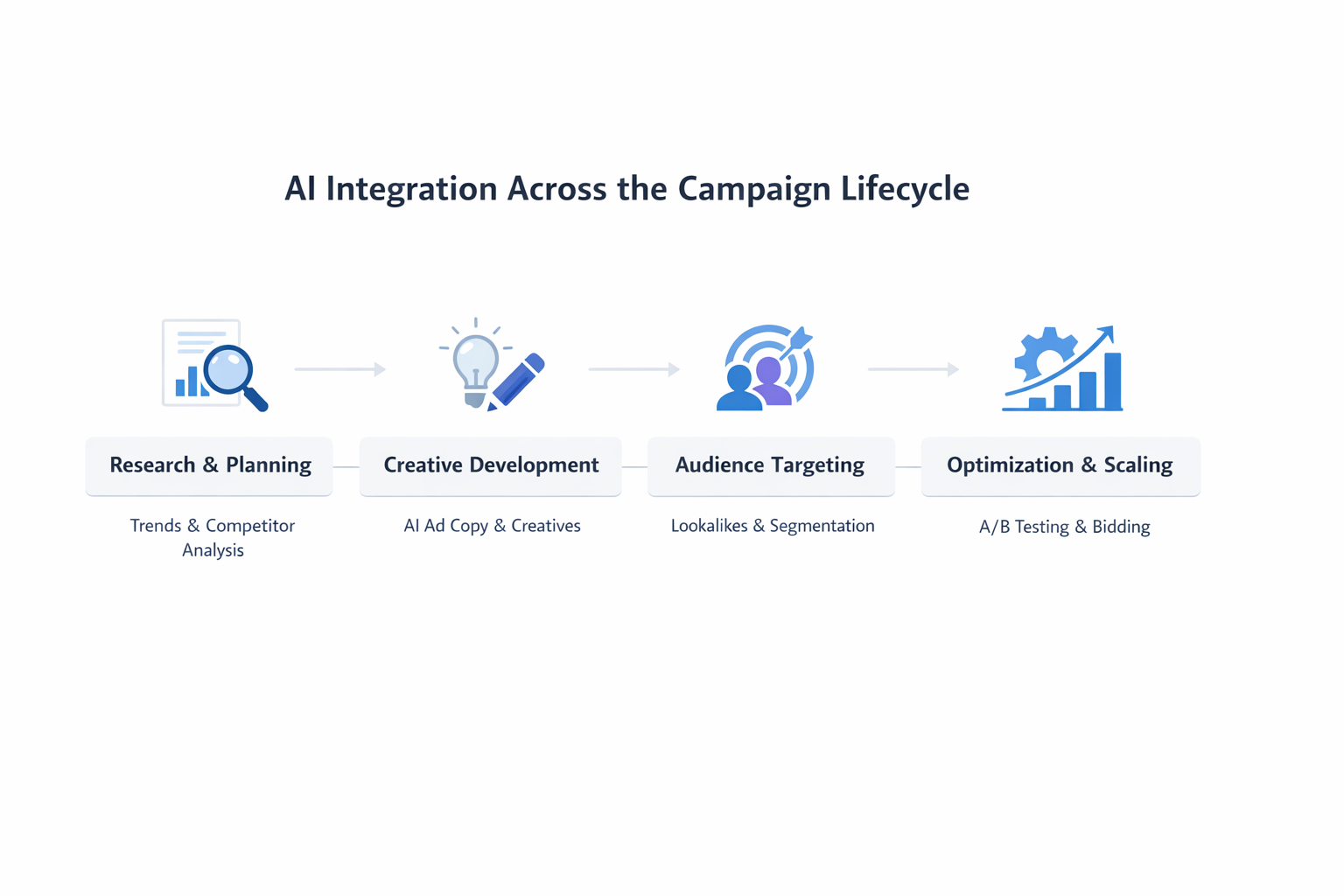
Here’s a practical breakdown:
-
Research and Planning
Use AI to analyze past performance trends, study competitor creatives, or cluster users based on engagement. For example, identify which groups converted fastest last quarter and build segments from there. -
Creative Production
AI tools can generate copy ideas, test headline tone, and suggest image formats. Start with prompts tied to past winning creative. For example: “Write new ad hooks focused on back pain relief for people aged 30–50 working from home.” -
Audience Targeting
Update lookalikes based on recent purchasers. Use AI to remove overlap between warm and cold segments. Layer behavior-based insights to avoid poor-quality leads. -
Optimization & Scaling
Train AI to detect early fatigue, run structured A/B tests, or predict performance drop-offs. Just don’t rely on AI to guess scaling thresholds — give it thresholds to work from.
For deeper targeting insights, check this breakdown of AI-powered audience strategies.
Step 3: Add Human Checkpoints — Automation Can’t Think
AI moves fast. That’s not always good. If there’s no review process, you’ll burn spend optimizing toward poor results.
For example, AI might favor a creative because it gets cheap clicks — but those clicks don’t convert. Or it may overprioritize a segment that’s already saturated.
To prevent this, schedule manual checkpoints:
-
Weekly reviews of top-performing ad comments (do people understand the offer?).
-
Spot-checks of AI-generated ad copy (is the tone consistent?).
-
Visual audits to ensure alignment between the ad and landing experience.
AI excels at repetition. But strategy requires human attention.
Step 4: Treat AI Like a Junior Strategist — Train It Carefully
Don’t prompt your AI tool like it’s a search engine. Treat it like a junior strategist that needs context to deliver quality work.
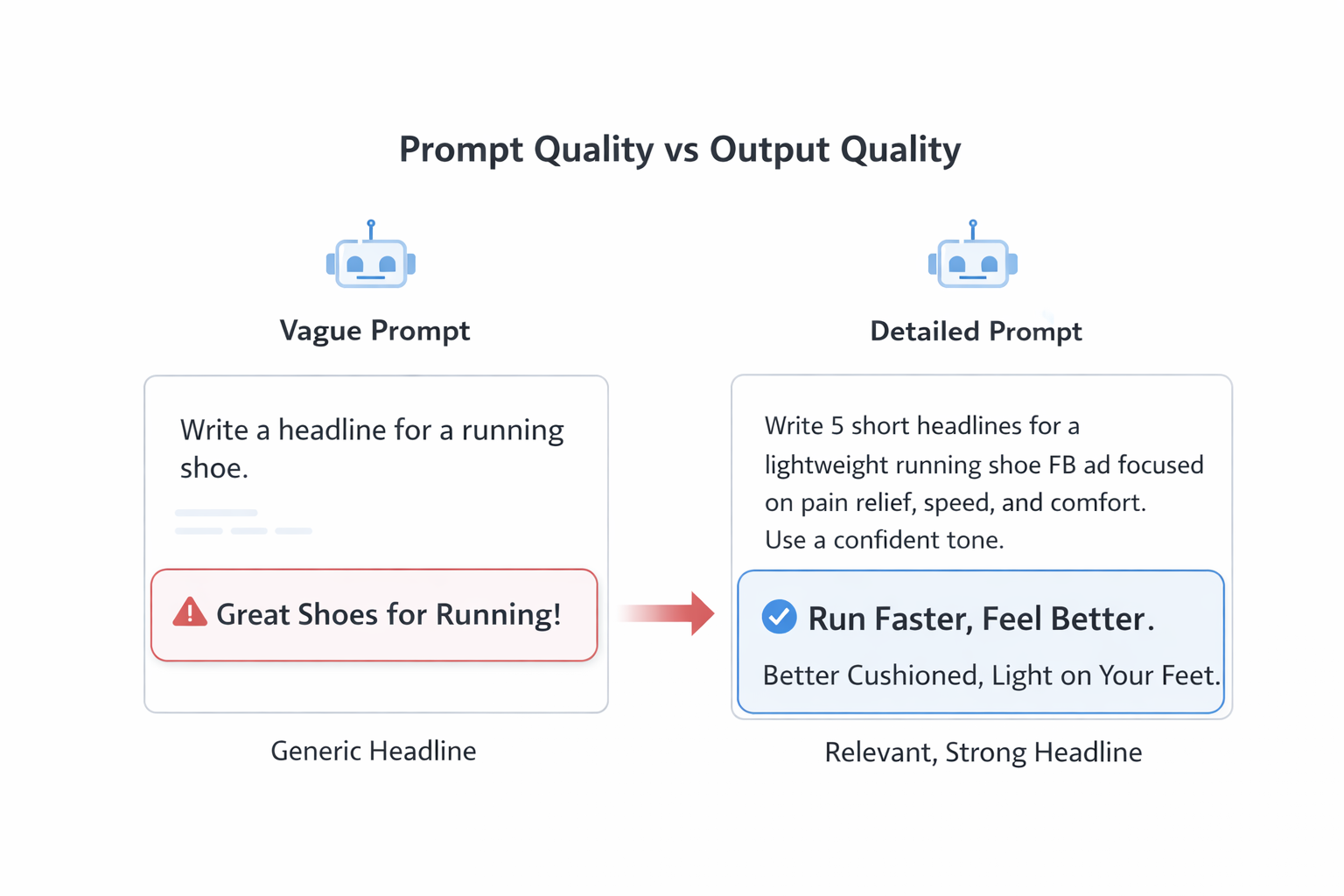
- Example of a poor prompt: “Write a headline for a productivity tool.”
- Better: “Write 3 Facebook ad headlines for a time tracking tool targeting remote freelancers who often struggle with focus. Use a confident tone and focus on solving mental fatigue.”
You’ll get stronger outputs and avoid rework. Over time, use feedback from performance data to update and refine these prompts.
Step 5: Align With Business Metrics — Not Just What the Platform Shows
Most AI tools optimize based on ad platform metrics: CPM, CTR, CPC. But none of these reflect business value directly.
You need to connect platform performance with revenue-generating activity. If CTR is high but your bounce rate is 90%, the traffic is meaningless.
Instead, track:
-
Profit per campaign, not just ROAS.
-
Customer acquisition cost (CAC), not just cost per click.
-
Purchase volume from first-time buyers, not return customers.
Not all conversions have equal value. A lead who converts immediately and remains a long-term customer is worth more than a click that turns into a low-margin sale. Build your optimization logic — and your AI feedback loops — around these long-term signals.
Step 6: Build a Feedback Loop From Every Campaign
AI becomes smarter when you feed it campaign results. But most teams move on without documenting what worked. That leads to inconsistent results — even when the tools are powerful.
After each campaign, record:
-
What targeting mix performed best?
-
Which ad copy got high CTR and low bounce rates?
-
Where did fatigue first show up — and how fast?
Use this data to refine your prompts, ad formats, and timing. Over time, your campaigns will launch faster and hit benchmarks sooner.
You can also reference case-based insights in AI testing strategies for Meta ads to identify what to track.
Advanced Tips for Pro-Level Optimization
If you’re already running multi-stage campaigns, here are advanced ways to use AI smarter:
-
Use AI for audience overlap detection and exclusion modeling. Many accounts waste spend by re-targeting users who are already in other ad sets. Use AI to identify duplication early.
-
Segment creative tests by audience intent. For example, test urgency-driven messaging in high-intent lookalikes and story-driven messaging in colder audiences. AI can help you structure these tests efficiently.
-
Combine AI insights with Advantage+ campaigns. AI tools can help you spot when Meta’s Advantage+ bidding and placement recommendations misalign with business goals. Adjust or override accordingly.
-
Use predictive performance scoring. Some AI tools can flag creatives likely to fatigue early or audiences that are nearing saturation — before performance drops. Integrate these into your scaling decisions.
-
Go deeper with behavioral segmentation. Move beyond interest targeting and use AI to cluster users based on actual actions — like scroll depth, time on site, or checkout behavior. These signals are often more predictive of purchase intent than demographic data alone.
Build AI-powered testing sequences. Instead of running disconnected A/B tests, use AI to run structured testing matrices — isolating variables like image, CTA, or headline — and progressively narrowing in on top-performing combinations. This reduces waste and speeds up time-to-insight.
- Feed campaign learnings back into your strategy. AI is only as good as the data it’s trained on. Use post-campaign insights — which ad combinations worked for which audience, which offers drove the best CAC — to refine your prompts, pre-launch targeting, and scaling rules.
These tactics will help you get ahead of platform algorithms, not just follow them.
Conclusion: AI Is Only as Smart as the Strategy Behind It
If your AI tools aren’t delivering better performance, the issue isn’t the tools — it’s the structure. This framework gives you a way to guide AI, not be guided by it.
Here’s what matters most:
-
Set clear, measurable campaign goals.
-
Use the right AI tools at the right stage.
-
Check performance regularly and manually.
-
Write smarter prompts to get smarter output.
-
Align optimization with real business results.
-
Capture insights and use them to improve future campaigns.
With this system, AI won’t just help you run campaigns. It will help you grow profitably and predictably.