You’re running ads. You’re spending money. You’re following “best practices.” But your results are flat — or worse, declining.
This isn’t unusual. Many Facebook and Instagram ad accounts experience performance drops even when the basics are in place.
The problem isn’t always visibility or clicks. It’s structural misalignment — across offer strategy, targeting logic, and creative execution.
Let’s break down the deeper causes of underperformance — and how to fix them with smarter inputs, not just more spend.
Visibility Without Relevance Is a Waste
Most campaigns fail not because users didn’t see them, but because users didn’t care.
Modern algorithms (especially Meta’s) are optimized for delivery. They will find impressions. What they won’t do is force someone to act on an offer that feels irrelevant, redundant, or low-value.
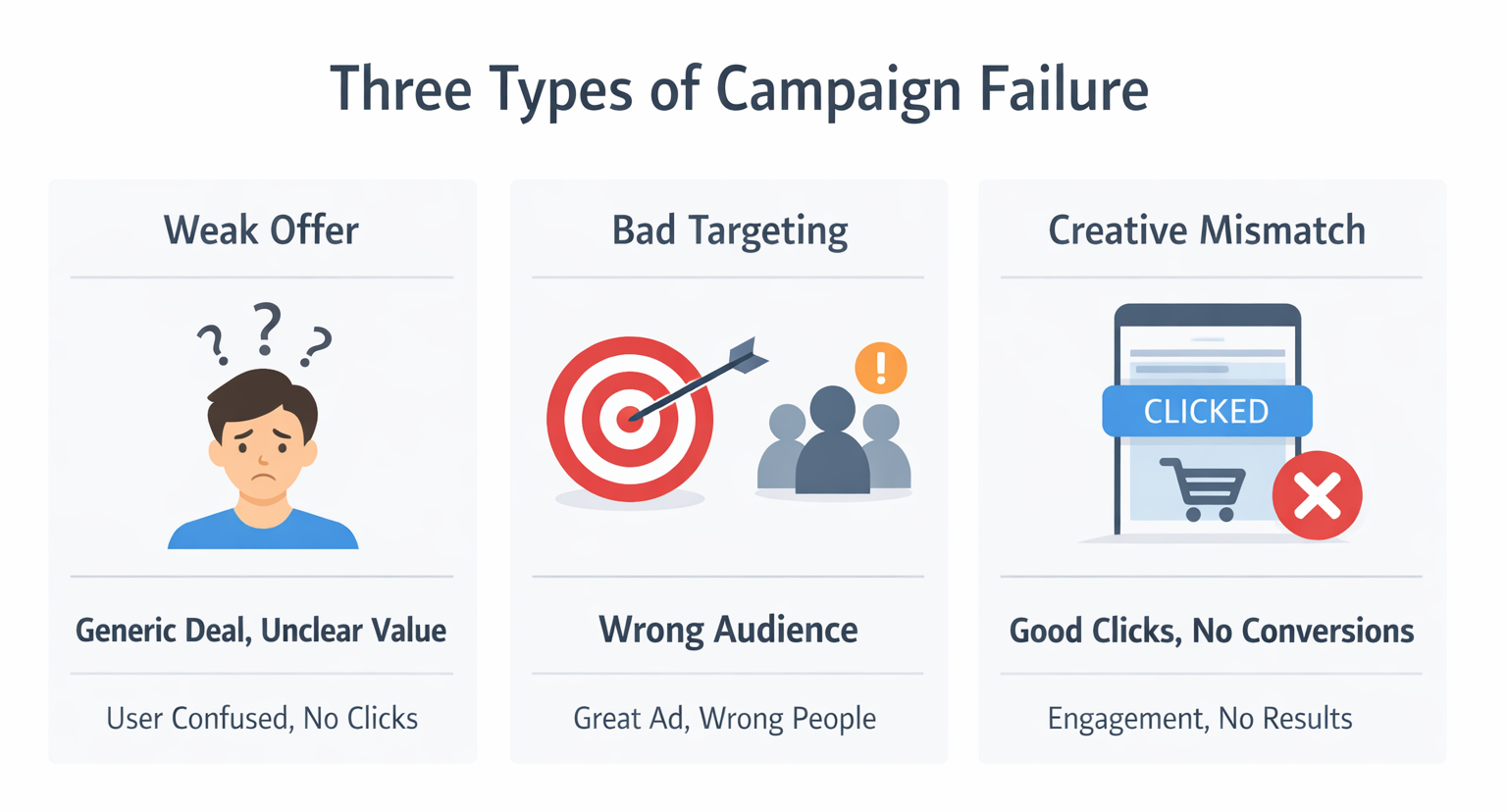
Campaigns often underperform for one of three reasons:
-
Weak perceived value — The offer feels generic, optional, or easily delayed.
-
Targeting misalignment — You’re reaching people at the wrong moment in the buying cycle.
-
Creative confusion — Your ad introduces friction, not clarity.
These problems don’t get solved by better hooks or bigger budgets. They require rebuilding the system behind the ad.
Your Offer Doesn’t Just Need Value — It Needs Contextual Value
A good offer is not just about discount or benefits.
It’s about framing — making sure the value feels relevant, immediate, and risk-free for the right audience.
What you consider persuasive may not register the same way to someone who’s never heard of your brand.
Similarly, a returning visitor may need specificity more than education.
Here’s how offer breakdowns usually happen:
-
Lack of outcome framing — Features are listed, but there’s no clear promise of transformation.
Example: “AI-powered CRM” is a feature. “Close deals 30% faster without manual follow-ups” is an outcome. -
Offer lacks strategic urgency — Urgency isn’t just about countdown timers.
A smarter approach is audience-aware urgency. For example: “Only available for new customers this week” speaks to cold leads. “Reactivation bonus ends Friday” speaks to lapsed users. -
Unclear entry point — Users don’t know what to do next. Too many CTAs or pricing options cause drop-off.
Use guided decision logic (one product, one goal, one path) and test that against multistep conversion flows.
If you're getting clicks but not sales, your offer positioning may be misaligned. This article outlines why ad clicks don’t always convert — and how to fix it with better message framing and offer sequencing.
Targeting Isn’t Just About Data — It’s About Signals Over Time
The most sophisticated advertisers are no longer targeting fixed personas.
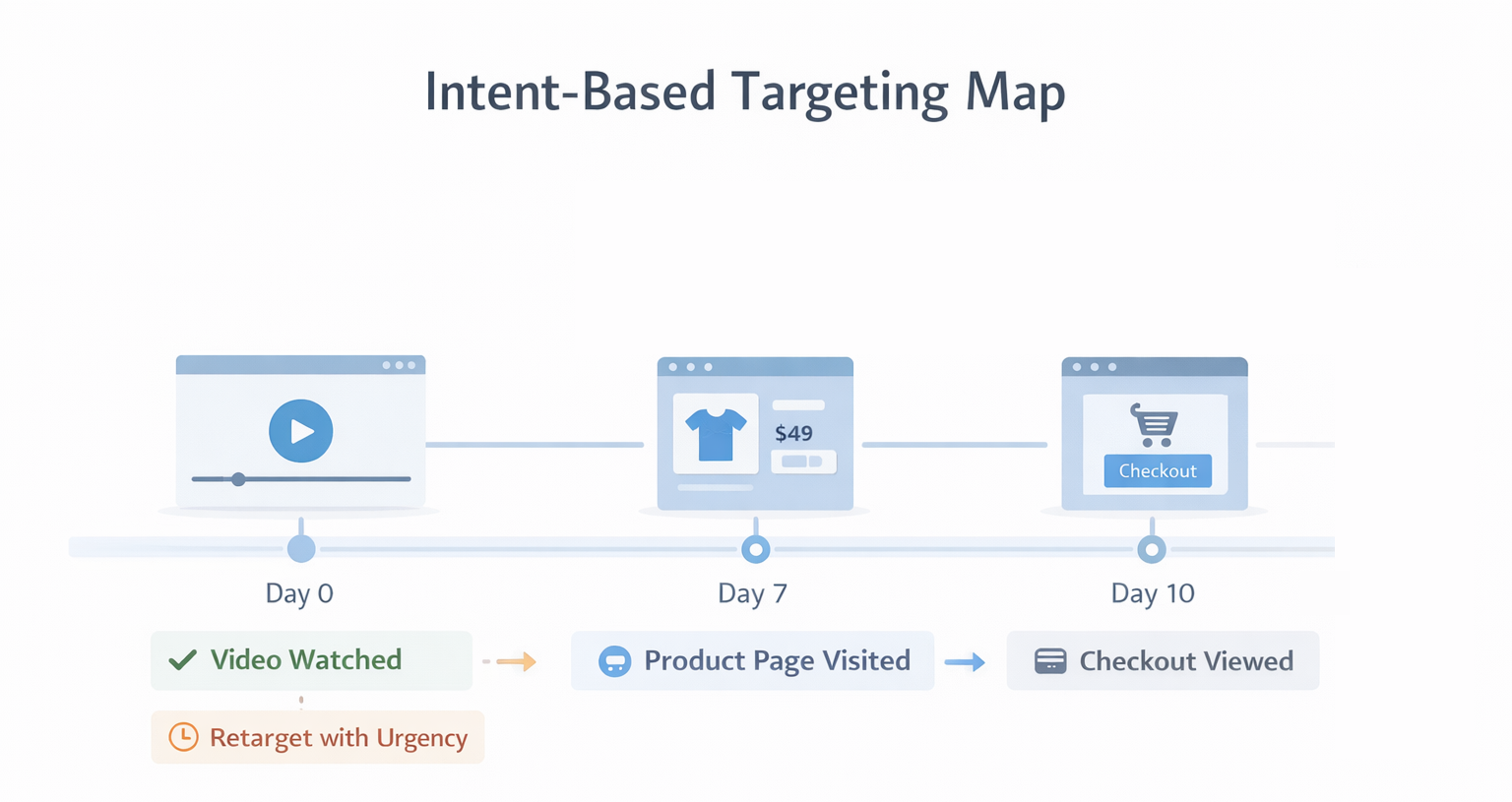
They’re targeting behavioral readiness. That means using time-based signals, exclusion logic, and sequential retargeting to match message to intent.
Many accounts still rely on static lookalikes and interest stacks. These are blunt instruments — they only work when paired with fresh, intent-rich inputs.
Look for these signs of targeting failure:
-
High frequency with low engagement — This means you’re over-serving stale users who have already disengaged. Exclude based on scroll depth, engagement score, or dwell time.
-
Conversion windows too short or too wide — A 7-day retargeting window may be too short for higher-ticket items, but 30+ days might include users who’ve mentally moved on. Test staggered windows (3-day, 10-day, 21-day) to map lag time and intent decay.
-
Too much overlap between ad sets — Meta will penalize you with internal competition if your ad sets hit the same users. Use audience segmentation based on past action: e.g., “Engaged but didn’t visit checkout” vs. “Visited checkout but didn’t buy.”
To address this hidden budget drain, study why audience overlap reduces performance and how to implement exclusion rules for cleaner segmentation.
Advanced accounts now use progressive audience shaping: start with a wide net → exclude quickly based on behavior → retarget narrow segments with custom sequences. Your media budget should follow intent density — not guesswork.
Your Creative May Be Polished — But Misplaced
Performance creative isn’t about how good it looks. It’s about what it says to whom and when.
Creative misfires are often subtle:
-
A testimonial ad shown to someone unfamiliar with your product lacks meaning.
-
A product demo shown before a pain point is established lacks urgency.
-
A discount ad shown too early can devalue perception instead of motivating action.
Sophisticated advertisers structure creative by journey stage:
-
Problem-aware audiences: Use content that dramatizes the problem and shows social context.
Example: “Why most project management tools waste your time” sets up the pitch better than a straight promo. -
Solution-aware audiences: Shift to feature-proof and demonstration.
Example: “Switching from Asana to [Your Tool]: A 60-second walkthrough.” -
Product-aware audiences: Focus on time-sensitive incentives, side-by-side comparisons, and trust amplifiers.
If you’re unsure how to structure creative this way, read this breakdown on aligning messaging with buyer awareness levels to avoid creative misfires.
Don’t just rotate creatives weekly. Build flows — where users move from one creative type to another as their behavior evolves.
Metrics Without Attribution Are Misleading
Many marketers still optimize toward vanity metrics — like CTR, CPM, or even ROAS — without understanding where conversions are truly coming from or why some steps break down.
Modern campaign optimization requires multi-stage diagnostic thinking:
-
CTR and thumb-stop rate: Measures attraction. If these are low, your creative is misaligned with platform norms or audience awareness.
-
Landing page CVR (conversion rate): Measures message-match. If this is low while CTR is high, your pre-click and post-click messages are disconnected.
-
Scroll depth or time-on-page: Indicates user intent beyond click. Low numbers here often mean unclear or overwhelming content.
-
Lead-to-sale conversion time: Tracks buying cycle. If this stretches beyond your attribution window, ROAS underreports performance.
Also, remember: not all conversions are equal.
A campaign with fewer but higher-LTV customers may outperform one with more but lower retention.
Use event-level tracking (Pixel and CAPI) along with CRM or post-purchase data. Attribution clarity is now a strategic edge.
You’re Treating Facebook Like It’s Still 2020
The Meta ad ecosystem has evolved — and the way you run ads needs to evolve with it.
Key shifts to account for:
-
CAPI is now essential — Pixel-only setups underreport key events.
-
Lookalike performance depends on seed quality, not just match rate.
-
Creative fatigue is faster than ever — especially for short-form video.
-
Attribution delays are real — users convert across time, devices, and sessions.
Facebook isn’t harder — it’s smarter. But only if your campaign structure adapts to signal-based delivery.
Strategic Realignment Beats Tactical Tweaks
If your ads aren’t working, it’s tempting to swap out creative or lower the budget.
But surface changes won’t fix structural misalignment.
Instead, ask:
-
Is your offer immediately relevant and urgent to new users?
-
Are your audiences shaped by recent actions, not assumptions?
-
Does your creative match the user’s level of awareness?
-
Are your metrics interpreted across full funnel stages — not in isolation?
If even one of these pieces is out of sync, results will stall.