Lead ads with calling allow people to contact your business directly from a Meta ad. Instead of filling out a form, users can call your business immediately after tapping the ad.
That changes the entire lead-generation dynamic.
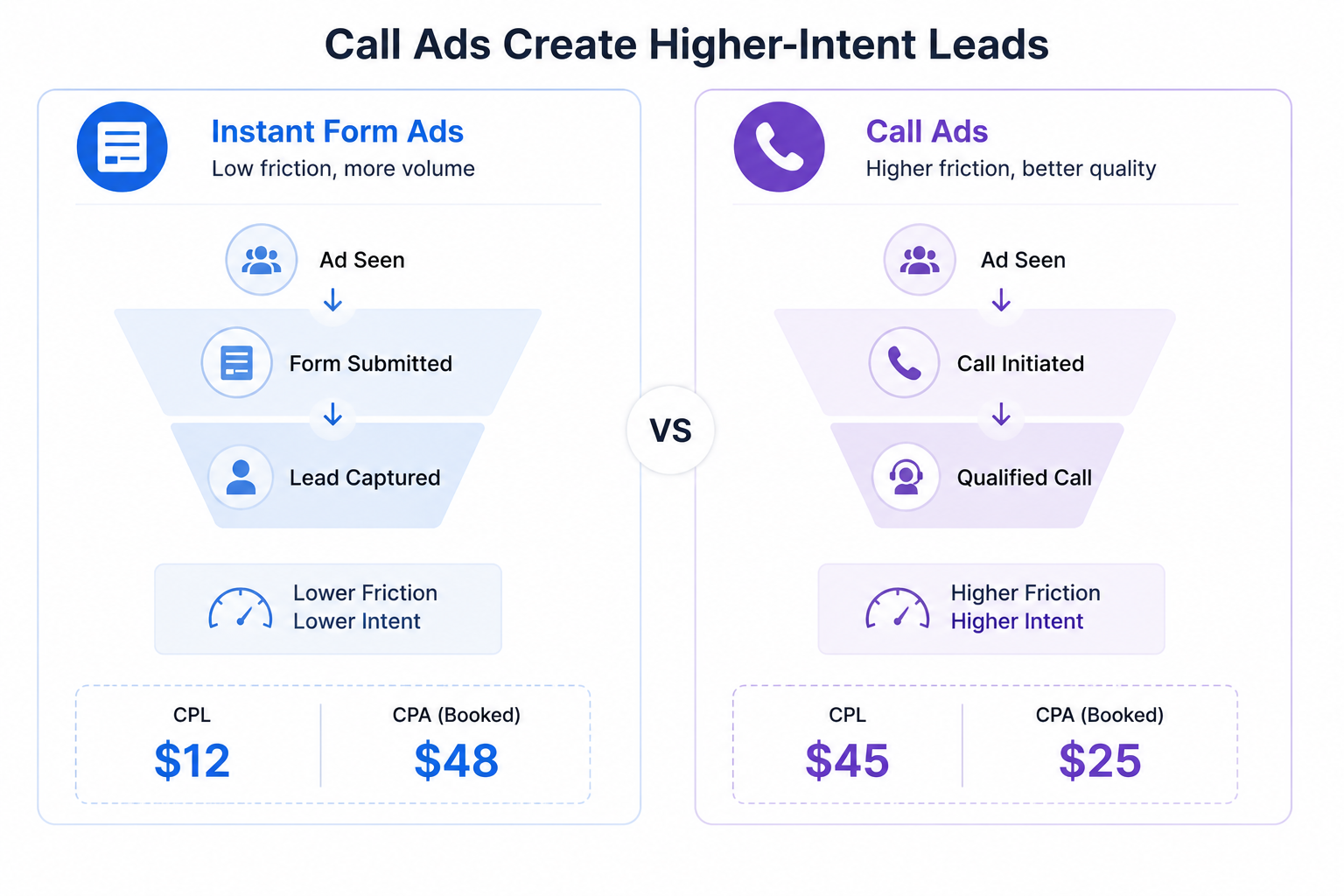
Phone calls create more friction than Instant Forms, but they also produce stronger buying intent. Someone willing to call usually wants pricing, availability, scheduling, or immediate answers.
For many service businesses, those leads close faster than traditional form submissions.
Why call ads often produce better lead quality
Meta offers several call-focused campaign types:
- Call ads, which optimise directly for phone calls.
- Call add-ons, which send users to a website while keeping a Call now button available.
- Website and calls campaigns, which optimise for both website actions and phone calls simultaneously.
Each campaign type changes user behavior differently.
Call ads usually create the highest intent because the conversion action happens immediately inside the app. The keypad opens automatically with the business number prefilled.
That extra friction filters casual users naturally.
A landscaping company, law office, or dental clinic may receive fewer total leads through call ads, but the people calling are often much closer to booking.
This is why many advertisers discover that higher CPL can still produce lower CPA.
If you are measuring only cost per lead, call campaigns may look inefficient. If you measure booked appointments or closed revenue, the numbers often reverse.
That distinction becomes critical when comparing CPA versus CPL for lead generation campaigns.
Business-hour scheduling changes conversion quality dramatically
Meta reported that call ads scheduled only during business hours generated 25.4% more call conversions compared to ads running continuously.
That result makes operational sense.
A user calling during active support hours reaches a real person immediately. A missed call often becomes a lost lead.
Many advertisers ignore this and let call campaigns run overnight. The campaign may still spend efficiently in Ads Manager, but sales teams later discover missed calls and poor contact rates.
Inside Meta reporting, this usually appears as:
- Strong click volume during evenings or weekends.
- Lower answered-call percentages outside office hours.
- Short call durations from accidental or abandoned calls.
- Rising CPA despite stable CPM and CTR.
The campaign looks healthy at the ad level while the sales process quietly breaks underneath it.
Call ads and call add-ons solve different problems
Advertisers often confuse these formats because both include calling features.
The delivery behavior is very different.
Call ads
Call ads optimise only for phone calls.
These work best when:
- The business closes leads primarily by phone.
- The service requires consultation before purchase.
- Fast response time matters.
- Mobile behavior dominates conversions.
Common industries include legal services, healthcare clinics, HVAC, emergency repair, home services, and local professional services.
Call add-ons
Call add-ons prioritise website conversions first while still offering a call option.
These campaigns fit businesses where users may want to:
- Read product details.
- Compare pricing.
- Browse services.
- Book online independently.
The phone call becomes a secondary conversion path rather than the primary goal.
Website and calls campaigns
Website and calls campaigns allow Meta to optimise toward both outcomes simultaneously.
Advertisers can also apply value rules to prioritize one conversion type over another.
This becomes useful when:
- Calls generate higher-quality leads.
- Website purchases still matter.
- Different users convert through different paths.
For example, some users may purchase directly online while others need a phone conversation before converting.
Placement limitations affect delivery more than many advertisers realize
Call-focused campaigns do not run equally across all placements.
Meta limits call functionality primarily to mobile placements, including:
- Facebook Feed.
- Facebook Marketplace.
- Facebook Reels.
- Instagram Feed.
- Instagram Stories.
If users access ads from unsupported placements, the call component may disappear completely.
This can create inconsistent performance across campaigns.
A campaign may produce strong call volume on Instagram Stories but weak conversion rates elsewhere because users never see the phone functionality.
When diagnosing call campaigns, review placement breakdowns carefully before changing creatives or targeting.
Callback requests can rescue lost leads
Meta allows advertisers to enable callback requests when calls are missed.
Many businesses overlook this feature, even though it can recover high-intent leads that would otherwise disappear.
This matters most for businesses handling:
- High call volume.
- Limited office staffing.
- Local-service appointment scheduling.
- Long consultation sales cycles.
A missed inbound call often has stronger intent than a cold outbound lead generated through a form.
Callback request reporting inside Meta Business Suite helps advertisers measure this behavior through metrics like:
- Calls placed.
- 20-second calls.
- 60-second calls.
- Callback requests submitted.
Those duration metrics matter because short calls often signal poor qualification or accidental taps.
Longer conversations usually correlate more closely with buying intent.
Attribution settings change how Meta optimises call campaigns
Call ads also allow attribution settings at the ad-set level.
That setting controls how long Meta credits conversions back to an ad interaction.
For businesses with short sales cycles, shorter attribution windows may improve optimization accuracy. Businesses with longer consideration periods may need broader attribution windows to understand true campaign influence.
This becomes especially important for high-ticket services where users may call multiple times before converting.
Without accurate attribution logic, advertisers often pause profitable campaigns too early.
Better audience quality improves call efficiency
Phone leads are expensive compared to simple form fills. That makes audience quality even more important.
Broad targeting may generate large amounts of low-quality phone activity, including accidental calls, weak-fit users, or low-intent inquiries.
LeadEnforce helps reduce that waste by building higher-intent audiences from Facebook groups, Instagram followers, engagement behavior, and social profile signals.
For appointment-based businesses, niche B2B services, and local operators, stronger audience intent often improves:
- Call duration quality.
- Appointment-booking rate.
- Cost per qualified lead.
- Sales efficiency after the call.
Businesses relying heavily on inbound consultations should also review Facebook ads for appointment-based businesses and learn how to improve lead conversion rates from Facebook ads before scaling budgets aggressively.
Final takeaway
Lead ads with calling create more friction than traditional lead forms, but that friction often improves lead quality.
The best-performing call campaigns usually combine:
- Strong business-hour scheduling.
- Fast call handling.
- Correct campaign type selection.
- Accurate attribution settings.
- High-intent targeting.
Cheap leads are easy to generate.
Qualified phone conversations are much harder — and far more valuable.