Most personalization strategies fail long before they hit scale.
Not because the idea is wrong, but because the execution breaks the feedback loop the algorithm depends on. You start with tailored creatives, see early performance, and then everything fragments — delivery slows, learning resets increase, and results become inconsistent.
At that point, personalization stops acting like a multiplier and starts behaving like noise.
This article explains why that happens and how to structure creative personalization so it scales without destroying signal quality.
Why Most Personalization Efforts Stall
You can usually spot the issue inside Ads Manager within a few days.
Performance looks promising at launch, but then:
-
Spend fragmentation — budget spreads across too many creatives, and no single variation exits the learning phase
→ Each ad set receives partial data, so the system never accumulates enough conversions to stabilize delivery. -
CTR–quality mismatch — click-through rate varies widely, but downstream metrics don’t follow
→ This often reflects the same issue explained in What Causes Facebook Lead Ads to Fail (Even When Metrics Look Good), where surface engagement hides deeper performance problems. -
Rising CPM under variation — costs increase as more creatives are introduced
→ The system loses confidence in which creative to prioritize and starts competing more aggressively in auctions.
What looks like “more relevance” at the surface level often reduces the algorithm’s ability to generalize.
How the Algorithm Interprets Creative Variations
Meta doesn’t “understand” your creative in a human sense. It clusters performance based on observable behaviors.
When multiple creatives enter delivery, the system evaluates:
-
Conversion-linked combinations — which creative + audience pairs actually generate optimized events
→ Not just clicks, but outcomes tied to your optimization goal. -
Pattern stability across auctions — whether performance repeats or fluctuates
→ High variance reduces system confidence and slows spend allocation. -
Behavioral consistency — whether similar users respond in similar ways
→ This determines whether scaling is possible or limited to small pockets.
Here’s where personalization often breaks things:
-
Diluted conversion density — conversions split across too many assets
→ Instead of 50 conversions on one creative, you get 10 across five. -
Intent drift between messages — each variation attracts a slightly different user profile
→ Behavioral signals become fragmented and harder to model. -
No dominant pattern — the system can’t confidently prioritize a winner
→ Budget distribution becomes unstable and reactive.
The Tradeoff Between Personalization and Signal Strength
More personalization does not automatically mean better performance.
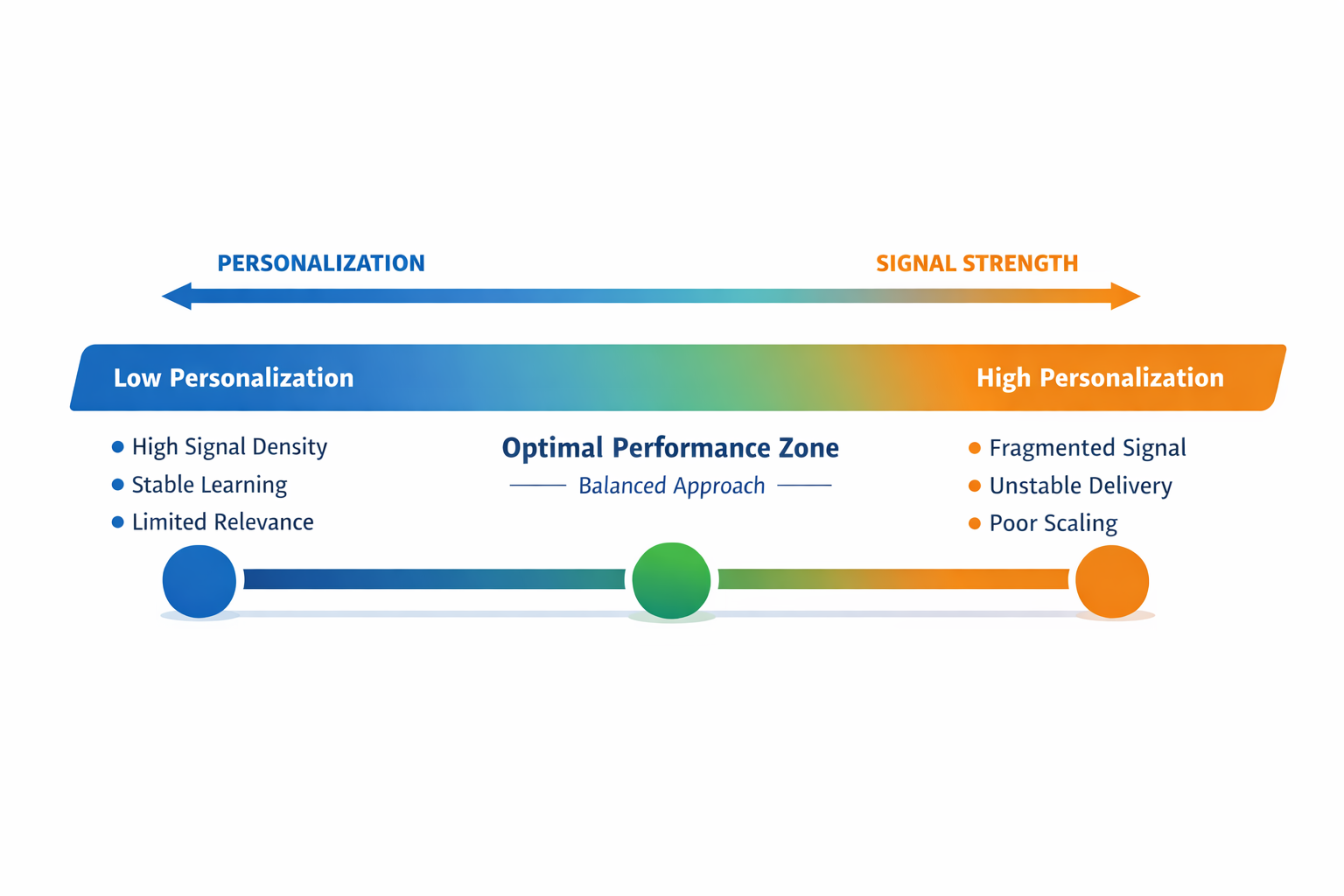
In practice, you’re balancing two opposing forces:
-
Relevance gain — stronger alignment between message and audience segment
-
Signal loss — reduced data concentration per creative
This tradeoff becomes visible when:
-
CPQL volatility — cost per qualified lead fluctuates despite stable CPL
-
Learning instability — frequent resets after creative changes
-
Scaling ceiling — performance stops expanding
This is the same dynamic discussed in The Science of Scaling Facebook Ads Without Killing Performance, where stable signal is the foundation of scale.
Structuring Personalization Without Breaking Delivery
1. Personalize at the Angle Level, Not the Variation Level
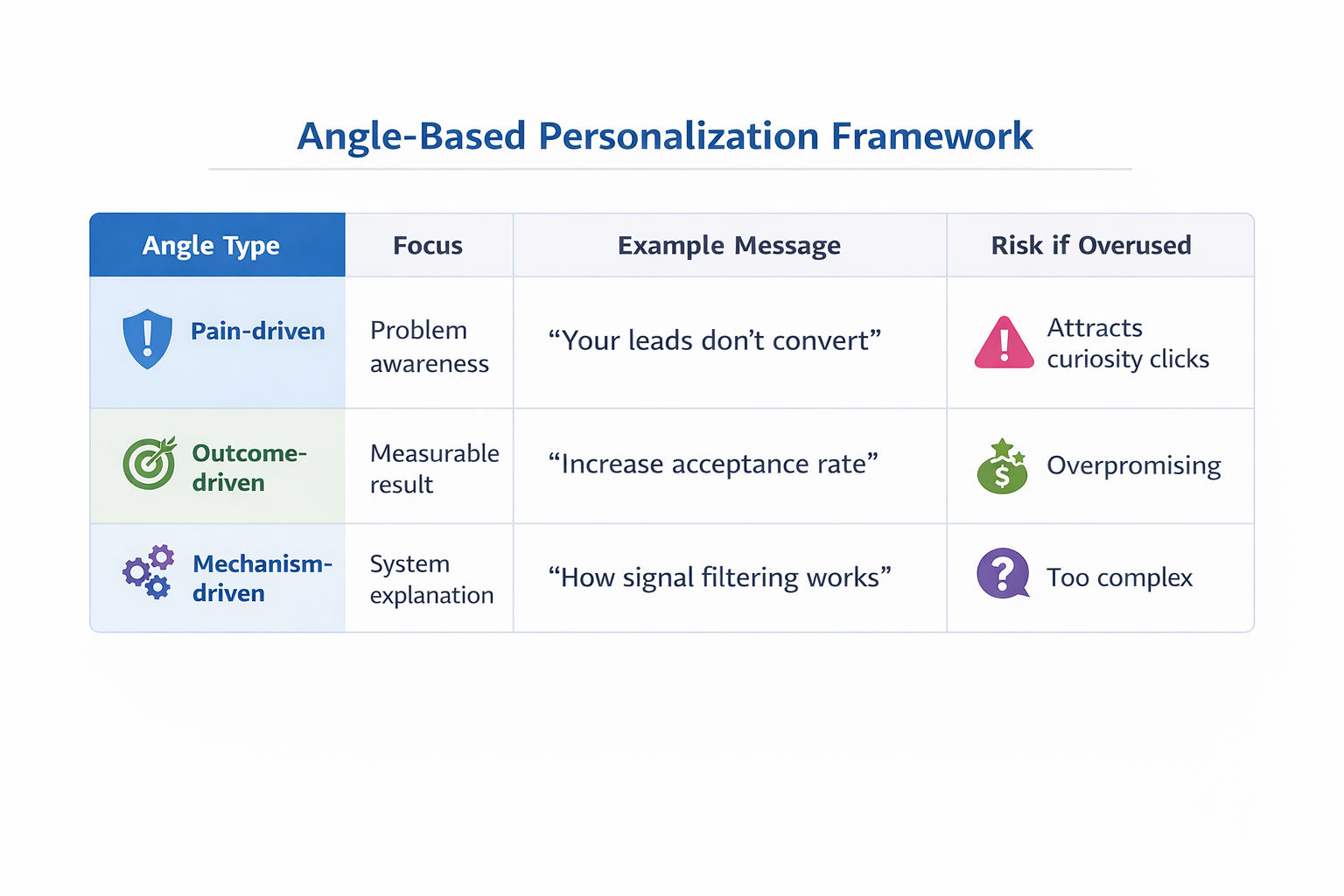
Instead of creating dozens of variations, define a few clear angles:
-
Pain-driven angle — specific operational problem
-
Outcome-driven angle — measurable result
-
Mechanism-driven angle — how it works
Each angle represents a behavioral hypothesis.
2. Consolidate Delivery Around Fewer Assets
-
Limited creative set — 2–4 core creatives per ad set
-
Budget concentration — avoid fragmentation
-
Active pruning cycles — remove weak performers early
This aligns with Key Strategies for Facebook Ad Testing: What You Need to Know, where test quality depends on sufficient data per variation.
3. Align Personalization With Qualification
-
Built-in qualification signals — reflect constraints in the creative
-
Intentional friction — filter low-intent users
-
Metric pairing — track acceptance rate vs CTR
Personalization should filter, not just attract.
4. Sequence Personalization Instead of Expanding It
-
Top of funnel control — limited variation, stable signal
-
Mid funnel refinement — behavior-based messaging
-
Bottom funnel qualification — high-intent creatives
This follows the logic behind Facebook Ads Funnel Strategy: From Audience Identification to Conversion, where structure enables performance consistency.
Diagnosing When Personalization Is Hurting Performance
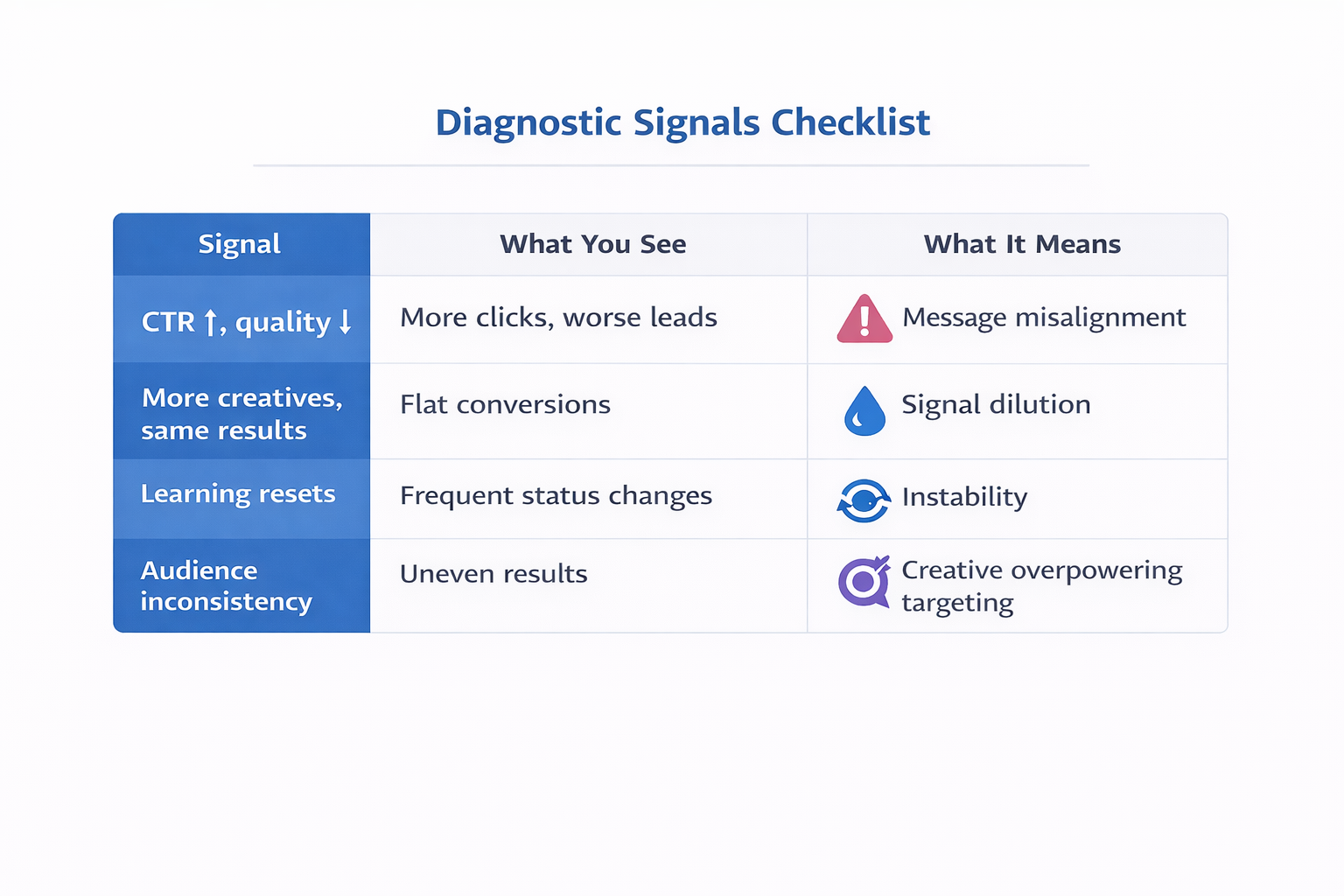
Look for:
-
CTR–quality divergence
-
Creative volume growth without results
-
Audience inconsistency
-
Learning phase churn
If these appear, personalization is fragmenting signal.
A More Scalable Way to Think About Personalization
-
Angle-based structure
-
Signal concentration
-
Qualification alignment
-
Sequenced expansion
This keeps the system stable while still improving relevance.
Practical Takeaway
If performance drops as you add creatives, the issue isn’t fatigue — it’s signal fragmentation. Reduce variation first.
Then rebuild personalization in a way the system can actually learn from.