Lead generation campaigns have evolved far beyond simple cost-per-click optimization. With increasing competition, rising ad costs, and algorithm-driven platforms, advertisers must adopt advanced bidding strategies to remain efficient and competitive.
Modern bidding is no longer just about setting limits—it’s about leveraging data, automation, and predictive signals to guide platforms toward high-quality conversions.
Understanding the Role of Smart Bidding
Smart bidding uses machine learning to optimize bids in real time based on a wide range of signals, including device, location, time of day, audience behavior, and intent.
According to industry data, campaigns using automated bidding strategies can achieve up to 30% higher conversion rates compared to manual bidding when properly configured.
Key Smart Bidding Models
-
Target CPA (Cost Per Acquisition): Focuses on generating conversions at a specific cost threshold.
-
Target ROAS (Return on Ad Spend): Optimizes for revenue efficiency rather than volume.
-
Maximize Conversions: Allocates budget to generate the highest number of leads possible.
-
Maximize Conversion Value: Prioritizes high-value leads over sheer volume.
Selecting the right model depends on campaign maturity, available data, and business goals.
Leveraging First-Party Data for Bid Optimization
First-party data has become a cornerstone of effective bidding strategies. Advertisers who integrate CRM data, customer lists, and behavioral signals into their campaigns gain a significant advantage.
Studies show that campaigns utilizing first-party audience data can improve conversion efficiency by up to 25%.
Practical Applications
-
Upload customer match lists to prioritize high-intent audiences
-
Use lookalike or similar audiences to expand reach
-
Segment users based on lifecycle stage (e.g., new leads vs. returning prospects)
These inputs allow bidding algorithms to focus on users more likely to convert.
Value-Based Bidding for Lead Quality
Not all leads are equal. Value-based bidding shifts the focus from quantity to quality by assigning different values to different types of conversions.
For example:
-
A demo request may be worth more than a newsletter signup
-
Enterprise leads may carry higher value than small business inquiries
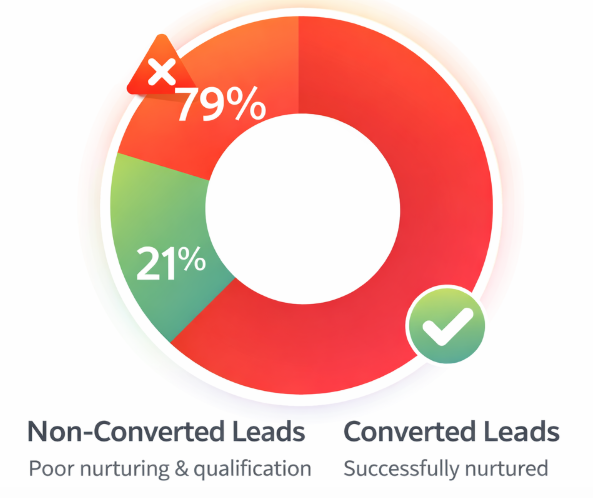
The majority of leads fail to convert, highlighting the importance of prioritizing lead quality and nurturing over volume
Advertisers implementing value-based bidding have reported up to 20% improvement in ROI, as platforms prioritize high-impact conversions.
Implementation Tips
-
Assign monetary values to conversion actions
-
Integrate offline conversion tracking (e.g., CRM outcomes)
-
Continuously refine values based on actual revenue data
Bid Adjustments and Layered Targeting
Even with automation, manual bid adjustments remain relevant when used strategically.
Key Adjustment Areas
-
Device: Increase bids for high-performing devices
-
Location: Prioritize regions with stronger conversion rates
-
Time of Day: Allocate budget to peak performance hours
-
Audience Segments: Boost bids for high-intent users
Layering these adjustments can improve campaign efficiency by 10–15%, especially in mature accounts.
Portfolio Bidding Strategies
Portfolio bidding allows multiple campaigns to share a unified bidding strategy, enabling algorithms to optimize across a broader dataset.
This approach is particularly effective for:
-
Large-scale lead generation accounts
-
Multi-channel campaigns
-
Businesses with diverse audience segments
Portfolio strategies can reduce cost per lead by up to 18% due to improved data aggregation and learning efficiency.
Using Predictive Signals and Intent Data
Advanced platforms now incorporate predictive signals such as browsing behavior, search intent, and engagement patterns.
Advertisers leveraging intent data see:
-
Higher conversion rates (15–25%)
-
Lower acquisition costs (10–20%)
How to Apply
-
Use in-market and custom intent audiences
-
Analyze search query trends
-
Align bidding with funnel stage signals
This allows campaigns to capture users at the moment of highest intent.
Budget Allocation and Scaling Strategies
Scaling lead generation campaigns requires careful budget management combined with adaptive bidding.
Best Practices
-
Gradually increase budgets (10–20% increments)
-
Avoid sudden changes that disrupt algorithm learning
-
Reallocate budget from underperforming campaigns to high-performing ones
Data suggests that controlled scaling can maintain efficiency while increasing lead volume by 20–40%.
Common Mistakes to Avoid
-
Overriding automation too frequently
-
Using insufficient conversion data (less than 30 conversions per month per campaign)
-
Ignoring lead quality metrics
-
Failing to align bidding strategy with funnel stage
Avoiding these pitfalls ensures that bidding strategies remain stable and effective.
Conclusion
Advanced bidding strategies are essential for maximizing lead generation performance in today’s competitive landscape. By combining automation, first-party data, value-based optimization, and strategic adjustments, advertisers can significantly improve both efficiency and lead quality.
The key is not choosing a single strategy, but integrating multiple approaches into a cohesive system that evolves with campaign data.
Suggested Reading