One of the most frustrating Meta Ads Manager problems happens before the campaign even launches.
You choose an objective, start building the campaign, and then realize the placement or format you expected is unavailable, restricted, or not ideal for the business outcome you need.
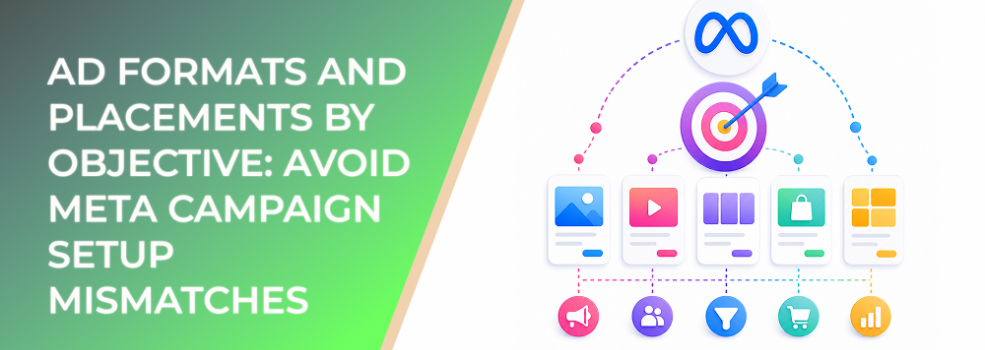
Meta’s help article on this topic identifies which ad placements and ad formats are available for each ad objective.
For performance marketers, this is not just a setup detail. Objective, format, and placement alignment can affect CPC, CPA, CAC, ROAS, and lead quality from day one.
Why objectives affect placements and formats
Your campaign objective tells Meta what outcome you want.
That objective can influence:
- available placements;
- available ad formats;
- conversion locations;
- optimization options;
- delivery behavior;
- reporting expectations.
For example, a format that makes sense for awareness may not be the best option for lead generation. A placement that supports reach may not support the conversion path you want. A creative format that looks strong visually may underperform if it does not fit the user’s stage in the funnel.
This is why objective selection should happen before creative production, not after.
The business impact of setup mismatches
Higher CPC
When an ad format does not fit the placement, users scroll past it faster. Weak engagement can make clicks more expensive.
Higher CPA
If the objective optimizes toward the wrong action, you may get users who complete low-value actions but do not convert into leads or customers.
Higher CAC
Customer acquisition suffers when objective, placement, and creative pull in different directions. You may pay to attract users who were never likely to buy.
Lower ROAS
Sales campaigns need the right combination of objective, format, audience, and post-click experience. A mismatch can produce traffic without revenue.
Poor lead quality
Lead campaigns can generate low-cost submissions when the format makes it too easy for low-intent users to respond. That is not efficient if sales teams reject most of the leads.
Wasted creative production
If the chosen objective does not support the format or placement you planned for, your team may need to rebuild assets late in the process.
Typical scenarios where this applies
This issue often appears when:
- a team creates creative before confirming campaign objective;
- an advertiser wants to run a specific format across all placements;
- a business shifts from awareness to leads without changing creative;
- a campaign uses Reels-style creative for a conversion path that needs more context;
- an agency inherits an account with inconsistent objective choices;
- an SMB owner boosts content and later expects sales-level performance;
- a B2B team uses engagement optimization and wonders why leads are weak.
It also comes up during rapid testing. Growth marketers often want to test multiple formats quickly, but format testing only works when the objective supports the action being measured.
Risks and considerations
Objective choice changes the signal
If you choose engagement, Meta will look for engagement. If you choose leads, Meta will look for lead behavior. Those audiences can differ.
Format availability is not the same as format quality
Just because a format is available does not mean it is the best choice for your funnel.
Placement support can vary
Not every placement is available for every ad, and placement availability can depend on ad type and settings.
Creative may need multiple versions
A single ad asset rarely works equally well across Feed, Stories, Reels, and other environments.
Reporting can become misleading
If you compare campaigns with different objectives, placements, and formats, performance differences may not be caused by creative alone.
Prerequisites and dependencies
Before building the campaign, confirm:
- business goal;
- campaign objective;
- conversion location;
- audience strategy;
- available creative formats;
- supported placements;
- target KPI;
- budget;
- follow-up process for leads or customers.
A good campaign brief should answer this question:
“What action are we asking Meta to optimize toward, and does the format support that action in the placement where the ad will appear?”
How LeadEnforce helps
LeadEnforce helps make objective and format testing more meaningful by improving who sees the ads.
When you test formats against generic audiences, weak results may come from poor targeting rather than poor creative. LeadEnforce helps advertisers build high-intent audiences from Facebook groups, Instagram profiles, followers, engagers, LinkedIn professional data, and custom social-profile data.
That gives marketers better testing conditions.
For example:
- test carousel vs video against a competitor-follower audience;
- test lead forms against a niche Facebook group audience;
- test Reels creative against Instagram engagers;
- test B2B lead campaigns against professional segments informed by LinkedIn data.
With more relevant audiences, advertisers can better judge whether the objective-format-placement combination is working.
Practical recommendations
Choose the objective before producing creative
Do not build assets first and force them into a campaign objective later.
Map format to funnel stage
Use awareness formats for discovery, consideration formats for education, and conversion formats for action.
Confirm placement compatibility early
Before briefing design or video teams, check whether the intended format can run where you want it to run.
Evaluate quality, not only volume
For lead gen, track qualified lead rate. For sales, track purchase rate and ROAS. For affiliate campaigns, track downstream conversion, not just clicks.
Use consistent testing variables
When comparing formats, keep audience, budget, objective, and placement as consistent as possible.
Avoid vanity-objective traps
An engagement campaign can be useful, but it should not be judged like a sales campaign.
Final takeaway
The best Meta campaigns do not start with a random creative format. They start with a clear objective, then choose the placements and formats that support the business outcome.
To test formats against more relevant, high-intent audience segments, join the free 7-day LeadEnforce trial period.
Related LeadEnforce Articles
- How to Create Ads Using Format Display Options in Meta Ads Manager — Explains how format display options can change ad behavior across placements.
- How to Customize Ad Creative for Placements in Meta Ads Manager — Helps advertisers adapt creative once placement and format choices are made.
- Ways to Advertise on Instagram (And Which One Actually Scales) — Useful for comparing Instagram advertising methods and performance control.
- Creative vs Context: Why the Same Ad Wins in One Placement and Loses in Another — Reinforces why format and placement context must align.