Advantage+ campaign budget is useful because it lets Meta distribute spend across ad sets based on delivery opportunity. For many advertisers, that means less manual budget shifting and faster optimization.
But there is a common problem: Meta may spend heavily on the ad set that is easiest to deliver, while another important audience receives too little budget to prove whether it works.
That is where ad set spend limits can help.
Used carefully, spend limits can protect audience tests, prevent risky segments from consuming too much budget, and give high-intent audiences a fair chance to perform. Used poorly, they can block Meta from allocating budget to the best-performing ad sets and make CPA, CAC, or ROAS worse.
What ad set spend limits actually solve
Ad set spend limits are not a replacement for campaign strategy. They are a control mechanism.
When you use Advantage+ campaign budget, the campaign budget sits at the campaign level. Meta then decides how much to spend across the ad sets inside that campaign. Ad set spend limits allow you to set boundaries for individual ad sets, such as minimum or maximum spend.
This matters when your campaign includes audiences with different delivery profiles.
For example, a broad audience may spend quickly because it has a large pool of users and enough conversion opportunities. A smaller, more targeted audience may be more relevant but slower to spend. Without a minimum spend limit, that smaller audience may never receive enough delivery to generate a meaningful read.
At the same time, a maximum spend limit can prevent an experimental or lower-confidence ad set from consuming too much budget before you understand lead quality or conversion performance.
Why this matters for campaign performance
Budget allocation directly affects the quality of your testing.
If one ad set receives nearly all the spend, your test may become misleading. You might conclude that one audience is stronger simply because it had enough delivery, while another audience never received a real opportunity.
That can affect:
- CPC, because Meta may favor easier inventory rather than higher-intent inventory.
- CPA, because cheap traffic does not always become qualified leads or sales.
- CAC, because low-quality delivery can create follow-up costs for sales teams.
- ROAS, because the highest-spending ad set may not be the most profitable one.
- Budget efficiency, because promising audiences may be abandoned too early.
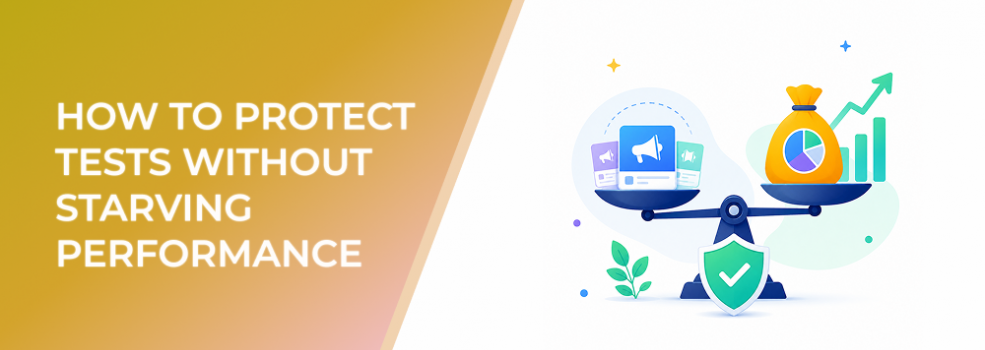
The key is to use spend limits to improve the fairness of a test, not to micromanage every dollar.
Typical scenarios where ad set spend limits make sense
Testing a high-intent custom audience against a broader audience
A custom audience built from a relevant Facebook group, Instagram engager segment, or professional profile dataset may be smaller than a broad interest-based audience.
If both ad sets sit in the same campaign, Meta may favor the broader audience because it has more delivery flexibility. A minimum spend limit can help the high-intent audience receive enough exposure to evaluate its true value.
Protecting a new audience test
If you are testing a new audience source, you may want it to receive enough budget for a directional read without allowing it to dominate the campaign.
In this case, a minimum spend limit can protect learning, while a maximum spend limit can control downside risk.
Running campaigns for multiple client priorities
Agencies often need to balance performance optimization with client expectations. A client may want a specific region, product line, or audience segment to receive exposure even if Meta would otherwise shift spend elsewhere.
Spend limits can support that structure, but they should still be tied to clear performance goals.
Managing short promotional windows
For webinars, events, seasonal offers, product launches, or affiliate campaigns, there may not be enough time for Meta to naturally distribute spend evenly. A temporary spend limit can help ensure the right audience is tested before the campaign window closes.
Risks and considerations
The main risk is over-constraining the campaign.
Meta’s campaign budget optimization works best when it has room to move spend toward stronger delivery opportunities. If every ad set has strict limits, the campaign can become less efficient.
Common mistakes include:
- Setting minimum spend limits for too many ad sets.
- Keeping limits active after the test is complete.
- Using limits to force spend into audiences that are clearly underperforming.
- Setting maximum limits so low that winning ad sets cannot scale.
- Confusing audience relevance with audience performance.
- Ignoring downstream lead quality while focusing only on spend distribution.
Spend limits can also create false confidence. If a protected audience produces a low CPA during a small test, it does not automatically mean the audience will hold performance at scale.
Prerequisites and dependencies
Before using ad set spend limits, make sure the campaign structure is ready.
You need a clear campaign objective, distinct ad sets, enough budget for each ad set to receive meaningful delivery, and a defined evaluation window. You also need to know what success means beyond surface-level metrics.
For lead generation, that may include qualified lead rate, booked-call rate, sales acceptance rate, or pipeline quality. For ecommerce, it may include purchase conversion rate, average order value, and ROAS.
You should also check for overlap between ad sets. If two ad sets are targeting many of the same people, spend limits may not fix the underlying problem. They may simply force Meta to spend in two places that are competing for the same users.
How LeadEnforce helps
LeadEnforce helps advertisers build more relevant custom audiences before they start allocating budget.
Instead of relying only on broad interests or generic audience suggestions, you can create high-intent audiences from sources such as Facebook groups, Instagram followers, Instagram engagers, LinkedIn professional data, and custom social-profile data.
That makes ad set testing more useful.
For example, instead of testing “broad audience vs broad audience,” you can test:
- A Facebook group-based audience around a niche problem.
- An Instagram engager audience built from competitor or category profiles.
- A LinkedIn-informed audience aligned with job function, industry, or professional relevance.
- A custom social-profile audience built around people who already show signs of interest.
Spend limits are more valuable when the audiences being tested are meaningfully different. LeadEnforce helps create those cleaner, higher-intent test groups.
Practical recommendations
Use spend limits for a specific reason
Before setting a minimum or maximum, define the reason.
A good reason might be: “This high-intent audience is smaller, and we need enough spend to evaluate lead quality.”
A weak reason might be: “We want every ad set to spend evenly.”
Even spend is not the goal. Better performance is the goal.
Protect tests temporarily
Spend limits work best as temporary testing tools.
Once you have enough signal, remove or loosen the limits so Meta can allocate budget more freely. If the audience wins, let it scale. If it fails, stop forcing spend into it.
Separate risky tests from core scaling campaigns
If an audience is highly experimental, consider testing it in a separate campaign or with tighter controls. Do not let a speculative audience interfere with your main performance campaign unless the budget risk is acceptable.
Evaluate lead quality, not only delivery
A protected ad set may produce leads, but those leads still need to be qualified.
Track what happens after the click or form submission. If one audience has a higher CPL but produces better sales conversations, it may still be more valuable than a cheaper audience with poor fit.
Avoid stacking too many constraints
Spend limits, narrow audiences, exclusions, small budgets, and short campaign windows can all restrict delivery.
If performance is unstable, review the full campaign structure before blaming the audience.
Final takeaway
Ad set spend limits can be useful when you need to protect important audience tests, control experimental spend, or make sure a high-intent segment gets a fair evaluation. The best approach is to use them sparingly, measure real business outcomes, and remove constraints once the campaign has enough signal.
To test higher-intent audience inputs before you scale your next campaign, join the free 7-day LeadEnforce trial period.
Related LeadEnforce Articles
- How to Fix Uneven Spend Distribution Across Facebook Ad Sets — Directly relevant for advertisers struggling with campaign budget allocation across ad sets.
- How to Optimize Advantage Campaign Budget for Scalable Facebook Ads — Useful for understanding how campaign-level budget decisions affect scaling.
- Why Increasing Facebook Ads Budget Can Hurt Performance — Helps explain why budget increases and constraints can change performance dynamics.
- How Meta Advantage+ Can Help You Control Your Ad Spend Across Campaigns — Adds broader context on using Meta Advantage+ features for budget control.