Open almost any professional Facebook group and a similar pattern appears. Someone asks how others solve a specific operational problem, and dozens of professionals respond with their workflows.
A contractor may ask how teams track supplier invoices across multiple projects. A marketing agency owner might ask how others consolidate reporting across multiple ad accounts.
These discussions reveal something valuable for advertisers. The most relevant audience often already exists inside these communities.
Tools like LeadEnforce allow advertisers to build audiences from followers of Facebook groups. Instead of relying on broad interest targeting, campaigns can reach people who actively participate in industry discussions.
Once group audiences become targetable, performance depends largely on how closely the ads reflect the problems members already discuss inside those communities.
Why Facebook Groups Often Contain High-Intent Audiences
Look at the posts that generate the most comments inside industry groups. Most of them are not news posts or content sharing.
They are questions about tools, processes, or suppliers.
Typical examples include:
-
“What CRM are agencies using for managing client pipelines?”;
-
“How do contractors track change orders across multiple projects?”;
-
“Any good tools for automating client reporting?”.
Posts like these often produce dozens of responses from professionals describing their workflows.
From an advertising perspective, this behavior reveals two strong signals:
-
The person asking the question usually controls the workflow being discussed.;
-
The community is actively evaluating tools and solutions.
Interest targeting rarely captures this level of intent. Someone can belong to an industry interest category without ever facing the operational problem your product solves.
How LeadEnforce Makes Facebook Group Audiences Targetable
Facebook Ads Manager does not allow advertisers to target followers of specific Facebook groups directly. Most campaigns rely on interest categories or lookalike audiences.
Those options often combine large numbers of loosely related users.
LeadEnforce solves this by allowing advertisers to build audiences from followers of selected Facebook groups.
Instead of targeting broad interests such as:
-
construction industry;
-
digital marketing;
-
real estate investing;
you can target followers of communities such as:
-
contractor discussion groups;
-
regional builders networks;
-
marketing agency owner communities.
In practice, this creates an audience made up of professionals already participating in conversations about the topic your product addresses.
If you're unfamiliar with how these audiences are constructed, the article How to Build Your Target Audience from a Facebook Group explains the mechanics step by step.
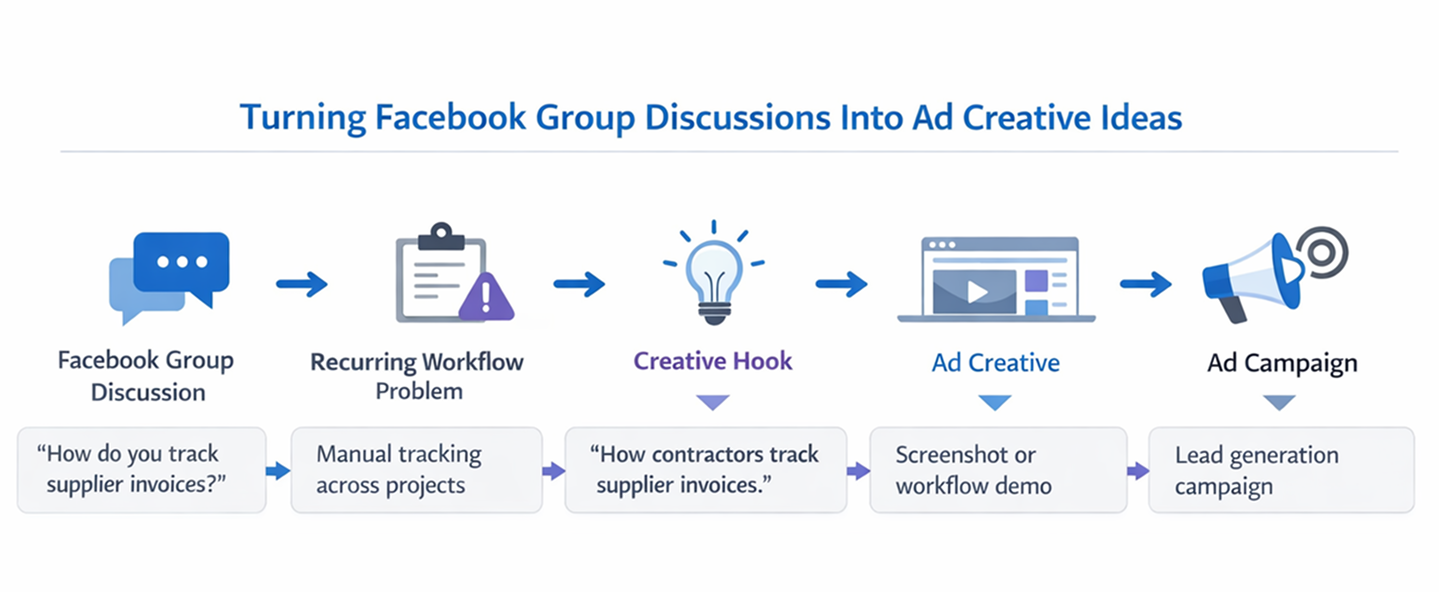
Tip 1 — Study Group Discussions Before Writing Any Creative
Many advertisers begin by brainstorming ad ideas internally. With Facebook group audiences, the more reliable approach is to start with the discussions happening inside the group.
Scan recent posts and identify threads that generate long comment chains. These conversations usually reveal problems that affect a large portion of the community.
Focus on three types of posts:
Tool recommendation questions
Examples include:
-
“What CRM are you using for client management?”;
-
“Which reporting tools work best for agencies?”.
These posts often indicate active evaluation of new solutions.
Workflow complaints
Members frequently describe frustrating processes such as:
-
compiling reports manually;
-
reconciling spreadsheets;
-
coordinating suppliers through email threads.
These complaints often produce strong engagement because many professionals experience the same issue.
Tool comparison discussions
Posts comparing two solutions often attract experienced users.
Examples include:
-
“Is Tool A better than Tool B for project tracking?”;
-
“Anyone switched from spreadsheets to a CRM?”.
These discussions often involve people already close to making a decision.
Tip 2 — Turn Workflow Problems Into Creative Hooks
Ads targeting professional communities perform best when they describe a recognizable workflow problem.

Many weak creatives start with the product category.
- Example: “Project management software for contractors.”
This forces the reader to connect the product with their own work. A workflow-based hook removes that step.
- Example:“How contractors track supplier invoices across multiple projects.”
The reader immediately recognizes the situation. If they face the same problem, the ad becomes relevant instantly.
Tip 3 — Reference Situations the Audience Encounters Daily
Generic marketing language rarely performs well with group audiences. Members respond more strongly to specific situations they encounter in their daily work.
Instead of writing abstract claims such as “Improve operational efficiency”, describe a real scenario:
-
“Still compiling weekly reports from three different platforms?”;
-
“Tracking subcontractor schedules across multiple spreadsheets?”.
These hooks resemble the types of posts that appear inside industry groups.
When users see the ad in their feed, it feels closer to a conversation topic than a traditional advertisement.
Tip 4 — Use Visuals That Show the Workflow
The visuals used in these campaigns should reinforce the operational context of the ad.
Highly stylized marketing graphics often perform poorly with professional audiences who spend time discussing practical tools.
Creative formats that tend to perform better include:
Interface screenshots
These show how the product organizes information. Instead of imagining the system, users immediately see how the workflow operates.
Process diagrams
Simple diagrams can illustrate how a workflow changes. Example structure:
- Manual reporting → automated reports → weekly summary dashboard.
This format communicates the improvement quickly.
Short demonstration videos
A short walkthrough of a task can show how the system works in practice.
This reduces skepticism because the ad demonstrates the workflow rather than describing it.
Tip 5 — Combine Several Related Groups Into One Audience
Advertisers sometimes create separate campaigns for each Facebook group. This often produces unstable delivery because individual communities may be relatively small.
A more effective approach is to combine several closely related groups into a single audience.
Example audience structure:
-
Construction Project Managers Network;
-
Regional Contractors Community;
-
Commercial Builders Discussion Group;
-
Construction Equipment Professionals.
Combining these communities creates a larger pool of professionals with similar behavioral signals, which helps Meta’s delivery system optimize campaigns.
If you want to learn how advertisers identify the best communities for targeting, the article How to Find and Target Facebook Groups Relevant to Your Business explains the process.
Tip 6 — Start With Educational Creatives
Many professionals inside Facebook groups are still researching solutions when they see your ad. They recognize the problem but may not yet be actively searching for a product.
Educational creatives often perform well as the first interaction. Examples include:
-
“How agencies generate performance reports across multiple ad accounts.”
-
“How contractors track project cost changes without spreadsheets.”
These ads attract attention because they promise insight rather than a direct sales pitch.
After users engage with the content, retargeting campaigns can introduce the product and explain the solution.
For deeper strategies on building strong targeting segments, see How to Create High-Converting Facebook Custom Audiences.
Tip 7 — Watch Comment Quality Instead of Only CTR
Click-through rate alone does not reveal whether the ad resonates with the community.
The comment section often provides stronger signals.
High-quality engagement often includes:
-
detailed comments describing current workflows;
-
users tagging colleagues;
-
questions about implementation.
These interactions show that the creative reflects the real operational context of the group.
If the ad receives reactions but little discussion, the message may be too generic.
Turning Facebook Group Discussions Into a Creative Pipeline
One advantage of targeting Facebook group audiences is that the community continuously generates new creative ideas.
A single discussion thread can produce several advertising angles.
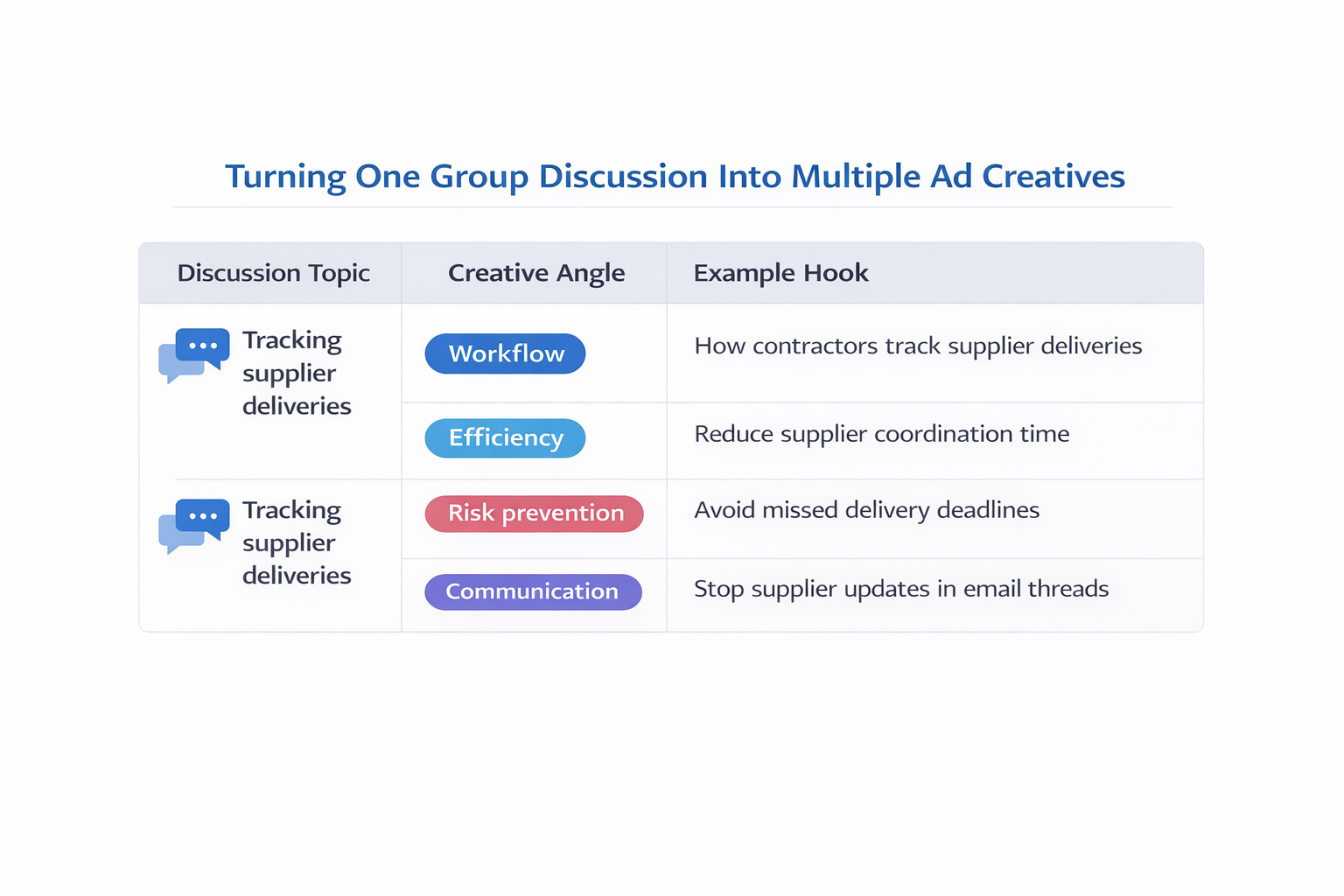
For example, a discussion about tracking supplier deliveries could support creatives focused on:
-
workflow organization;
-
time-saving processes;
-
avoiding missed delivery deadlines;
-
coordinating supplier communication.
Monitoring group discussions regularly allows advertisers to discover these opportunities.
Instead of guessing which problems matter to the audience, the community conversations reveal them directly.
Conclusion
Facebook groups often contain some of the most concentrated professional audiences on the platform. Members join these communities to exchange advice, discuss workflows, and evaluate tools used in their field.
LeadEnforce makes these audiences reachable by allowing advertisers to build campaigns targeting followers of specific groups.
Once targeting is solved, campaign success depends largely on creative relevance.
Advertisers who study group discussions, identify recurring operational problems, and design creatives around those workflows can build campaigns that feel relevant to the audience rather than intrusive.