

For many small businesses, Facebook and Instagram ads can feel confusing, expensive, or even unfair. The tools seem designed for brands with big budgets and full-time ad teams.
But the truth isn’t that Facebook ads don’t work for small businesses — it’s that the default playbook often doesn’t apply.
In this article, we’ll break down why smaller advertisers face real challenges, what still works in their favor, and how to run campaigns that make the most of your size and speed.
Why Facebook Ads Are More Challenging for Small Businesses
Small advertisers face three main obstacles: limited data, limited time, and limited flexibility within Meta’s systems.
Let’s look at each.
Small Budgets = Weak Signals for Optimization
Meta’s ad delivery system is powered by machine learning. The less data you feed it, the harder it is for it to optimize.
That creates several real problems:
-
Ads stay stuck in the Learning phase. Without 50+ conversions per ad set per week, the system can’t stabilize.
-
Testing is expensive. You’ll need at least 3–4 variations of creative or targeting to run proper A/B tests — often out of reach for small budgets.
-
Performance is unstable. With low volume, even a few poor days in a row can kill a campaign.
Tip: Start with fewer campaigns and feed more budget into the one that shows early signs of stability. Instead of splitting $30/day across three ad sets, put $30 into one broad audience with 2–3 high-quality creatives.
One Person Doing Everything = Bottlenecks
Most small businesses don’t have a dedicated performance marketer. You may be doing everything — from running the shop to writing copy to analyzing ad data.
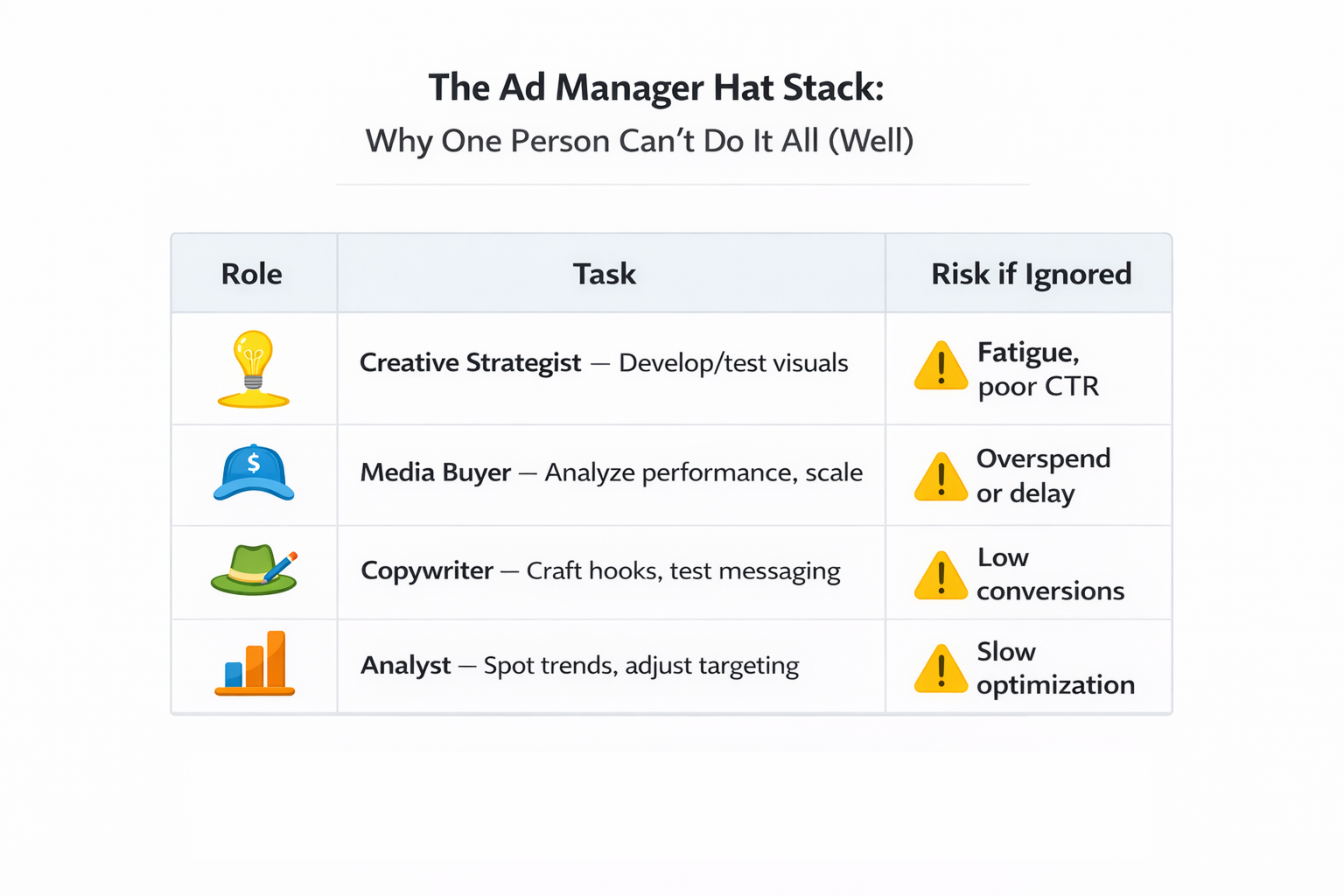
That leads to:
-
Missed signals. You may not have time to check your ads daily or catch early signs of fatigue or scaling potential.
-
Rushed decisions. Turning off ads too early, or scaling them too late, can waste days of spend.
-
Creative stagnation. Without a system for testing fresh creatives, performance drops and CPMs rise.
Tip: Block 2 hours each week just for ad management. Use that time to review results, rotate in new creatives, and pause what’s underperforming. Create a repeatable workflow — not just ad-hoc changes.
For a bigger-picture content strategy, explore these social media growth strategies for small businesses that align organic and paid engagement.
Meta’s Tools Favor Larger Accounts
Meta’s newer automation features — like Advantage targeting and Advantage campaign budget — rely heavily on broad data signals. Larger accounts naturally benefit more from these tools.
However, they can still work for small advertisers when used correctly.
Tip: Use Advantage campaign budget (ACB) with caution. It performs best when your ad sets have similar audience sizes and creative quality. Avoid mixing high-intent warm audiences and cold lookalikes in one ACB campaign. Keep those separate.
What Small Businesses Still Do Better Than Big Brands
Even though the system favors scale, small advertisers have unique strengths that still matter in today’s ad environment.
You Know Your Customer Better Than Meta Does
Big brands rely on research and audience modeling. You talk to your customers every week.
That gives you an edge in:
-
Writing better hooks. Use the exact language your customers use to describe their pain points.
-
Designing relevant offers. Build lead magnets, bundles, or product trials based on what people ask for.
-
Choosing better targeting inputs. Know which interests, accounts, or groups they follow — and use that data with tools like Leadenforce.
Tip: If your goal is to build long-term brand equity, check out this guide to building brand identity through Facebook ads — especially useful when you're competing in a crowded category.
You Can Move Faster Than Any Brand
Big brands move slowly. You don’t have to.
Use your speed to:
-
Test small but often. Instead of launching 10 ads at once, test 2 each week and rotate regularly.
-
React to real-time trends. Tie your ads to what’s happening in your industry, local events, or seasonal conversations.
-
Turn winning ads into offers. If a certain creative is driving clicks, quickly turn it into an email offer, landing page, or retargeting ad.
Tip: This article on how small businesses can compete with big brands using Facebook ads shows how agility and precision give you a real advantage — even if you’re outspent.
How to Make Facebook Ads Work — Without Scaling Like a Big Brand
Here’s how to structure your ad strategy when you're working with limited time and budget.
1. Prioritize Warm Audiences First
Cold targeting burns budget fast. Start with people already familiar with your business:
-
Instagram engagers
-
Facebook video viewers
-
Website visitors or cart abandoners
-
Email list or past customers
Tip: Create a remarketing funnel. Show Instagram engagers a testimonial video, then follow up with a product offer ad 3–4 days later.
2. Use Broad Targeting — But With Creative That Qualifies
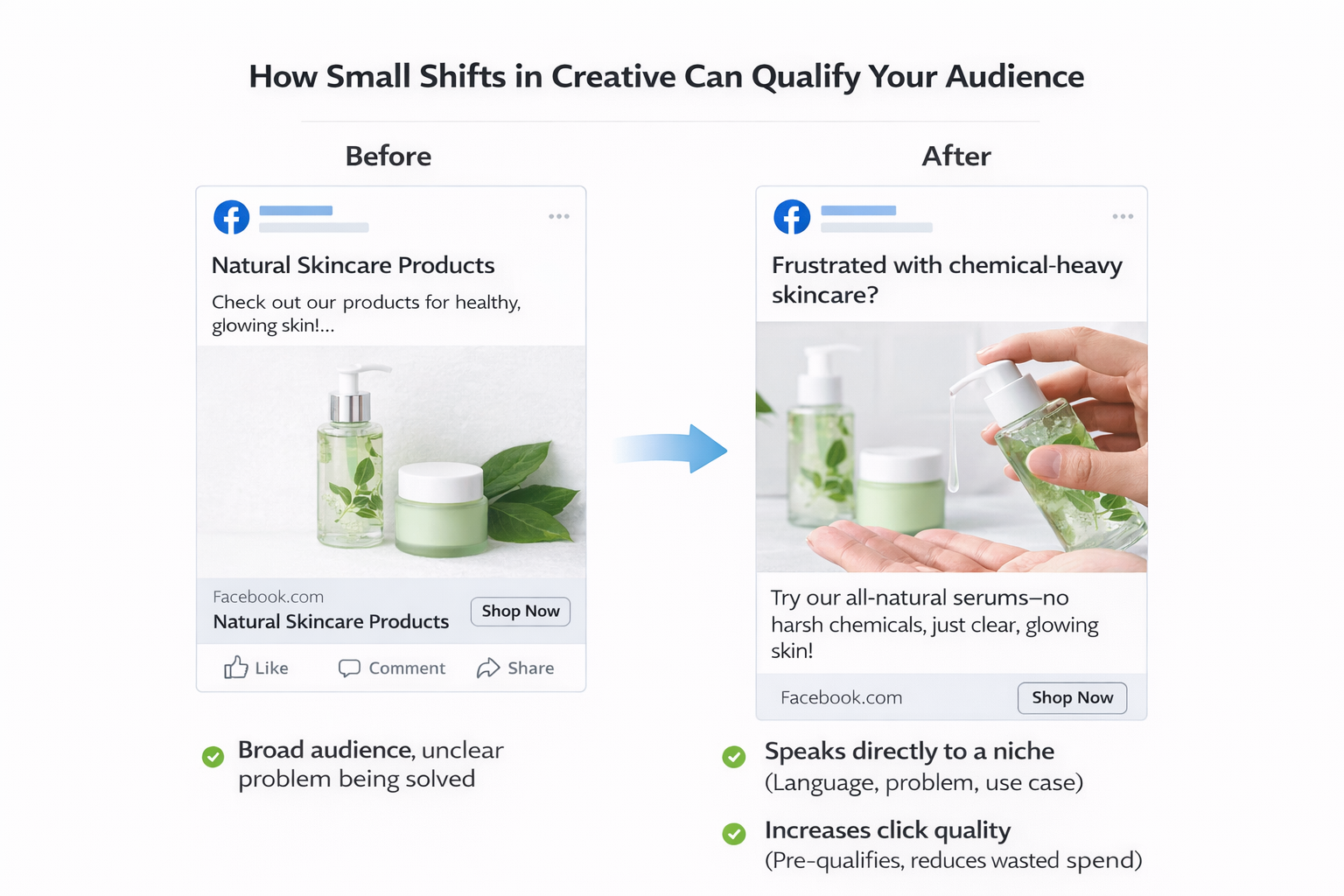
Advantage+ targeting is powerful, but only if your creative makes it clear who the ad is for.
Tip: Open your targeting, but let your creative speak directly to a niche. For example:
"Frustrated with chemical-heavy skincare?" filters the audience naturally — without needing interest targeting.
3. Make Creative the Center of Your Strategy
In 2026, ad creative isn’t just content — it’s your targeting, sales pitch, and brand voice in one.
Strong creative includes:
-
A clear hook in the first 2 seconds
-
Movement — even subtle animation or transitions
-
Real product use, not static beauty shots
-
Captions or on-screen text for mobile viewers
Tip: Use your phone to shoot 15-second clips of product use, founder commentary, or behind-the-scenes stories. These raw videos often outperform polished ads — especially on Instagram.
Bonus Strategy: Target What Meta Can’t — Groups and Competitor Accounts
Facebook Ads Manager doesn’t allow you to target:
-
Members of specific Facebook groups
-
Followers of specific Instagram accounts
-
People engaging with niche communities
But those behaviors are highly valuable. If someone follows a competitor brand or joins a product-specific group, that’s real intent — not a vague interest.
Tip: Use a tool like Leadenforce to reach these audiences. It’s one of the only ways small businesses can out-target larger ones.
Also consider pairing paid campaigns with organic storefronts. Here's how to make the most of Facebook Shops as a small business to capture interest and drive direct conversions.
Final Thoughts: It's Harder — But Not Impossible
Yes, Facebook and Instagram ads can be harder for small businesses. The platform is built for scale, and small budgets limit how fast you can test, learn, and grow.
But you still have control over what matters most:
-
Your creative
-
Your audience understanding
-
Your speed and decision-making
Focus on getting better at those three, and you’ll outperform brands spending 5x more — because you’re building strategy, not just ads.
