Brand campaigns need a different setup mindset than direct-response campaigns.
When the goal is awareness, reach, recall, or broad engagement, advertisers often care less about immediate CPA and more about predictable delivery, controlled exposure, and message consistency.
That is where the buying type decision matters.
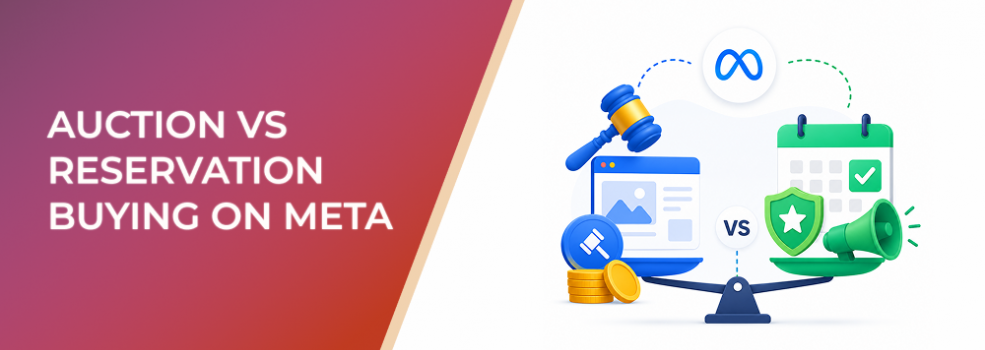
Meta advertisers generally need to understand the difference between auction buying and reservation buying. Both can support brand activity, but they solve different problems.
Choosing the wrong buying type can lead to unstable reach, weak frequency control, or overspending on impressions that do not support the campaign goal.
The Core Difference
Auction buying is flexible.
Your ads compete in real time, and delivery adjusts based on budget, bids, audience, relevance, placement, and expected action rates. This is familiar to most performance marketers because it supports testing, optimization, and scaling.
Reservation buying is more planned.
It is designed for advertisers who want predictable reach, reserved delivery, and fixed CPM planning for eligible awareness or engagement campaigns. Instead of relying entirely on auction variability, reservation gives media planners more control over delivery expectations.
The practical decision is simple: use auction when flexibility and optimization matter most; consider reservation when predictability and planned reach matter more.
Business Impact on CPM, Budget Efficiency, and Campaign Control
Buying type affects how confidently you can plan spend.
Auction campaigns can be efficient, but costs fluctuate. CPM may rise during competitive periods. Delivery may shift quickly toward placements or users Meta predicts will respond. That can help performance campaigns, but it can make brand planning less predictable.
Reservation campaigns give more predictability. This can help when a campaign has fixed dates, a launch window, or a message that must reach a defined audience at a planned exposure level.
The tradeoff is flexibility.
A reservation campaign may not adapt like an auction campaign optimized for leads, purchases, or high-intent actions. For brand campaigns, that may be acceptable. For revenue-driven campaigns, it may be limiting.
Typical Scenarios Where This Applies
Auction buying often fits:
- Lead generation campaigns.
- Ecommerce sales campaigns.
- Retargeting campaigns.
- Rapid creative testing.
- Small and mid-sized performance budgets.
- Campaigns where CPA, CAC, or ROAS is the main success metric.
Reservation buying can fit:
- Product launches.
- Brand awareness campaigns.
- Major announcements.
- Seasonal brand pushes.
- Event promotion.
- Campaigns where reach and frequency planning matter.
- Large campaigns with fixed media plans.
The right choice depends on whether the campaign is trying to optimize response or guarantee planned exposure.
Risks and Considerations
Reservation can create a false sense of security.
Predictable delivery does not automatically mean valuable delivery. If the audience is poorly defined, the campaign may reach people who are technically in the target but commercially irrelevant.
Another risk is using reservation for a goal that should be handled by direct-response optimization. If your real KPI is qualified leads, purchases, or pipeline, auction campaigns usually offer more flexible performance optimization.
Auction campaigns have their own risks. They can chase cheap engagement, shift spend into lower-quality placements, or create uneven exposure if the campaign structure is too broad.
Brand campaigns also face creative fatigue. Predictable frequency is useful only if the creative stays relevant and the audience is worth repeated exposure.
Prerequisites and Dependencies
Before choosing a buying type, advertisers should define:
- Campaign goal: awareness, engagement, leads, or sales.
- Budget size and timing.
- Whether fixed reach planning is needed.
- Audience size and relevance.
- Desired frequency or exposure level.
- Creative rotation plan.
- Measurement expectations.
- Whether the campaign is part of a larger funnel.
Reservation campaigns especially need clear planning before launch because the setup is less suitable for constant tactical changes.
How LeadEnforce Helps
LeadEnforce helps strengthen the audience foundation before the buying type decision.
For brand campaigns, broad reach can easily become broad waste. LeadEnforce helps advertisers build audiences from Facebook groups, Instagram profiles, followers, engagers, LinkedIn professional data, and custom social-profile sources.
That gives media teams more relevant audience inputs for both auction and reservation strategies.
A brand campaign targeting people connected to a relevant niche community is usually more meaningful than a campaign aimed at broad demographic assumptions. An agency running awareness for a B2B client can use professional audience signals. A startup launching in a category can target people already engaging with adjacent brands or communities.
Better audience relevance makes both buying types more useful.
Practical Recommendations
Use auction when you need flexibility, optimization, and performance learning.
Use reservation when your campaign requires planned reach, fixed timing, and controlled exposure.
Do not choose reservation simply because a campaign is “brand.” Some brand campaigns still benefit from auction flexibility, especially when budgets are smaller or audience testing is still underway.
Build the audience before choosing the buying type. A weak audience will not become strong because delivery is predictable.
Review frequency and engagement together. High reach with poor interaction may indicate that the audience or creative is not resonating.
Keep direct-response and brand KPIs separate. Reservation campaigns should not be judged exactly like sales campaigns.
Final Takeaway
Auction and reservation buying are not better or worse by default. They are built for different campaign needs.
Auction supports flexibility and optimization. Reservation supports planning and predictability. The strongest setup starts with the campaign goal, audience quality, budget reality, and the level of delivery control you actually need.
To build more relevant audiences before your next Meta brand campaign, join the free 7-day LeadEnforce trial period.
Related LeadEnforce Articles
- Meta Advertising Explained: Placements, Transparency, and Ad Delivery — Explains how delivery signals and placements shape campaign performance.
- How the Meta Ad Auction Works and Why It Impacts CPC and ROAS — Useful for understanding when auction buying makes sense.
- Meta Ads Budgets Explained: Daily vs Lifetime and CBO vs ABO — Helps advertisers understand budget pacing and spending behavior.
- Campaign Budgets vs Ad Set Budgets: Which Meta Ads Setup Works Better? — Relevant for comparing control and automation in campaign setup.