Advantage+ Audience gives Meta more flexibility to find people likely to respond to your ads. That flexibility can improve scale, but it can also create confusion.
Many advertisers assume every audience input works like a hard targeting rule. It does not.
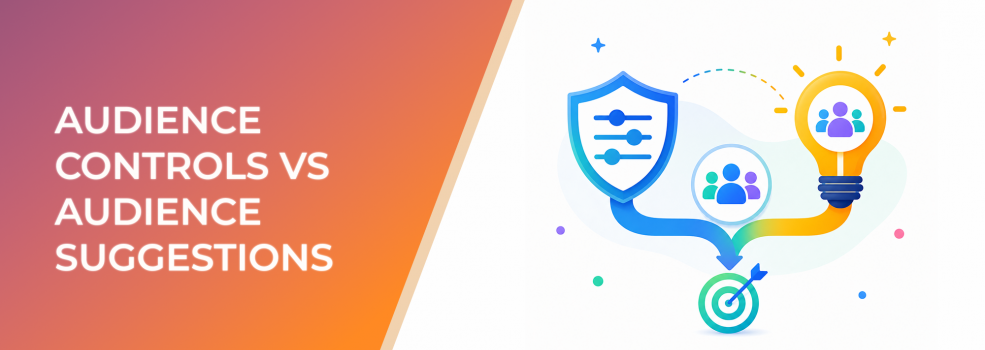
Some inputs act as controls. They limit delivery. Other inputs act as suggestions. They guide Meta, but Meta may still deliver beyond them when it predicts better results.
Understanding this difference is essential if you care about CPC, CPA, CAC, ROAS, lead quality, and wasted spend.
The difference between controls and suggestions
Audience controls are the boundaries you do not want Meta to cross. These are the non-negotiable requirements for who should or should not see your ads.
Depending on campaign setup and available options, controls may include inputs such as location, minimum age, language, and exclusions.
Audience suggestions are different. They are signals that tell Meta what kind of audience you prefer. Meta can use them as a starting point, but it may expand beyond them if it believes broader delivery can improve performance.
This distinction matters because a suggestion is not a guarantee.
If your business must serve only certain locations, languages, or age ranges, those requirements should be handled through controls where available. If your business prefers a certain audience type but can accept broader discovery, suggestions can help guide optimization.
Why this matters for performance marketers
When advertisers misunderstand controls and suggestions, campaign performance can become difficult to interpret.
You may believe you are targeting a specific audience, but Meta may be using that audience as a signal rather than a strict boundary. That can lead to impressions, clicks, or leads from people who do not match your expected customer profile.
This can affect:
- CPC, because broader delivery may find cheaper clicks that are not necessarily qualified.
- CPA, because low-cost conversions may not be high-value conversions.
- CAC, because sales or support teams may spend more time on poor-fit leads.
- ROAS, because purchase quality can vary by audience source.
- Lead quality, because form submissions can come from people outside your real ICP.
- Budget efficiency, because spend may move toward easier delivery instead of better-fit prospects.
The solution is not to avoid Advantage+ Audience. The solution is to separate hard constraints from strategic guidance.
Typical scenarios where this applies
Local businesses
A local service business may want Meta to find more potential customers, but it cannot serve people outside a specific area.
Location should be treated as a hard requirement, while interests or audience suggestions can guide delivery inside that area.
B2B lead generation
A B2B advertiser may prefer professionals in certain roles, industries, or company types. Some of those traits may be better represented through custom audiences, professional data, or creative qualification rather than relying only on broad suggestions.
If the offer is highly specific, advertisers should monitor downstream lead quality closely.
Agencies managing client expectations
Clients may say, “We only want this audience,” while the campaign setup may treat some audience inputs as suggestions.
Agencies should explain which inputs are strict controls and which are optimization signals. This prevents confusion when campaign delivery appears broader than expected.
Ecommerce scaling campaigns
Ecommerce brands may use audience suggestions to guide Meta toward likely buyers while allowing broader delivery for scale.
This can work well when the product has broad appeal, but it still requires monitoring purchase quality, ROAS, and average order value.
Risks and considerations
The main risk is using a suggestion when you need a control.
If your offer has strict geographic, language, age, or customer-exclusion requirements, do not assume a preferred audience signal is enough.
Other risks include:
- Overusing controls and starving delivery.
- Underusing controls and allowing irrelevant traffic.
- Assuming a low CPA means the audience is high quality.
- Ignoring exclusions for current customers, recent converters, or poor-fit segments.
- Using vague creative that fails to qualify the audience.
- Launching campaigns without checking whether delivery matches the intended market.
There is also a strategic risk: advertisers may blame Advantage+ Audience when the real problem is weak inputs, unclear offers, or poor measurement.
Prerequisites and dependencies
Before using audience controls and suggestions, define your targeting requirements in two categories.
First, identify the non-negotiables. These may include service area, age restrictions, language requirements, customer exclusions, or other eligibility constraints.
Second, identify the preferences. These may include interests, behaviors, lookalikes, custom audience signals, professional traits, competitor engagement, or category relevance.
You also need a clear way to judge performance. For lead gen, raw lead volume is not enough. For ecommerce, purchase count alone may not be enough. Review qualification, revenue, ROAS, repeat purchase potential, or pipeline impact.
How LeadEnforce helps
LeadEnforce helps advertisers improve the quality of audience suggestions and custom audience signals.
Instead of giving Meta generic interest ideas, advertisers can build more relevant audiences from real social behavior and professional context.
LeadEnforce can help create audiences based on:
- Facebook group membership around specific topics or problems.
- Instagram followers and engagers connected to relevant profiles.
- LinkedIn professional data for role, industry, or B2B relevance.
- Custom social-profile data that reflects specific audience criteria.
This is especially helpful when audience suggestions are used to guide automation. Better signals can help Meta start from a more relevant audience hypothesis.
For advertisers who need stricter control, LeadEnforce can also support cleaner segmentation. You can build distinct custom audiences for different campaign tests instead of relying on broad, overlapping assumptions.
Practical recommendations
Classify every input before launch
Before building the campaign, label each targeting input as either a hard requirement or a strategic signal.
This prevents confusion later.
If the business cannot serve people outside a location, that is a control. If the business prefers people who engage with a certain type of content, that may be a suggestion or custom audience signal.
Use suggestions to guide, not guarantee
Audience suggestions can be helpful, but they should not be treated as strict targeting rules.
Use them to give Meta direction, then validate results through reporting and lead quality.
Strengthen suggestions with better audience data
Do not rely only on broad interests when stronger data is available.
Use customer lists, qualified leads, engaged social audiences, competitor-profile engagement, Facebook group audiences, or professional profile data to give Meta a clearer signal.
Monitor delivery quality
Review location, age, placement, creative response, lead qualification, and conversion outcomes.
If Meta is finding cheap but poor-fit users, the campaign may need stronger controls, better exclusions, sharper creative, or a different optimization event.
Keep exclusions clean
Exclusions are often overlooked.
Exclude existing customers, recent buyers, current opportunities, or already-converted users where appropriate. This helps protect budget and improves the clarity of prospecting campaigns.
Final takeaway
Audience controls and audience suggestions play different roles in Advantage+ Audience. Controls protect non-negotiable requirements, while suggestions guide Meta toward preferred opportunities. Advertisers who understand the difference can use automation more confidently without losing sight of audience quality or business outcomes.
To create stronger custom audience signals for your Advantage+ tests, join the free 7-day LeadEnforce trial period.
Related LeadEnforce Articles
- How Advantage+ Audience Automation Can Improve Your Ad Targeting — Directly relevant for advertisers using Advantage+ Audience.
- Meta Advantage+ or Manual Setup? How to Make The Right Choice — Helps advertisers decide when automation or manual control is more appropriate.
- Using Advantage+ Detailed Targeting to Reach the Right Audience Efficiently — Adds practical guidance on using Meta’s audience expansion and targeting tools.
- Why Are Your Facebook Ads Being Shown to the Wrong Audience? — Useful for troubleshooting delivery that does not match the intended audience.
- Facebook Ads Targeting Updates: How To Adapt in 2026 and Beyond — Provides broader context on adapting to changes in Meta targeting.