Most campaigns don’t fail because the offer is weak. They fail because the audience wasn’t mentally prepared to understand its value. This is where warm-up and pre-framing come in—shaping perception before the landing page loads, before the CTA appears, and before the prospect makes a judgment.
A well-prepared audience converts at higher rates, has lower acquisition costs, and responds better to retargeting. Here is how to build that momentum.
Why Warm-Up Matters
A cold user sees your ad and thinks, "Why should I care?" A warmed audience already recognizes the problem, knows what the solution should look like, and is more open to your message.
Useful statistics:
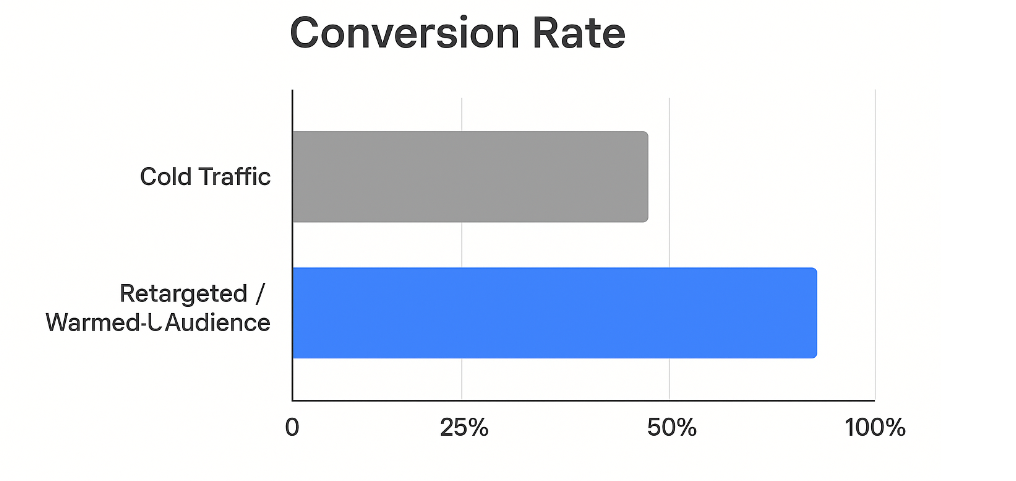
Retargeted / warmed-up audiences can convert up to 1.5× more often than cold traffic
-
Research shows that conversion rates increase by up to 2.8× when audiences have interacted with brand content in advance.
-
Campaign data across industries reveals that warmed users have up to 40% lower cost per acquisition compared to cold audiences.
Step 1: Build Mental Availability
Warm-up starts before the pitch. The goal is simple: get the audience to think about the problem.
Ways to build mental availability:
-
Short-form educational content
-
Engaging posts that highlight the pain point
-
Data-driven insights that make the problem feel urgent
-
Simple stories showing the problem in real life
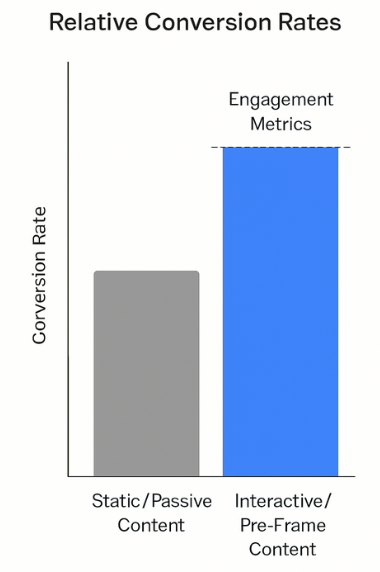
Interactive or pre-framing content drives roughly double the conversions compared to passive content formats
This content doesn’t sell. It prepares.
Step 2: Pre-Frame the Solution
Pre-framing is shaping the context in which the offer will be interpreted. When people feel the problem and understand the ideal form of the solution, they’re primed to say yes.
Examples of effective pre-framing:
-
Comparative posts showing old vs. new ways of solving the problem
-
Visual breakdowns of how a solution works
-
Social proof that signals adoption and trust
-
Value frameworks ("the 3 things an effective solution must have")
The goal is to teach prospects how to think about the coming offer.
Step 3: Create Micro-Commitments
Warm audiences respond better when they've taken small actions beforehand. Micro-commitments train the brain to expect a bigger yes.
Examples:
-
Saving a post
-
Visiting a profile
-
Watching 50%+ of a video
-
Clicking a "learn more" teaser
-
Interacting with a poll or vote
Even simple engagements can raise later conversion rates.
Step 4: Sequence Content for Momentum
Warm-up works best as a flow. Spread messages over days or weeks:
-
Problem awareness
-
Agitation
-
Light education
-
Pre-framing the solution
-
Priming for conversion
When ads, posts, and retargeting fit together, conversions rise naturally.
Step 5: Use Engagement Signals
High-intent actions tell you who’s ready. These users convert at significantly higher rates.
Examples of warm signals:
-
Repeated video views
-
Page visits and return visits
-
Profile and content interactions
-
Opt-ins for low-friction offers
Using these signals to segment audiences leads to more efficient spend and higher ROAS.
Conclusion
Audience warm-up is no longer optional. It’s foundational. When people understand the problem, feel the urgency, and know what a good solution should look like, conversions rise—often dramatically.
Instead of pushing harder at the bottom of the funnel, prepare your audience earlier.