Digital marketers often pour time and resources into crafting the perfect ad — testing headlines, refining audiences, adjusting bids, and analyzing CTRs. But once a user clicks, that carefully optimized journey often falls apart.
Post-click optimization is what determines whether those paid clicks turn into actual revenue. It’s not just about landing pages; it’s about delivering on the promise your ad made, reducing friction, and converting curiosity into action.
In this guide, we’ll cover everything you need to build a high-performance post-click experience — from message alignment to technical performance, and from user psychology to CRO best practices.
What Is Post-Click Optimization?
Post-click optimization (PCO) refers to the process of refining and improving the user experience after a person clicks on your ad. It includes everything that happens from the moment the landing page loads until a user completes a desired action — whether that’s a purchase, form submission, sign-up, or download.
While pre-click optimization focuses on capturing attention and generating interest, post-click optimization ensures that interest doesn’t go to waste.
A strong PCO strategy enhances conversion rates, improves return on ad spend (ROAS), and gives your paid traffic a competitive edge.
Why the Post-Click Phase Is Critical
Clicks don’t equal conversions. A user’s decision to act is influenced by a complex mix of trust, clarity, ease, and perceived value — all of which unfold after the click.
When marketers ignore this phase, they risk high bounce rates, rising acquisition costs, and underperforming campaigns.
Here’s what’s at stake with poor post-click execution:
-
Wasted budget: Even minor friction can prevent users from converting, making every paid click more expensive.
-
Low conversion rates: A mismatch between ad messaging and landing page content disrupts user flow and damages trust.
-
Decreased ROAS: If your landing pages fail to close the deal, even your best ads can’t deliver ROI.
-
Ad platform penalties: Platforms like Google Ads factor landing page experience into Quality Score, which can affect ad rank and CPC.
Strong post-click experiences create momentum. They remove doubt, reinforce value, and guide users through to completion.
1. Align Message, Intent, and Expectation
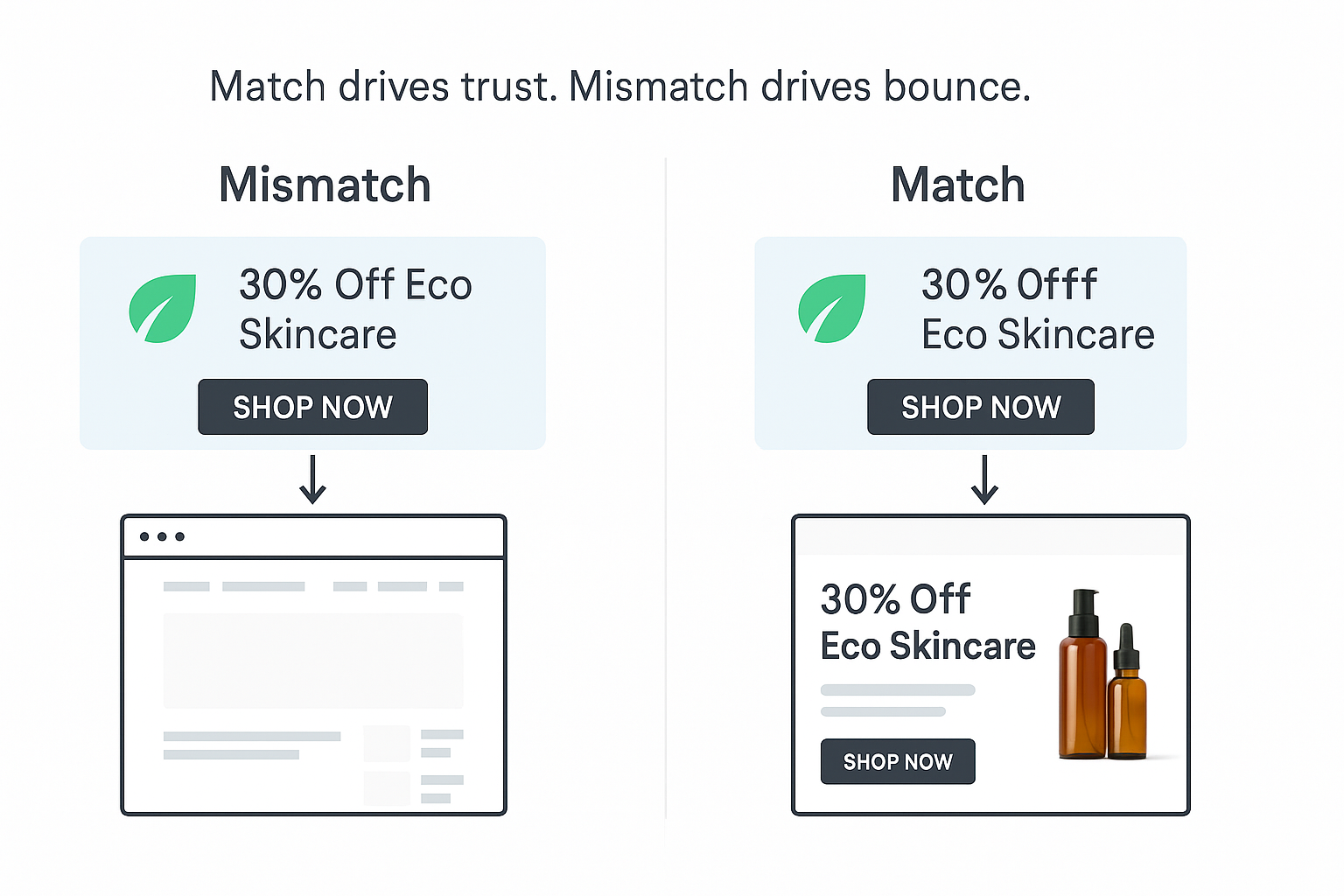
Message match is foundational in post-click strategy. Users clicked your ad with a specific expectation in mind — often tied to a promise of value. If your landing page doesn’t deliver that same promise immediately, users bounce.
Best practices:
-
Repeat the core offer and value proposition from the ad in your landing page headline and subhead.
-
Mirror ad language where relevant, especially for single-keyword ad groups or retargeting.
-
Design visual consistency across ad and page elements, including color palette, imagery, and typography.
-
Segment landing pages by intent. Avoid sending cold, warm, and returning visitors to the same experience.
A high-converting landing page reassures the user: “Yes, you’re in the right place — here’s exactly what you came for.” If you’re running cold campaigns, especially on Meta, message match becomes even more critical.
Misaligned copy or vague creative often causes Meta to flag your ad set as underperforming. You’ll want to avoid the dreaded Ad Set May Get Zero warning by tightly aligning your audience, ad, and landing page offer.
2. Prioritize Speed and Technical Performance
Page load speed has a direct, measurable impact on bounce rate and conversion rate. Google research shows that as load time increases from 1 second to 5 seconds, bounce probability increases by 90%.
What to optimize:
-
Compress images and serve modern formats (WebP instead of JPEG or PNG where possible).
-
Implement lazy loading for below-the-fold content to reduce initial load time.
-
Minimize third-party scripts such as chat widgets, analytics tools, and trackers. Audit their necessity.
-
Use a fast, mobile-optimized hosting environment, especially for ecommerce or dynamic content.
-
Enable caching, minify CSS and JS, and serve content via a CDN if traffic is global.
Remember: a beautifully designed page that loads slowly is still a poorly optimized one.
3. Streamline the Conversion Path
A confusing or cluttered landing page introduces decision fatigue. The more choices you present, the more likely users are to stall.
Your post-click path should be intuitive, linear, and designed to reduce hesitation.

Design principles to follow:
-
Limit each page to one core conversion goal. Avoid competing CTAs or promotions that distract from the primary offer.
-
Place your main CTA prominently, ideally above the fold and repeated strategically throughout the page.
-
Minimize form fields. Ask only for essential information, especially on first interaction. Use progressive profiling if needed.
-
Use visual hierarchy to guide the eye from headline to offer to CTA using spacing, contrast, and flow.
-
Design for mobile first. Make sure CTAs are thumb-friendly and that layouts don’t require zooming or horizontal scrolling.
When in doubt, simplify. A shorter, clearer path will outperform a more elaborate one almost every time.
4. Build Trust Instantly
People won’t convert unless they feel safe, understood, and confident in your brand. The post-click moment is where many advertisers lose trust by being vague, overly promotional, or opaque.
Ways to build trust fast:
-
Add third-party validation. Display customer reviews, user ratings, press mentions, or endorsements near the call to action.
-
Use security signals. Include trust badges, SSL indicators, money-back guarantees, or secure checkout messaging.
-
Be transparent. Clearly state shipping policies, return processes, and data privacy practices.
-
Use authentic visuals. Show real people, real products, or actual use cases instead of stock images.
-
Use precise, benefit-led language. Show how your offer solves a problem.
If your Facebook campaigns are driving traffic but failing to convert, take a step back and review the landing experience through the user’s eyes.
Facebook Ads Not Converting: How to Fix It offers a great diagnostic approach to identify where your funnel might be leaking trust.
5. Test Relentlessly — but Methodically
Conversion rate optimization is not a one-time task. It’s an ongoing process of testing, learning, and refining.
How to approach testing:
-
Use tools like Google Optimize or VWO to run A/B or multivariate tests.
-
Start with high-impact variables, such as headline, CTA text, hero image, or page layout.
-
Test one variable at a time to isolate impact.
-
Let tests run long enough to reach statistical significance.
-
Keep detailed documentation on hypotheses, test setups, outcomes, and insights.
Post-click improvements compound over time. The better you get at testing, the more efficient your budget becomes.
6. Personalize Where It Matters
Personalization doesn’t need to be complex to be effective. Even modest tweaks based on behavior or geography can lift engagement.

Easy personalization ideas:
-
Geo-targeted headlines or offers. Mention shipping availability or location-specific promotions.
-
Dynamic content insertion. Use URL parameters to adjust copy based on ad variant.
-
Retargeting-specific landing pages. Speak differently to someone who already knows your brand.
-
On-site behavioral triggers. Use exit intent, scroll depth, or inactivity to serve personalized CTAs.
Done well, personalization adds relevance and removes doubt.
Final Thoughts: Stop Optimizing Only the Ad
Every paid click costs you money. But the value of that click is only realized when the post-click experience delivers.
Too many advertisers leave performance on the table by focusing entirely on front-end ad metrics, while landing pages, forms, and load times go unexamined.
The smartest advertisers treat post-click optimization as an extension of their ad strategy — not a separate, secondary concern.
If you’re refining your entire campaign funnel — not just the landing page — you’ll also want to ensure your ad objectives are properly structured for the outcome you want.
This is a common oversight, especially when scaling. Review Meta Ad Campaign Objectives Explained to ensure your pre-click strategy supports what you're optimizing for post-click.
Get the click, yes. But then? Earn the conversion.